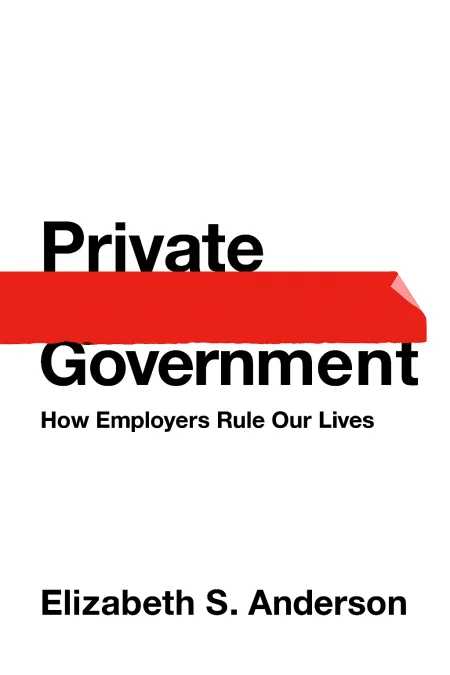
Private Government
How Employers Rule Our Lives (and Why We Don't Talk about It)
Book Edition Details
Summary
In the corridors of corporate America, a quiet revolution unfolds—a battle not against external foes, but against the invisible chains of workplace governance. Elizabeth Anderson's "Private Government" unveils a startling truth: many of our employers are wielding the kind of power typically reserved for authoritarian regimes. With an incisive blend of political philosophy and historical insight, Anderson dismantles the myth of workplace freedom, exposing how modern employment often mirrors dictatorship. From controlling speech and attire to dictating off-duty conduct, these private governments leave little room for personal autonomy. By reimagining the dialogue around economic liberty, this bold exploration challenges us to rethink how we define freedom in the land of the free. Through her thought-provoking narrative, Anderson invites readers to envisage a future where true workplace liberty is not just a dream but a reality.
Introduction
The modern workplace presents a striking paradox that challenges our most basic assumptions about freedom and democracy in contemporary society. While we celebrate the triumph of democratic governance and individual liberty in the political sphere, millions of workers spend the majority of their waking hours under forms of authority that would be deemed tyrannical if exercised by any government. This contradiction reveals a profound blind spot in how we understand power, freedom, and governance in the twenty-first century. The analysis presented here employs historical investigation and philosophical reasoning to expose this contradiction, tracing how ideas about markets and freedom that once promised liberation for working people have been transformed into justifications for workplace authoritarianism. Through careful examination of pre-industrial egalitarian thought and its collision with industrial reality, a framework emerges for understanding workplace authority not as a natural outcome of free markets, but as a form of private government that operates beyond democratic accountability. This perspective opens pathways for reconsidering fundamental questions about how work should be organized in societies committed to human dignity and democratic equality.
From Market Liberation to Workplace Dictatorship
The concept of free markets once stood as a beacon of egalitarian hope, promising to dismantle hierarchical systems of domination that characterized pre-industrial society. From the English Levellers of the seventeenth century through Abraham Lincoln, advocates of market freedom envisioned a world where most people would work for themselves as independent farmers, artisans, and small merchants, free from subjugation to masters or lords. This vision rested on specific material conditions and assumptions that made it both coherent and appealing to those seeking equality. The Levellers opposed guild monopolies and royal charters not merely as economic inefficiencies, but as instruments of private government that prevented ordinary people from achieving economic independence. Adam Smith's pin factory employed only ten workers because he wrote at the threshold of the Industrial Revolution, when economies of scale were minimal and self-employment remained viable for most of the population. The egalitarian promise of markets depended crucially on the possibility of universal self-employment, which would eliminate the subordination inherent in wage labor. Thomas Paine's libertarian economics made sense in a context where land was abundant, labor was scarce, and most free workers could realistically expect to become their own bosses after a few years of wage work. The Republican Party's opposition to slavery's expansion into western territories reflected this vision, fearing that large plantations would monopolize land needed for independent farmers. This market egalitarianism contained internal contradictions that would prove fatal. It depended on the exclusion of women from economic independence and the violent appropriation of land from indigenous peoples. More fundamentally, the Industrial Revolution destroyed the material basis for universal self-employment by creating massive economies of scale that made large hierarchical organizations far more efficient than small independent producers.
The Reality of Private Government at Work
Most American workers today labor under what can accurately be described as communist dictatorships in miniature. The modern workplace concentrates all productive assets under centralized ownership, operates according to top-down planning rather than market mechanisms, and subjects workers to authority that is both arbitrary and unaccountable. This reality contradicts fundamental assumptions about freedom and democracy that Americans hold dear. The scope of employer authority extends far beyond what is necessary for productive coordination. Workers can be fired for their political activities, sexual relationships, Facebook posts, or simply because their boss finds them too attractive. They submit to surveillance, searches, and restrictions on their speech that would violate constitutional rights if imposed by democratic government. The doctrine of employment-at-will means that workers surrender virtually all rights except those specifically protected by law when they accept a job. This system of private government emerged not from voluntary contracts or market forces, but from legal rules established by the state. The default constitution of workplace governance assigns dictatorial power to employers while leaving workers with no voice except the right to quit, often at enormous personal cost. Theories of the firm that attempt to justify this arrangement based on efficiency fail to explain why employers need authority over workers' off-duty conduct or personal lives. The persistence of workplace authoritarianism reflects ideological blindness rooted in pre-industrial assumptions about market society. When economists and politicians speak of workers as if they were independent contractors freely negotiating with employers, they deploy concepts that might have made sense when most people were self-employed but bear no relationship to contemporary reality. This ideological confusion prevents recognition of workplace governance as a form of government that should be subject to democratic scrutiny and reform.
Evaluating Workplace Authority and Worker Freedom
The arbitrary and unaccountable nature of employer authority inflicts injuries that extend beyond material deprivation to encompass fundamental violations of human dignity and standing. When Amazon forces workers to labor in dangerous heat while parking ambulances outside to collect those who collapse, or when employers steal wages while demanding ever greater productivity, they express contempt for workers as human beings worthy of basic respect and consideration. These conditions cannot be adequately addressed through market mechanisms alone because they result from structural inequalities in power rather than temporary market failures. Exit rights provide insufficient protection when workers face similar authoritarian conditions across entire industries, when job loss carries devastating consequences, or when employers can capture most of the benefits that make any particular job worthwhile. The suggestion that workers should simply quit bad jobs ignores the reality that systemic problems require systemic solutions. Constitutional protections for workers, analogous to bills of rights that constrain government power, offer one avenue for limiting employer abuse. Laws protecting workers' rights to bathroom breaks, freedom from sexual harassment, and basic workplace safety represent hard-won victories in establishing minimum standards of human treatment. However, such protections can only establish floors below which conditions cannot fall, rather than ensuring that workers have meaningful input into decisions that govern their daily lives. The inadequacy of exit rights and constitutional minimums points toward the necessity of worker voice in workplace governance. This need not require full workplace democracy, which faces practical obstacles in large-scale enterprises requiring close coordination. However, it does require institutional mechanisms through which workers can participate in decisions affecting their interests, hold supervisors accountable for abuses of power, and maintain their dignity as autonomous agents rather than mere instruments of production.
Toward Democratic Alternatives in Employment Relations
The challenge of workplace governance demands experimentation with alternative institutional arrangements that balance productive efficiency with respect for human freedom and dignity. European models of codetermination demonstrate that worker participation in firm governance can coexist with high levels of prosperity and innovation, suggesting that the stark choice between efficiency and democracy presented by defenders of workplace authoritarianism is false. The path forward requires abandoning the pretense that current workplace arrangements result from voluntary agreements in free markets. The state has already made fundamental choices about how workplaces are governed by establishing employment-at-will as the default arrangement and by protecting employers' authority to make arbitrary decisions affecting workers' lives. Recognizing these as political choices opens space for democratic deliberation about alternatives. Various mechanisms could enhance worker voice without requiring revolutionary changes to existing economic institutions. Stronger legal protections for worker organizing, expansion of collective bargaining rights, works councils that give workers input into workplace policies, and enhanced due process protections against arbitrary discipline all represent feasible reforms that could reduce the authoritarian character of contemporary employment relations. The goal should not be to eliminate all hierarchy or authority in large organizations, which would undermine their productive capabilities, but rather to subject workplace authority to democratic accountability. Just as political democracy does not eliminate government but makes it answerable to those it governs, workplace democracy would not eliminate management but would require that managerial authority be exercised in ways that respect workers' standing as free and equal persons.
Summary
The central insight emerging from this analysis is that the language of freedom and markets has been systematically deployed to obscure rather than illuminate the reality of power relations in contemporary workplaces, creating a form of ideological blindness that prevents democratic societies from addressing fundamental questions about how work should be organized. The historical investigation reveals how ideas about market freedom that once promised liberation from hierarchical domination have been transformed into justifications for new forms of arbitrary authority, demonstrating the importance of examining political concepts in their concrete institutional contexts rather than as abstract ideals. This framework provides essential tools for readers seeking to understand how democratic principles might be extended beyond the political sphere to encompass the economic relationships that shape most people's daily experience of freedom or its absence.
Related Books
Download PDF & EPUB
To save this Black List summary for later, download the free PDF and EPUB. You can print it out, or read offline at your convenience.
By Elizabeth S. Anderson
