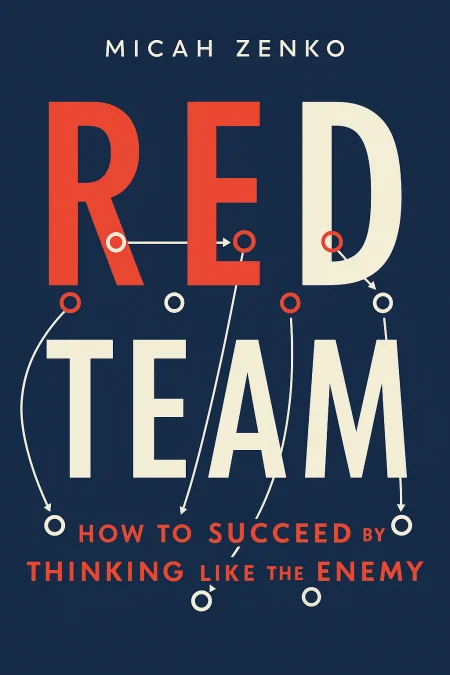
Red Team
How to Succeed by Thinking Like the Enemy
Book Edition Details
Summary
In the shadowy realms where strategy meets subterfuge, "Red Team" by national security expert Micah Zenko unveils the art of thinking like the enemy to outsmart them. This riveting exploration digs into the clandestine practice of red teaming, where visionaries adopt the mindset of adversaries to expose vulnerabilities before they become disasters. From high-stakes military maneuvers to the corporate boardroom's strategic chess games, Zenko offers a treasure trove of case studies that reveal the fine line between insight and oversight. With a keen eye for detail and a narrative that crackles with tension, this book is a masterclass for leaders and thinkers aiming to turn potential threats into strategic victories. Dive into a world where understanding the enemy's playbook is your greatest weapon.
Introduction
Organizations across all sectors suffer from a fundamental inability to accurately assess their own vulnerabilities and weaknesses. This cognitive limitation stems from institutional biases, hierarchical structures that suppress dissent, and the natural human tendency toward confirmation bias. When institutions rely solely on internal evaluation mechanisms, they create dangerous blind spots that leave them vulnerable to strategic surprises, security breaches, and competitive disadvantages that could have been prevented through systematic external challenge. The solution lies in structured adversarial thinking that deliberately introduces opposition perspectives into organizational decision-making processes. This methodology employs simulated attacks, alternative analyses, and devil's advocacy to force institutions to confront uncomfortable truths about their assumptions, strategies, and defenses. By systematically adopting the viewpoint of competitors, enemies, or critics, organizations can transform their inherent blind spots into strategic advantages. The evidence spans military operations, intelligence analysis, cybersecurity, and corporate strategy, demonstrating how adversarial assessment reveals critical vulnerabilities that traditional evaluation methods consistently miss. The most successful institutions have learned to institutionalize dissent through formal processes that make challenging conventional wisdom a competitive advantage rather than a threat to organizational harmony. This exploration examines both the transformative potential and inherent limitations of adversarial thinking, revealing how organizations can harness opposition perspectives to improve performance while avoiding common implementation failures.
The Fundamental Problem: Why Organizations Cannot Self-Assess Effectively
Organizations systematically fail to identify their most dangerous vulnerabilities due to predictable cognitive and institutional biases that create analytical blind spots. Individual decision-makers suffer from confirmation bias, anchoring effects, and mirror imaging that cause them to interpret information in ways that confirm existing beliefs rather than challenge fundamental assumptions. These cognitive limitations become amplified within organizational structures that reward conformity and discourage dissent, creating echo chambers where shared assumptions go unexamined. Hierarchical structures naturally suppress challenging viewpoints through subtle but powerful mechanisms. Employees learn to anticipate their superiors' preferences and adapt their communications accordingly, creating what appears to be consensus but actually represents systematic self-deception. The phrase "you cannot grade your own homework" captures this fundamental limitation of self-assessment, where organizations become prisoners of their own success and unable to perceive emerging threats or adapt to changing circumstances. Historical examples demonstrate the catastrophic consequences of organizational myopia across all sectors. Intelligence failures, military disasters, and corporate collapses often stem not from lack of information but from the inability to process contradictory evidence or challenge established assumptions. The 2008 financial crisis, intelligence failures preceding major terrorist attacks, and military defeats against unconventional opponents all illustrate how sophisticated organizations can be blindsided by threats they were theoretically equipped to detect. The pattern repeats because the underlying problem remains constant: organizations develop internal logic that becomes increasingly disconnected from external reality. Success breeds overconfidence, established procedures become sacred, and questioning fundamental assumptions becomes professionally risky. Without systematic external challenge, even the most intelligent and well-resourced institutions drift toward strategic surprise and operational failure.
Red Teaming Methods: Military, Intelligence, and Private Sector Applications
Military organizations represent the most developed application of adversarial thinking principles, driven by the life-and-death consequences of strategic miscalculation. Combat environments punish commanders who cannot anticipate enemy actions, creating strong institutional incentives for developing systematic opposition analysis. Military red teams employ war gaming, vulnerability assessments, and alternative planning exercises that force commanders to confront how intelligent adversaries might exploit their operational assumptions and tactical preferences. Intelligence agencies utilize adversarial thinking to overcome analytical biases and prevent strategic surprises through dedicated units that challenge mainstream assessments. These teams produce alternative analyses that deliberately adopt provocative perspectives, examining how foreign audiences might perceive American actions or exploring low-probability but high-impact scenarios that traditional analysis might overlook. The methodology proves particularly valuable when analyzing adversary intentions, where mirror imaging and cultural biases most severely distort analytical conclusions. Private sector applications focus primarily on cybersecurity and competitive strategy, where adversarial thinking has become essential for survival in contested environments. Cybersecurity red teams attempt to breach organizational defenses using realistic attack methods, revealing vulnerabilities that automated scanning tools consistently miss. Business war gaming forces executive teams to role-play competitor responses to strategic initiatives, uncovering assumptions about market dynamics and competitive behavior that traditional analysis fails to examine. The effectiveness of these applications varies significantly based on organizational culture and leadership commitment. Military red teams succeed when commanders actively seek challenging perspectives and create protected environments for dissent. Intelligence red teams prove valuable when their products reach decision-makers who genuinely want their assumptions tested. Private sector red teams generate improvements when organizations commit to addressing identified vulnerabilities rather than treating assessments as compliance exercises that provide false confidence without meaningful change.
Implementation Failures: Common Misuses and Structural Limitations
Red teaming initiatives frequently fail due to fundamental misunderstandings about their purpose, scope, and implementation requirements. Organizations often treat adversarial assessment as a compliance exercise rather than a genuine attempt to discover vulnerabilities, leading to superficial evaluations that provide false confidence rather than meaningful insights. The most common failure involves assigning adversarial roles to individuals who lack the independence, expertise, or psychological characteristics necessary for effective opposition thinking. Composition problems plague many red team efforts when organizations staff teams with insiders who become captured by the same biases they were meant to challenge. Simply designating someone as a devil's advocate without providing appropriate training, resources, or institutional protection typically produces predictable opposition that reinforces rather than challenges existing assumptions. Effective adversarial thinking requires individuals with specific psychological characteristics: intellectual fearlessness, analytical creativity, and the interpersonal skills necessary to challenge authority while maintaining credibility. Timing and integration failures represent another critical category of red team misuse. Organizations frequently commission adversarial assessments too late in the decision-making process to influence outcomes, treating them as validation exercises rather than genuine evaluations. Alternatively, red team findings may be ignored or misinterpreted, particularly when they challenge deeply held beliefs or require costly remedial actions that leadership prefers to avoid. The most subtle failure mode involves the gradual institutionalization of red teaming in ways that neutralize its effectiveness. As adversarial assessment becomes routine, teams risk losing their oppositional edge and becoming predictable elements of standard procedures. Organizations learn to game their own red teams, while red teams learn to moderate their findings to maintain institutional acceptance. The challenge lies in maintaining the independence and creativity that make adversarial thinking valuable while integrating it sufficiently into organizational structures to ensure findings receive serious consideration and implementation.
Best Practices: Requirements for Successful Adversarial Assessment Programs
Successful adversarial assessment requires adherence to fundamental principles that address the most common failure modes while maximizing the methodology's transformative potential. Leadership commitment proves absolutely essential, as red teams cannot succeed without genuine support from decision-makers who are willing to hear uncomfortable truths and act on challenging findings. This support must be visible throughout the organization and sustained over time, even when assessments prove inconvenient or costly to implement. The positioning of adversarial assessment teams requires careful balance between independence and institutional awareness. Teams must maintain sufficient distance from organizational pressures to think freely while remaining close enough to understand operational realities and communicate effectively with decision-makers. Methodological diversity prevents red teams from becoming predictable or easily gamed, requiring extensive toolkits of analytical techniques, simulation methods, and assessment approaches that can be adapted to different contexts and challenges. Frequency calibration represents another critical success factor, as organizations must find the optimal balance between continuous challenge and operational paralysis. Too frequent adversarial assessment can paralyze decision-making and create organizational cultures obsessed with finding problems rather than implementing solutions. Too infrequent assessment allows organizations to drift back into complacency and lose the benefits of systematic opposition thinking. Future developments in adversarial assessment will likely incorporate advancing technologies while addressing persistent human and organizational challenges. Artificial intelligence and machine learning may enhance red teams' ability to process information and identify patterns, but the fundamentally human elements of creativity, empathy, and adversarial thinking will remain central to effective practice. The greatest opportunities lie in expanding adversarial thinking beyond traditional security applications to address complex challenges in healthcare, climate change, and other domains where organizational blind spots carry significant societal consequences.
Summary
The fundamental insight underlying effective adversarial thinking is that organizational blind spots are inevitable consequences of human psychology and institutional structure rather than correctable management failures. This recognition leads to systematic approaches for introducing external perspectives into decision-making processes through formal red teaming methodologies that challenge assumptions, test defenses, and explore alternative scenarios. Success depends on maintaining the delicate balance between independence and institutional integration, employing individuals with appropriate psychological characteristics and methodological skills, and securing genuine leadership commitment to acting on uncomfortable findings. Adversarial thinking represents a structured approach to institutionalizing dissent that transforms potential weaknesses into strategic advantages, making it essential for organizations operating in competitive or dangerous environments where the cost of blind spots can be catastrophic.
Related Books
Download PDF & EPUB
To save this Black List summary for later, download the free PDF and EPUB. You can print it out, or read offline at your convenience.
By Micah Zenko
