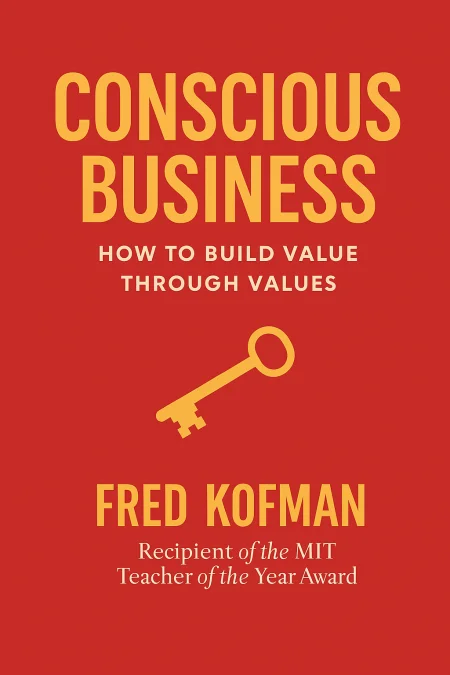
Conscious Business
How to Build Value Through Values
Book Edition Details
Summary
In a world where spreadsheets and profit margins dominate, Fred Kofman dares to shift the focus to something much more profound: consciousness. "Conscious Business" challenges the conventional wisdom of corporate success by diving deep into the heart of what truly drives a thriving organization—human values. As a consultant to tech giants like Google and Microsoft, Kofman has crafted a guide that doesn’t just tell you how to win in business, but how to cultivate an environment where every decision, from handling pressure to questioning your very purpose, is illuminated by awareness. This isn't just a book; it's a manifesto for leaders ready to elevate their company culture by aligning it with the authentic aspirations of their people.
Introduction
Sarah stared at her computer screen, the quarterly report glowing back at her with numbers that told a story of success—revenue up, costs down, shareholders pleased. Yet something felt hollow. Around her, colleagues moved through their days like sleepwalkers, going through motions that seemed increasingly disconnected from any deeper purpose. The morning meeting had been particularly brutal, with finger-pointing and blame-shifting replacing genuine problem-solving. She wondered if this was what success was supposed to feel like. This disconnect between external achievement and internal fulfillment haunts countless professionals today. We've mastered the mechanics of business but lost touch with its human essence. We've optimized processes while neglecting the people who run them. We've pursued profits while forgetting the purpose that originally inspired us. The result is organizations filled with talented individuals who feel increasingly isolated, frustrated, and disengaged from their work. Yet there exists another way—a path that honors both the practical demands of business and the deeper human needs for meaning, connection, and growth. This approach recognizes that true organizational excellence emerges not from fear-based management or manipulative tactics, but from conscious leadership that awakens the best in people. When we learn to integrate responsibility, integrity, and humility with authentic communication and constructive collaboration, we create workplaces where both individuals and organizations can thrive. The journey toward conscious business begins with a single choice: the decision to show up fully awake to the possibilities that exist when we bring our whole selves to our work.
The Foundation: From Blame to Responsibility
Marcus had always prided himself on being a problem-solver, but lately every solution seemed to create new problems. His team meetings had devolved into blame sessions, with everyone pointing fingers at external circumstances—the economy, the competition, the unrealistic demands from headquarters. When the latest project failed to meet its deadline, Marcus found himself joining the chorus of complaints about factors beyond their control. The shipping company had made errors, the previous meeting had run long, the client had changed requirements at the last minute. Each explanation was technically accurate, yet nothing improved. It was during a particularly frustrating conversation with his colleague Al that Marcus began to see the pattern. Al had arrived late to their meeting, immediately launching into a detailed account of traffic jams and delayed flights. While Al's explanations were valid, they were also powerless. By focusing exclusively on external factors, Al had positioned himself as a victim of circumstances rather than as someone capable of influencing outcomes. Marcus realized he had been doing the same thing—choosing explanations that preserved his innocence but destroyed his power to create change. The shift from victim to player thinking represents one of the most fundamental transformations in conscious business. When we take unconditional responsibility, we're not claiming to control everything that happens to us, but rather acknowledging our unlimited ability to choose our response to whatever occurs. This response-ability becomes the foundation for both personal integrity and organizational excellence. True integrity means aligning our actions with our deepest values, regardless of external pressures or immediate consequences. It requires the humility to recognize that our perspective, however valid, is only one piece of a larger puzzle that others can help us complete.
Communication Breakthrough: Truth, Conflict, and Connection
The tension in the conference room was palpable as Edward threw the financial report onto the table with obvious disgust. Christina watched her week of careful work dismissed as "a disaster" and felt her heart sink. What followed was a painful dance of hidden thoughts and diplomatic words—Edward expressing frustration through harsh criticism while privately worrying about the board meeting, Christina maintaining professional composure while internally questioning her competence and his leadership. Both left the encounter feeling misunderstood and resentful, the real issues buried beneath layers of unexpressed truth. This scene plays out in countless organizations every day, where the most important conversations happen in people's minds rather than in the room. We've become experts at managing our external image while our internal experience remains hidden and unprocessed. The gap between what we think and what we say creates a toxic environment where problems fester, relationships deteriorate, and genuine collaboration becomes impossible. We tell ourselves we're being professional or diplomatic, but we're actually being dishonest in ways that serve no one. Authentic communication requires the courage to bridge this gap between inner truth and outer expression. It means learning to transform our raw thoughts and emotions into messages that honor both honesty and respect. When we master the art of productive expression—sharing our perspectives while owning them as our views rather than absolute truth—and productive inquiry—genuinely seeking to understand others' reasoning rather than simply waiting for our turn to speak—we create the conditions for real dialogue. This foundation of authentic communication becomes essential when we face the inevitable conflicts that arise when passionate people care deeply about different things.
The Marketplace as Sacred Practice
After twenty-five years in corporate finance, Patricia had achieved everything she'd once dreamed of: corner office, six-figure salary, respect from peers, and financial security for her family. Yet as she prepared for another day of meetings and spreadsheets, she couldn't shake the feeling that something essential was missing. Her work felt mechanical, disconnected from any deeper sense of purpose or meaning. She found herself going through the motions, competent but uninspired, wondering if this was all there was to professional success. The transformation began when Patricia started viewing her daily business activities as opportunities for spiritual practice. Instead of seeing her difficult clients as obstacles to her success, she began to see them as teachers who challenged her to develop patience and compassion. Rather than treating her team meetings as necessary evils, she approached them as chances to serve others and contribute to their growth. Her spreadsheets became exercises in precision and care, her negotiations became opportunities to find solutions that honored everyone's needs. This shift didn't make Patricia's work easier, but it made it infinitely more meaningful. She discovered that the marketplace could be a profound arena for personal development, a place where she could practice her highest values under the pressure of real-world consequences. Her colleagues began to notice a change in her presence; she seemed more centered, more creative, more genuinely interested in others' success. Paradoxically, as she became less attached to her own advancement, her influence and effectiveness grew. The marketplace had become her temple, and work had transformed from a burden into a blessing.
Summary
The path from unconscious to conscious business is ultimately a journey from fear to love, from scarcity to abundance, from separation to connection. Throughout these stories of transformation, we see individuals discovering that their greatest challenges often contain their most profound opportunities for growth. When Marcus stopped blaming external circumstances and started taking responsibility for his responses, he didn't just solve immediate problems—he reclaimed his power to influence his world. When Edward and Christina learned to communicate authentically, they didn't just improve their working relationship—they created a model for the kind of honest, respectful dialogue that makes genuine collaboration possible. The principles of conscious business are simple to understand but require courage to implement. They ask us to show up fully present to our work, to speak our truth with respect and humility, and to approach conflicts as opportunities for creative problem-solving rather than battles to be won. Most importantly, they invite us to remember that business is ultimately about human beings serving other human beings, and that our success is measured not just by what we achieve but by who we become in the process. When we align our actions with our deepest values and treat each interaction as an opportunity to express our highest selves, we discover that work can become a powerful vehicle for both personal fulfillment and positive impact in the world.
Related Books
Download PDF & EPUB
To save this Black List summary for later, download the free PDF and EPUB. You can print it out, or read offline at your convenience.
By Fred Kofman
