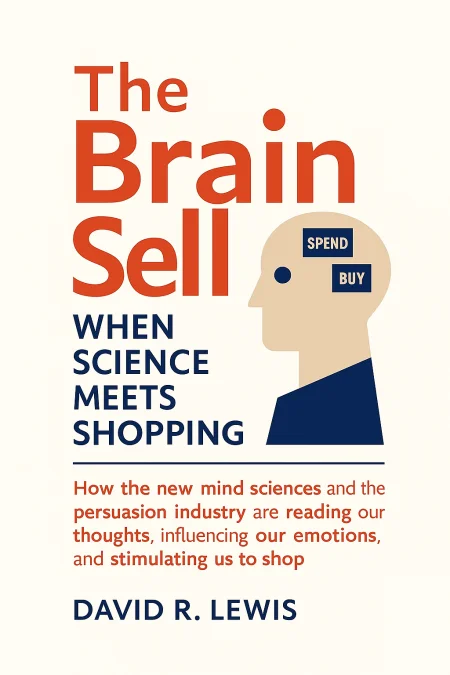
The Brain Sell
When Science Meets Shopping
Book Edition Details
Summary
In the high-stakes world where science meets salesmanship, "The Brain Sell" uncovers the invisible strings that tug at your wallet and mind. Imagine a gathering of brilliant minds—a physicist, engineer, mathematician, biochemist, and neuropsychologist—tasked with dissecting a seemingly simple grooming product's marketing magic. Here lies the tantalizing truth: neuroscience isn't just about lab coats and experiments; it's the secret weapon in the art of persuasion. Dr. David Lewis, a pioneer in neuromarketing, exposes the sophisticated techniques that craft your shopping experience, from the subtle sway of scents to the psychological power of packaging. This book is your backstage pass to the billion-dollar world of subliminal influence, arming both marketers and savvy shoppers with the knowledge to navigate—and manipulate—the consumer landscape.
Introduction
Every time you walk into a store, scroll through social media, or browse an online shopping site, you're entering a carefully orchestrated psychological battlefield where your brain is the target. You might think you're making independent choices about what to buy, but cutting-edge neuroscience reveals a startling truth: most of your purchasing decisions are being influenced by sophisticated techniques that operate below your conscious awareness. Companies now employ teams of neuroscientists, behavioral psychologists, and data analysts who can literally peer into your brain to understand exactly what triggers your buying impulses. This invisible war for your wallet uses everything from the specific colors on product packaging to the precise temperature of store air conditioning. Modern marketers can track your eye movements, measure your emotional responses, and even predict your purchasing behavior before you're aware of your own intentions. Through advanced brain imaging technology, researchers have discovered that up to 95% of our buying decisions happen in the unconscious mind, driven by emotional triggers and psychological shortcuts that evolved millions of years ago. As we explore this hidden world of consumer manipulation, you'll discover how retailers engineer environments to keep you shopping longer, how brands create emotional attachments that feel almost like love, and how digital platforms use your own data to craft personalized persuasion campaigns designed specifically for your psychological profile.
How Neuroscience Revolutionized Modern Marketing
For decades, marketers relied on asking people what they wanted, but neuroscience revealed a fundamental problem with this approach: people often don't know why they make purchasing decisions, and when they think they do, they're frequently wrong. The human brain makes most buying choices in regions that operate below conscious awareness, processing information through emotional pathways that verbal questioning simply cannot access. This discovery sparked a revolution in how companies understand and influence consumer behavior. Modern neuromarketing employs sophisticated brain imaging technologies like functional magnetic resonance imaging and electroencephalography to observe neural activity in real-time as people view advertisements, handle products, or navigate shopping environments. These tools can detect emotional responses, attention levels, and memory formation with precision that far exceeds traditional focus groups or surveys. When researchers scanned people's brains while they tasted identical cola drinks, they found that simply knowing the brand name literally changed how the brain processed the taste, demonstrating how deeply marketing messages penetrate our cognitive processes. This scientific approach has enabled companies to optimize every aspect of the consumer experience with unprecedented precision. Marketers can now test different versions of advertisements to see which ones generate stronger neural responses in reward centers of the brain, adjust store layouts based on how they affect stress hormones, and even predict purchasing behavior by observing brain activity patterns before consumers themselves are aware of their buying intentions. Some researchers can determine with 80% accuracy whether someone will purchase a product simply by watching their brain activity during the first few seconds of consideration. The implications extend far beyond individual shopping trips. Neuromarketing has revealed that our brains constantly process marketing stimuli even when we're not consciously paying attention, leading to the development of techniques that influence behavior through subtle environmental cues, carefully timed digital notifications, and orchestrated sensory experiences that bypass rational decision-making entirely. This represents a fundamental shift from trying to convince the conscious mind to directly triggering the unconscious processes that actually drive most human behavior.
The Psychology Behind Shopping Decisions
Understanding why people buy requires recognizing that your brain operates through two distinct thinking systems that are constantly competing for control of your decisions. System 1 thinking is lightning-fast, automatic, and emotional, making snap judgments based on feelings, past experiences, and learned associations. System 2 thinking is slow, deliberate, and rational, carefully weighing options and considering long-term consequences. While you might believe your purchases are driven by logical analysis, research consistently shows that System 1 thinking dominates consumer behavior, accounting for the vast majority of buying choices. This explains why so many marketing techniques focus on triggering emotional responses rather than providing logical arguments. When you see a product displayed under warm lighting with pleasant music playing in the background, these environmental cues are specifically designed to activate positive emotions that influence your fast, automatic thinking system. Your rational mind might later construct logical reasons for the purchase, but the actual decision was made at an emotional level within milliseconds, before conscious reasoning even began. Shopping psychology is also heavily influenced by mental shortcuts called heuristics that your brain uses to process information quickly in our complex modern world. The availability heuristic makes you judge how common or important something is based on how easily you can remember examples, which is why companies invest billions in memorable advertising campaigns that stick in your mind. The anchoring effect causes you to rely too heavily on the first piece of information you encounter, explaining why retailers strategically place expensive items at store entrances to make everything else seem reasonably priced by comparison. Social psychology plays an equally powerful role in purchasing decisions because humans are fundamentally social creatures who constantly look to others for cues about appropriate behavior. Marketers exploit this tendency through techniques like displaying customer reviews, showing "bestseller" labels, creating artificial scarcity to suggest high demand, and even using the mere presence of other shoppers to influence your choices. These social proof techniques work because your brain interprets the behavior of others as evidence of what you should do, often overriding your individual preferences and rational analysis.
Subliminal Advertising and Digital Persuasion
The concept of subliminal advertising has evolved far beyond crude attempts to flash hidden messages on movie screens into sophisticated digital persuasion techniques that operate continuously throughout your online experience. Modern subliminal influence works through carefully orchestrated priming effects that shape your thoughts and behaviors without your awareness, exploiting the fact that your brain processes vast amounts of information outside of conscious attention, and this unconscious processing significantly influences your subsequent decisions and preferences. Digital environments provide unprecedented opportunities for subliminal persuasion because they can be precisely controlled and personalized for each individual user. Websites can adjust colors, fonts, images, and layout elements in real-time based on your browsing history, demographic information, and even your current emotional state as inferred from your clicking patterns, scrolling speed, and time spent viewing different content. These subtle modifications can influence everything from how trustworthy you perceive a company to be to how much you're willing to spend on their products, all while feeling like natural, neutral design choices. Social media platforms have become particularly sophisticated influence engines that exploit your fundamental need for social connection and approval. The algorithms that determine what content appears in your feed are designed to maximize engagement by showing you posts, advertisements, and recommendations at precisely the moments when you're most psychologically receptive. The timing of notifications, the specific words used in sponsored content, and even the sequence of posts are all optimized based on extensive psychological research about persuasion, attention, and behavioral modification. Perhaps most concerning is the development of personalized persuasion profiles that combine data from multiple sources to create detailed psychological portraits of individual consumers. These profiles enable companies to craft marketing messages specifically designed to exploit your personal vulnerabilities, preferences, and decision-making patterns. By analyzing your purchase history, social media activity, search queries, and even your physical location data, algorithms can predict your emotional states, identify your insecurities, and deliver targeted messages at moments when you're most likely to respond impulsively, creating a form of digital manipulation that is both highly effective and largely invisible to the people being influenced.
Protecting Yourself from Hidden Persuaders
Awareness represents your first and most powerful defense against sophisticated marketing manipulation, but simply knowing these techniques exist isn't enough—you need to develop practical strategies for recognizing when they're being used and maintaining conscious control over your purchasing decisions. This doesn't mean becoming paranoid about every marketing message or avoiding shopping entirely, but rather cultivating a healthy skepticism and the mental habits necessary to pause and reflect before making buying choices, especially impulsive ones that you might later regret. Creating physical and temporal barriers between yourself and purchasing opportunities can dramatically reduce the influence of emotional manipulation techniques. When shopping online, avoid storing payment information in browsers or apps, which creates friction that allows your rational mind to catch up with emotional impulses triggered by persuasive design elements. In physical stores, be consciously aware of how environmental factors like music tempo, lighting warmth, and artificial scents might be influencing your mood and decision-making processes. Taking regular breaks during extended shopping sessions helps reset your mental state and reassess your actual needs versus manufactured desires. Understanding your own psychological vulnerabilities is crucial for effective self-protection because marketing techniques are most powerful when they target your specific emotional triggers and decision-making weaknesses. Pay attention to the circumstances under which you're most susceptible to persuasive influence—when you're tired, stressed, lonely, seeking social validation, or experiencing strong emotions. These mental states make you significantly more vulnerable to manipulation techniques, so consider avoiding shopping or making important purchasing decisions when you're psychologically compromised. Similarly, identify your personal triggers, whether they're certain types of sales appeals, social proof techniques, or environmental cues that tend to override your better judgment. The digital realm requires special vigilance due to the sophistication and personalization of online persuasion techniques that can adapt to your behavior in real-time. Regularly review and adjust privacy settings on social media platforms and websites to limit data collection about your preferences, behaviors, and psychological profile. Use ad blockers, privacy-focused browsers, and consider periodically clearing your browsing data to reduce the effectiveness of targeted advertising campaigns. Most importantly, cultivate the habit of researching major purchases independently from multiple sources rather than relying solely on information provided by sellers, and implement waiting periods before making significant buying decisions to ensure they align with your actual needs and long-term values rather than temporary emotional states or manufactured urgency.
Summary
The convergence of neuroscience and marketing has created an unprecedented ability to understand and influence human behavior at the most fundamental level, fundamentally shifting the balance of power between consumers and the companies competing for their business. By tapping directly into the unconscious processes that drive up to 95% of our purchasing decisions, modern marketing techniques can bypass rational thought entirely and trigger emotional responses that lead to buying behaviors we might not consciously choose if we were fully aware of the manipulation taking place. This scientific approach to persuasion operates through carefully orchestrated environmental cues, personalized digital experiences, and sophisticated psychological manipulation techniques that remain largely invisible to the people being influenced, raising profound questions about consumer autonomy in the modern marketplace. The most important insight from understanding these hidden persuasion techniques is that genuine consumer choice in today's world requires active effort and conscious awareness rather than passive participation in the shopping experience. Your brain, evolved for survival in ancient environments, remains remarkably vulnerable to modern marketing techniques that exploit deep-seated psychological drives and emotional needs that once helped our ancestors survive but now make us susceptible to commercial manipulation. However, this knowledge also represents your greatest source of power—by understanding how these techniques work and developing the mental habits necessary to recognize when they're being deployed, you can reclaim conscious control over your purchasing decisions and ensure they serve your genuine interests rather than simply the profit motives of increasingly sophisticated persuasion machines. As these techniques continue to evolve and become more personalized through artificial intelligence and big data analysis, the question facing both individuals and society is not whether we can eliminate marketing influence entirely, but whether we can maintain enough awareness and agency to preserve meaningful choice in an environment designed to undermine our rational decision-making processes.
Related Books
Download PDF & EPUB
To save this Black List summary for later, download the free PDF and EPUB. You can print it out, or read offline at your convenience.
By David R. Lewis
