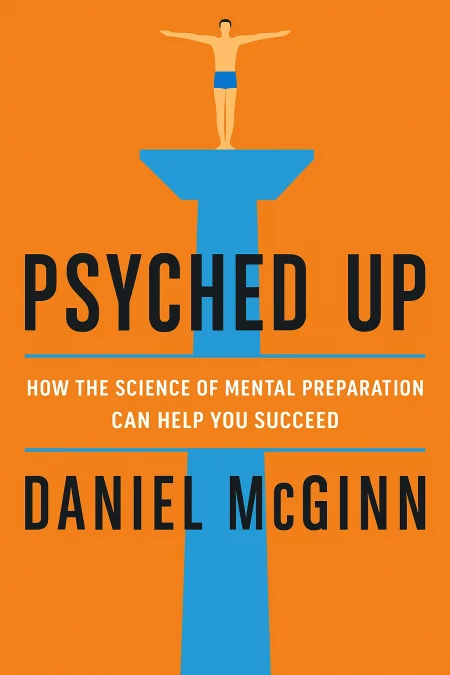
Psyched Up
How the Science of Mental Preparation Can Help You Succeed
Book Edition Details
Summary
In the high-stakes theater of life, where adrenaline surges and nerves jangle, how do champions consistently rise to the occasion? "Psyched Up" by Daniel McGinn delves into the art and science of mental priming, revealing the secrets behind the curtain of peak performance. With insights from luminaries like General Stanley McChrystal and NASCAR legend Jimmie Johnson, McGinn masterfully unpacks the rituals that transform anxiety into an ally. This isn't just another self-help manual; it's a playbook for harnessing your inner drive. Whether you're an introvert seeking quiet fortitude or an extrovert craving dynamic energy, discover your unique psych-up strategy to conquer life's defining moments.
Introduction
Picture this: You're moments away from the most important presentation of your career. Your heart pounds against your ribcage like a trapped bird. Your palms are slick with sweat, and your mind races through everything that could go wrong. In this crucial moment, what separates those who crumble under pressure from those who rise to meet it? The answer lies not in years of preparation, but in the final precious minutes before we perform. While we obsess over perfecting our skills through endless practice, we often neglect the critical moments that can make or break our success. Whether you're stepping onto a stage, entering a boardroom, or facing any high-stakes situation, how you prepare your mind in those last moments can determine whether you'll deliver your best performance or watch your potential slip away. This exploration into the science of peak performance preparation reveals a fascinating truth: the most successful people have learned to harness their pre-performance anxiety, transforming nervous energy into fuel for excellence. Through rigorous research and compelling real-world examples, we'll discover that getting "psyched up" isn't about suppressing our fears, but about channeling our natural responses in ways that enhance rather than hinder our abilities. The techniques that follow can transform anyone's approach to high-pressure situations, turning moments of dread into opportunities for breakthrough performance.
From Stage Fright to Flow: Reframing Pre-Performance Anxiety
Dr. Mark McLaughlin stands in the shadows of a hospital locker room, eyes closed, classical music flowing through his earphones. In thirty minutes, he'll make a life-altering incision into a patient's spine, operating inches from vital nerves and arteries. Most surgeons spend these precious moments chatting with colleagues or checking emails, treating surgery as routine. But McLaughlin follows a ritual he learned decades ago as a college wrestler, systematically preparing his mind for the challenge ahead. His preparation begins hours earlier with precisely three cups of coffee, continues with a mental review he calls the Five Ps, and culminates in this moment of centered stillness. When colleagues try to interrupt, he responds curtly: "Not now." He's learned that the physical skills are only half the battle. Mental preparation determines whether he'll operate with the focused precision his patients deserve. This same principle applies whether you're facing a job interview, giving a toast, or making a crucial sales pitch. Research consistently shows that our instinctive response to pre-performance anxiety, the universal advice to "calm down," actually works against us. Instead of fighting our body's natural arousal, we can learn to reinterpret those racing hearts and sweaty palms as signs of excitement rather than fear. Studies reveal that people who tell themselves "I'm excited" before performing significantly outperform those who try to relax. The goal isn't to eliminate nervousness, but to transform it into the energy that fuels exceptional performance.
The Ritual Advantage: How Routines and Superstitions Shape Success
Stephen Colbert's pre-show ritual seems almost mystical to outsiders. He rings a small bell in the bathroom, chews on a specific type of Bic pen, slaps himself twice in the face, then stares at a particular spot on the theater wall. When that pen style was discontinued, his staff scoured stationery stores worldwide to maintain his supply. To Colbert, these actions aren't quirky habits but essential elements of his transformation into his television persona. Meanwhile, at NASCAR tracks across America, crew chief Chad Knaus tends to his office bonsai tree every Thursday before races. This ritual emerged after his first tree died during a championship loss, creating a connection in his mind between plant care and racing success. Since adopting this weekly practice, his driver has won seven championships. Knaus also participates in team rituals, like the entire crew hand-waxing race cars before the season opener, regardless of their executive status. These examples illustrate a powerful truth: rituals work not because they're magic, but because they serve crucial psychological functions. They provide a sense of control in uncertain situations, create familiar anchors in high-stress environments, and offer structured ways to focus mental energy. Research demonstrates that people who perform pre-performance rituals, even arbitrary ones, consistently outperform those who don't. The specific actions matter less than the consistency and personal meaning attached to them. Whether it's wearing lucky socks or following a elaborate warm-up routine, rituals help us transition from our everyday mindset into our performance state, creating a bridge between preparation and peak execution.
Beyond Motivation: Strategic Pep Talks and Performance Playlists
When Erica Galos Alioto stands before 650 salespeople at Yelp's New York office on the last day of the month, she isn't channeling Knute Rockne's "win one for the Gipper" approach. Instead, she follows a carefully crafted formula that balances emotion with strategy. She begins by acknowledging the team's growth and celebrating top performers, then shifts to practical information about goal-setting and her "Success Equals Mentality plus Attitude plus Talent" framework. Alioto's approach reflects a crucial evolution in motivational speaking. While classic pep talks relied heavily on emotional appeals, modern research suggests that the most effective pre-performance communication combines strategic information with emotional energy. Military studies show that elite Special Forces units receive briefings focused primarily on mission specifics rather than motivational rhetoric. The assumption is that motivation already exists; what performers need most is clarity about execution. Similarly, the science behind motivational music reveals nuanced principles about when and how audio enhancement works best. TJ Connelly, who DJs for both the Boston Red Sox and New England Patriots, understands that different moments require different musical approaches. During batting practice, he plays high-energy rap to energize players. But for specific situational moments, like a crucial defensive play, he instantly cues songs that amplify the crowd's natural response, creating a feedback loop that elevates everyone's energy. The key lies not in simply playing loud, aggressive music, but in matching musical choices to the specific psychological needs of each performance moment.
The Enhancement Question: Confidence, Chemistry and Ethical Boundaries
At West Point's Center for Enhanced Performance, cadets listen to personalized audio tracks narrated by professional voice actors, designed to build confidence through vivid imagery and positive self-talk. These ten-minute recordings combine personal achievements with motivational music, creating what sports psychologists call "mental rehearsal." One lacrosse player's track reminds him of his fifteen saves against state champions, reinforcing his identity as an impact player while he sits in an egg-shaped chair, biofeedback sensors monitoring his response. This sophisticated psychological approach contrasts sharply with the growing trend of chemical enhancement in professional settings. Beta-blockers, originally developed for heart patients, now help lawyers, musicians, and executives manage performance anxiety. Modafinil, created to treat narcolepsy, has become Silicon Valley's cognitive enhancer of choice, promising extended focus and alertness without amphetamine-like side effects. These pharmaceutical tools raise profound questions about fairness, authenticity, and the future of human performance. The tension between mental and chemical enhancement reflects broader questions about how far we should go in optimizing our performance. While visualization techniques and confidence-building exercises seem natural and harmless, prescription medications venture into more complex ethical territory. Some argue that using available tools to perform better serves everyone's interests, especially in high-stakes professions like surgery or emergency response. Others worry about creating pharmaceutical arms races where enhanced performance becomes the baseline expectation.
Summary
The journey from anxiety to excellence isn't about suppressing our natural responses to pressure, but about understanding and redirecting them. The most compelling insight from performance psychology research is that our bodies' pre-performance arousal, the racing heart and heightened awareness we often interpret as panic, actually represents our system's attempt to help us succeed. The key lies in reframing these sensations as excitement rather than fear, and channeling that energy through structured preparation. Whether through elaborate rituals that create psychological anchors, strategic communication that combines emotional inspiration with practical guidance, or carefully chosen music that synchronizes our internal state with optimal performance conditions, the most successful people have learned to orchestrate their final pre-performance moments. They understand that while years of practice build competence, those crucial final minutes determine whether we'll access our full potential when it matters most. The ultimate lesson is both humbling and empowering: we have far more control over our performance than we realize, but that control must be cultivated through intentional practice of mental preparation techniques. Success isn't just about what we know or how hard we've practiced, but about how skillfully we can prepare our minds to deliver our best work when the spotlight shines brightest.
Related Books
Download PDF & EPUB
To save this Black List summary for later, download the free PDF and EPUB. You can print it out, or read offline at your convenience.
By Daniel McGinn
