
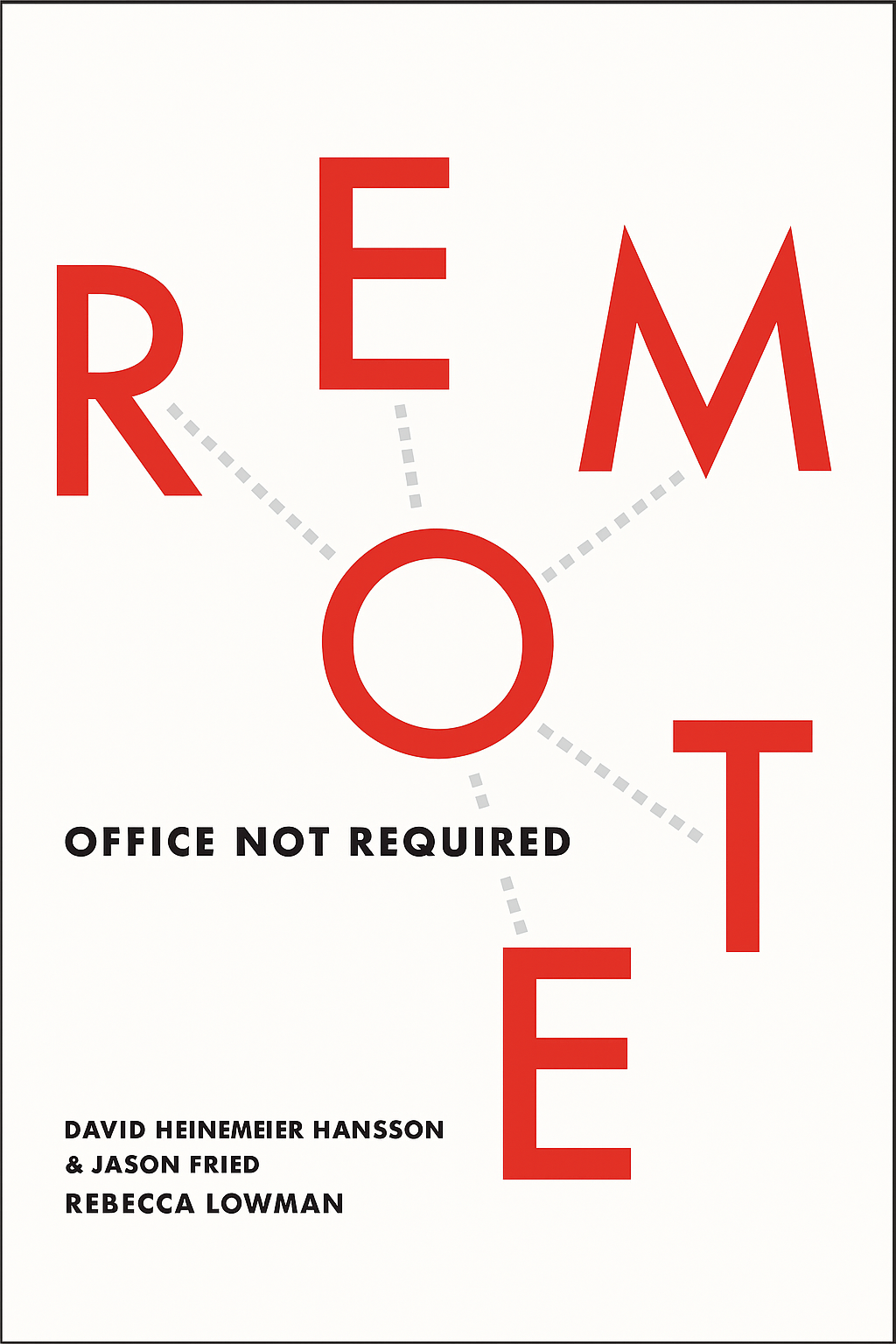
Remote
Office Not Required
byJason Fried, David Heinemeier Hansson, Rebecca Lowman
Book Edition Details
Summary
In an age where the cubicle is crumbling, "Remote" by the visionary minds behind 37signals—Fried and Hansson—revolutionizes our understanding of work. As technology tears down the old walls of the industrial work model, this groundbreaking narrative reveals how businesses can thrive by shifting workspaces from physical to virtual. The authors illuminate the compelling advantages of remote work—from expanding talent pools to reducing overheads—while addressing the fears that tether companies to tradition. With an engaging blend of data and real-world anecdotes, "Remote" is a clarion call to the future, offering actionable insights for leaders ready to embrace the inevitable shift. Whether you're a skeptic or a believer, this book promises to reshape your view of work's potential, one remote connection at a time.
Introduction
Picture yourself waking up tomorrow morning without the dreaded sound of an alarm clock, knowing you won't spend precious hours stuck in traffic or cramped on crowded trains. Imagine having the freedom to work from your favorite coffee shop, a quiet corner of your home, or even a beach in Bali while delivering your best work. This isn't a fantasy reserved for freelancers or entrepreneurs—it's the emerging reality of remote work that's transforming how we think about careers, productivity, and life itself. The traditional office model, with its rigid schedules and geographical constraints, is rapidly becoming obsolete as millions of workers and thousands of companies discover the profound benefits of location independence. The technology exists, the talent is distributed globally, and the old excuses for keeping everyone chained to desks are crumbling. The question isn't whether remote work is possible—it's whether you're ready to embrace the freedom, flexibility, and enhanced productivity that comes with breaking free from the outdated constraints of the conventional workplace.
Breaking Free from Office Chains
The modern office has become an interruption factory, a place where meaningful work goes to die amid constant meetings, casual drop-bys, and the endless buzz of forced collaboration. When you ask people where they go to get real work done, they rarely answer "the office." Instead, they mention early mornings before colleagues arrive, late evenings after everyone leaves, or weekends when the building is blissfully empty. Consider the story of 37signals, a software company that started with partners separated by an ocean—one in Copenhagen, the other in Chicago. Rather than seeing distance as a barrier, they discovered it was actually their secret weapon. Without the ability to interrupt each other constantly, they found themselves producing higher-quality work in focused stretches. Their remote setup forced them to communicate more thoughtfully, plan more carefully, and trust more completely. What began as a necessity evolved into a competitive advantage that allowed them to build a successful company with team members scattered across the globe. The transformation wasn't immediate. Initially, they worried about coordination challenges and communication gaps. However, they soon realized that the supposed benefits of in-person collaboration were largely illusory. The magic they thought required physical presence could be replicated and often improved through intentional remote practices. Their productivity soared, their stress levels dropped, and their ability to attract top talent expanded beyond geographical boundaries. Breaking free from office chains requires a fundamental shift in thinking. Start by identifying your most productive hours and protecting them fiercely. Experiment with working from different locations to find spaces that energize rather than drain you. Replace spontaneous interruptions with scheduled check-ins, and watch as your ability to enter deep work states transforms your output. The goal isn't to eliminate collaboration but to make it more intentional and valuable. Remember that the strongest chains are often mental ones. Challenge your assumptions about where good work happens, question whether that meeting truly requires physical presence, and consider whether your daily commute is adding value or simply burning precious life hours. The office will always be there as an option, but it no longer needs to be your prison.
Building Your Remote Success Framework
Remote work success isn't about replicating office dynamics from your kitchen table—it's about creating entirely new systems designed for distributed collaboration. The foundation of any successful remote framework rests on three pillars: visibility, accessibility, and rhythm. Everything your team needs to succeed must be visible to everyone, accessible from anywhere, and operating on predictable rhythms that create stability amid the flexibility. Basecamp, originally created to solve 37signals' own remote coordination challenges, exemplifies this principle in action. When their team realized that critical project information was locked away in individual email inboxes and local computer files, they built a centralized hub where discussions, files, schedules, and decisions could live transparently. This wasn't just a technical solution—it was a cultural shift toward radical transparency that eliminated the "wait for someone to get back to the office" bottleneck that kills remote productivity. The transformation was remarkable. Projects that once stalled waiting for approvals or clarifications began flowing smoothly across time zones. Team members in different countries could pick up where others left off seamlessly. The anxiety of being out of the loop vanished when everyone had access to the same information simultaneously. What started as a survival tool became the product that would eventually serve millions of users worldwide. Building your framework starts with conducting an information audit. Identify every piece of critical information currently trapped in individual systems, email accounts, or physical locations. Create shared spaces for ongoing discussions, project files, and decision-making records. Establish clear protocols for when to use email versus instant messaging versus phone calls, based on urgency and complexity. Most importantly, ensure that no single person becomes a bottleneck for others' progress. The strongest remote frameworks feel almost invisible to their users. They remove friction rather than add process, they clarify rather than complicate, and they empower rather than restrict. Start small, test with willing team members, and expand gradually as you discover what works best for your specific context and culture.
Mastering Remote Leadership Skills
Leading remote teams requires abandoning the industrial-age obsession with monitoring chair occupancy and embracing a results-focused approach that judges performance by output rather than input. The most dangerous management trap in remote work is the desperate attempt to maintain control through surveillance technology, constant check-ins, and productivity theater that misses the entire point of remote work's potential. Betty Hase, head of design for Herman Miller, demonstrates masterful remote leadership from her Chicago office while managing a team of ten designers scattered across the United States and reporting to a boss in New York. Rather than trying to coordinate through constant video calls or elaborate tracking systems, she focuses on creating clear objectives, removing roadblocks, and ensuring her team has everything they need to excel. Her approach emphasizes trust-building through consistent communication and support rather than monitoring and control. The results speak for themselves. Her distributed team produces innovative furniture designs that compete successfully in global markets while maintaining high morale and low turnover. Team members feel empowered to do their best work during their most productive hours, leading to creative solutions that might never emerge in traditional office environments. The secret isn't managing remote workers differently—it's managing better, period. Mastering remote leadership begins with conducting regular one-on-one conversations focused on support rather than surveillance. Ask "What obstacles can I remove?" instead of "What did you do yesterday?" Shift from tracking time to tracking outcomes, and celebrate results rather than hours logged. Create multiple communication channels for different needs: email for non-urgent matters, instant messaging for quick questions, and phone calls for complex discussions. The most effective remote leaders become expert roadblock removers. They ensure team members have access to necessary resources, decision-making authority for their domains, and clear understanding of priorities and expectations. They protect their teams from unnecessary interruptions while remaining available for genuine emergencies. Above all, they model the behavior they want to see by respecting boundaries, communicating clearly, and trusting their team to excel.
Thriving in the Remote Lifestyle
The remote lifestyle offers unprecedented freedom to design work around life rather than the reverse, but this freedom requires intentional structure to prevent work from consuming everything. The greatest risk isn't underwork—it's overwork, as the boundaries between personal and professional life blur without deliberate effort to maintain them. Success requires creating rituals, routines, and physical cues that signal transitions between work and life modes. Jason, one of the 37signals founders, demonstrates this principle through his hybrid approach of working from home during productive morning hours before heading to the office for collaborative afternoon activities. This isn't about avoiding the office—it's about optimizing different environments for different types of work. His mornings at home are reserved for deep, focused tasks that require uninterrupted attention, while his office afternoons focus on meetings, discussions, and team interactions that benefit from in-person energy. This intentional structure transformed his productivity and life satisfaction. Instead of fighting against his natural rhythms or forcing all work into a single environment, he leverages the unique advantages of each setting. His most creative work happens in the quiet sanctuary of his home office, while his collaborative energy flourishes in the dynamic office environment. The combination produces better results than either setting alone could achieve. Thriving remotely starts with honest self-assessment about your optimal work rhythms and environmental needs. Experiment with different locations and schedules to discover when and where you produce your best work. Create physical and temporal boundaries that signal work mode versus life mode—perhaps changing clothes, closing the laptop, or taking a walk to mark transitions. Resist the temptation to work "just a little more" when your computer is always accessible. Most importantly, view remote work as an opportunity to integrate rather than separate the different aspects of your life. Use the time saved from commuting for exercise, family connections, or pursuing interests that energize you. Design a lifestyle that makes work more sustainable and enjoyable rather than simply relocating the same unsustainable patterns to a different address. The goal is optimization, not just transportation.
Summary
The remote work revolution represents more than a change in location—it's a fundamental reimagining of how great work gets done in the modern world. As the authors observe, "The future is already here—it's just not evenly distributed," and those who embrace remote work's possibilities gain access to unprecedented freedom, productivity, and life satisfaction. The old industrial model of centralized workplaces and synchronized schedules is giving way to a new paradigm that prioritizes results over presence, flexibility over rigidity, and trust over surveillance. The technology exists, the benefits are proven, and the competitive advantages are substantial for both individuals and organizations willing to make the transition. The only question remaining is whether you'll be among the early adopters who seize these opportunities or among the laggards who cling to outdated models until change is forced upon them. Start today by identifying one aspect of your work that could be done remotely, experiment with it for a week, and pay attention to how it affects both your productivity and your overall life satisfaction.
Related Books
Download PDF & EPUB
To save this Black List summary for later, download the free PDF and EPUB. You can print it out, or read offline at your convenience.
By Jason Fried
