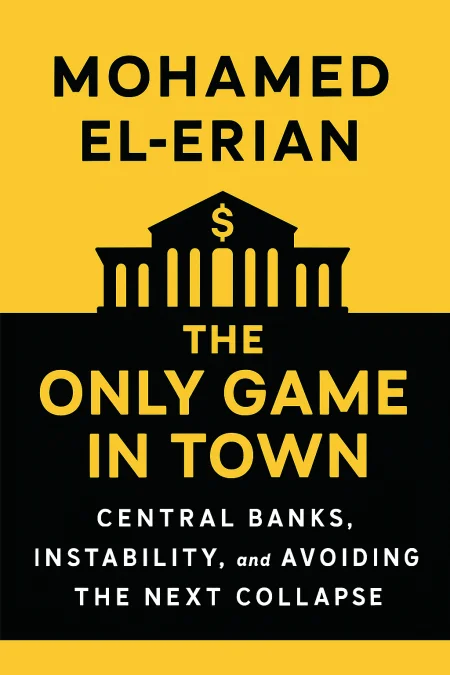
The Only Game In Town
Central Banks, Instability, And Avoiding The Next Collapse
Book Edition Details
Summary
In the shadow of looming economic uncertainty, "The Only Game in Town" unravels the complex dance of global finance with unflinching clarity. Mohamed El-Erian, a luminary in economic thought, presents a crucial narrative of choice: one path leads us to revitalized prosperity, while the other threatens chaos. As central banks reach the limits of their power, El-Erian urges a pivotal shift from reactive monetary policies to proactive strategies addressing the root of economic malaise. This compelling guide interweaves economics, finance, and behavioral science, equipping individuals and policymakers alike with the tools to navigate and shape the unpredictable terrain ahead. For those eager to understand and influence the fate of our financial future, this book stands as an essential beacon.
Introduction
The global financial crisis of 2008 marked a pivotal moment when central banks transformed from obscure technical institutions into the primary architects of economic recovery. This transformation represents one of the most significant shifts in modern economic governance, as monetary authorities assumed responsibilities far beyond their traditional mandates. The phenomenon reveals a dangerous imbalance in economic policy making, where central banks have become the sole active players in a game that requires multiple participants. This analysis examines how central banks evolved from crisis managers to perpetual economic guardians, operating in uncharted territory with experimental tools while other policy makers remained paralyzed. The unprecedented nature of this situation creates a bimodal distribution of potential outcomes—either a successful transition to sustainable growth or a descent into prolonged stagnation and financial instability. Understanding this dynamic is crucial for comprehending why conventional economic models have failed to predict recent developments and why the global economy faces such profound uncertainty. The examination draws upon behavioral economics, institutional analysis, and historical precedent to illuminate the risks and opportunities inherent in this extraordinary period of monetary dominance.
The Rise and Fall of Central Bank Supremacy
Central banking experienced a remarkable journey from the mid-1990s through the 2008 financial crisis, characterized by dramatic shifts in reputation and responsibility. During the "golden age," these institutions were celebrated as the masters of economic stability, credited with conquering inflation and smoothing business cycles. The Federal Reserve, European Central Bank, and Bank of England enjoyed unprecedented credibility as guardians of prosperity, with figures like Alan Greenspan elevated to near-mythical status as economic maestros. However, this golden era concealed fundamental weaknesses in oversight and understanding. Central banks had become complacent about the risks accumulating within financial systems, believing that sophisticated markets could self-regulate and that the "great moderation" represented a permanent achievement. They failed to recognize how deregulation and financial innovation were creating dangerous interconnections and excessive leverage throughout the system. The shadow banking sector grew largely unchecked, while traditional banks engaged in increasingly risky activities that regulators neither understood nor properly supervised. The collapse came swiftly and brutally. When the housing bubble burst and credit markets froze, central banks discovered they had been presiding over a house of cards. Their reputations plummeted as the very institutions they had failed to properly regulate required massive taxpayer bailouts. The crisis exposed how central banks had lost touch with the realities of modern finance, clinging to outdated models that ignored systemic risks and interconnectedness. Yet from this failure emerged an opportunity for redemption. As financial markets collapsed and economies spiraled toward depression, central banks proved their worth as crisis managers. They deployed unprecedented tools and resources to prevent complete economic collapse, demonstrating both innovation and determination that other policy makers lacked. This crisis response would ultimately propel them into their current role as the dominant force in economic policy making.
Ten Critical Challenges Facing the Global Economy
The prolonged reliance on central bank activism has illuminated ten interconnected challenges that threaten global economic stability and prosperity. These challenges represent the accumulation of structural problems that monetary policy alone cannot address, yet which central banks have been forced to confront as the only responsive policy makers. Economic growth remains frustratingly weak across advanced economies, characterized by inadequate investment, declining productivity, and the exhaustion of traditional growth models. Unemployment persists at dangerous levels, particularly among young people, threatening to create a "lost generation" whose skills and potential may never be fully realized. Income and wealth inequality have reached levels not seen since the early twentieth century, undermining social cohesion and economic dynamism. Political dysfunction has paralyzed fiscal policy in many countries, while trust in institutions continues to erode. The global coordination mechanisms that once provided stability have weakened, creating a dangerous vacuum in international economic governance. Financial risks have migrated from traditional banks to less-regulated sectors, morphing in ways that regulators struggle to understand or control. Market liquidity has become increasingly unreliable, despite central bank efforts to flood the system with money. Asset prices have decoupled from economic fundamentals, creating dangerous bubbles that threaten future stability. Meanwhile, even well-managed economies and innovative companies find themselves constrained by the broader dysfunction, unable to reach their full potential. These challenges reinforce each other in dangerous ways. Weak growth perpetuates high unemployment, which fuels political extremism and social tension. Political dysfunction prevents the fiscal reforms needed to address inequality and restore growth. Financial instability undermines confidence and investment, while institutional degradation makes coordinated responses increasingly difficult. Central banks find themselves fighting symptoms rather than causes, buying time but unable to cure the underlying diseases.
The Limits of Monetary Policy as Economic Cure
Despite their heroic efforts and innovative approaches, central banks face fundamental limitations that prevent them from solving the deep-seated problems plaguing the global economy. Monetary policy operates through specific transmission mechanisms that have become increasingly ineffective as economies have changed and financial markets have evolved. Central banks can influence interest rates, provide liquidity, and purchase securities, but they cannot directly boost productivity, reform education systems, or rebuild infrastructure. They cannot resolve political gridlock, address inequality through redistribution, or negotiate international trade agreements. Most crucially, they cannot create the comprehensive policy frameworks needed to restore sustainable growth and stability. The tools available to central banks are inherently blunt instruments designed for cyclical adjustments, not structural reforms. Quantitative easing and forward guidance can influence financial markets, but their impact on real economic activity has proven limited and uneven. These policies have succeeded in boosting asset prices and supporting financial institutions, but they have failed to generate the broad-based economic recovery that was promised. Moreover, prolonged reliance on unconventional monetary policies has created new risks and distortions. Asset bubbles have formed in multiple markets, inequality has worsened as the wealthy benefit disproportionately from rising asset prices, and financial markets have become dangerously dependent on continued central bank support. The longer these policies persist, the greater the risk that central banks will transition from being part of the solution to becoming part of the problem. The effectiveness of monetary policy has also been undermined by the changing structure of financial markets and the global economy. Traditional transmission mechanisms have weakened, while new channels of influence remain poorly understood. Central banks find themselves operating in uncharted territory, forced to experiment with untested tools while bearing responsibility for outcomes they cannot fully control.
Navigating the T-Junction: Policy Choices and Future Outcomes
The global economy approaches what can be characterized as a T-junction, where the current path of central bank-dependent growth will soon become unsustainable, forcing a choice between two dramatically different futures. This bimodal distribution of outcomes reflects the unprecedented nature of current circumstances and the limited time remaining for course correction. One path leads to renewed prosperity through comprehensive policy reform that addresses the structural challenges identified earlier. This would require unprecedented coordination between monetary, fiscal, and structural policies, supported by renewed political will and international cooperation. Success would unleash the considerable productive potential that currently sits idle, from unemployed workers to innovative technologies to accumulated corporate cash reserves. The alternative path leads to prolonged stagnation, recurring financial crises, and social fragmentation. Continued reliance on monetary policy alone would eventually exhaust central bank credibility and effectiveness, leading to market instability and economic decline. Political systems would become increasingly dysfunctional, inequality would worsen, and international cooperation would further deteriorate. The choice between these outcomes is not predetermined by economic forces or historical inevitability. Rather, it depends on decisions made by policy makers, business leaders, and citizens over the coming years. The window for positive action is closing, but it has not yet closed completely. Understanding this T-junction requires abandoning comfortable assumptions about gradual transitions and normal distributions of outcomes. The current situation is inherently unstable and cannot persist indefinitely. The magnitude of accumulated imbalances and the exhaustion of conventional policy tools create conditions where small changes can trigger large consequences, either positive or negative.
Summary
The elevation of central banks to dominant positions in economic policy making represents both a remarkable institutional adaptation and a dangerous policy imbalance that cannot be sustained indefinitely. While these institutions deserve credit for preventing economic collapse and maintaining stability during unprecedented crisis, their forced assumption of responsibilities beyond their capabilities has created systemic risks that threaten both their effectiveness and the broader economy. The bimodal distribution of future outcomes reflects the fundamental choice facing modern societies: whether to restore balanced policy making through comprehensive reform or to drift toward stagnation and instability through continued institutional dysfunction.
Related Books
Download PDF & EPUB
To save this Black List summary for later, download the free PDF and EPUB. You can print it out, or read offline at your convenience.
By Mohamed El-Erian
