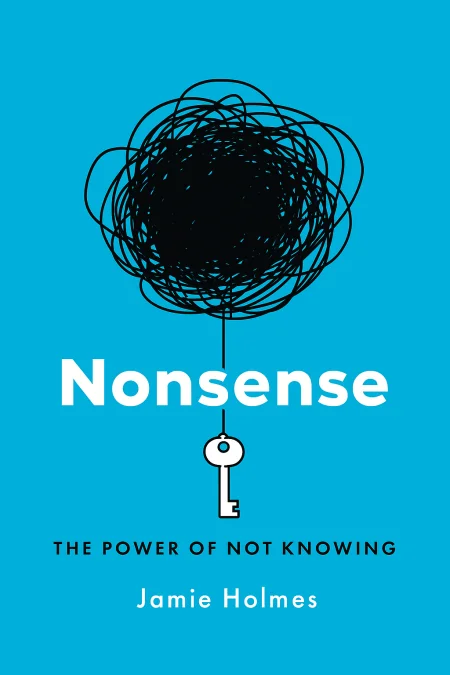
Nonsense
The Power of Not Knowing
Book Edition Details
Summary
Chaos looms large, but what if embracing the confusion could be your superpower? In "Nonsense," Jamie Holmes takes you on a riveting exploration of ambiguity's hidden gifts—those moments of bewilderment that spark innovation, empathy, and growth. Our world, saturated with conflicting information and relentless uncertainties, demands a fresh skillset: the art of navigating the unknown. Holmes, weaving together tales from espionage to advertising genius, reveals how our instinctive rush for clarity often blinds us to richer truths. This book isn't just about surviving in a disordered world; it's about thriving. It's about transforming perplexity into possibility, inviting you to rethink how you approach life’s most bewildering puzzles. As you dive into Holmes' compelling narratives, discover why the key to success lies not in what you know, but in how you embrace what you don't.
Introduction
The human mind operates as a sophisticated pattern-recognition system, constantly transforming ambiguous information into coherent understanding. This remarkable capacity enables us to navigate complex environments and make rapid decisions, yet it also creates unexpected limitations when taken to extremes. Modern life presents unprecedented levels of uncertainty, from technological disruption to global interconnectedness, challenging traditional approaches to problem-solving and decision-making. The drive to eliminate ambiguity and reach definitive conclusions serves essential survival functions, but it can also blind us to creative possibilities and lead to premature closure in situations requiring deeper analysis. Through examining diverse contexts—from wartime intelligence failures to breakthrough scientific discoveries, from educational reform to entrepreneurial success—a compelling case emerges for cultivating comfort with not knowing. This investigation challenges conventional wisdom about the relationship between certainty and effectiveness, revealing how uncertainty functions as a fundamental resource for innovation, learning, and adaptation. The exploration reveals fascinating contradictions in human cognition, demonstrating how the very mechanisms that help us make sense of the world can also limit our potential for growth and creative breakthrough when we fail to recognize their boundaries.
The Certainty Trap: How Need for Closure Limits Human Potential
The human brain operates through an automatic process of gap-filling and pattern completion, transforming ambiguous sensory input into coherent understanding. This mechanism works so efficiently that we rarely notice its operation, yet it profoundly shapes every aspect of our experience. When encountering new information, the mind immediately searches for familiar patterns, fills missing details, and resolves contradictions based on prior knowledge and expectations. Experimental research reveals the extent to which this drive for closure can distort perception. When people view playing cards with reversed colors—red spades or black hearts—they initially see what they expect rather than what appears before them. The mind's tendency to impose familiar categories onto unfamiliar stimuli demonstrates how aggressively it works to maintain consistency and avoid confusion. This same mechanism explains why scrambled text remains readable as long as first and last letters remain in place. The need for closure intensifies under stress, time pressure, and cognitive load. Background noise during decision-making makes people more likely to change uncertain opinions quickly while simultaneously making those with strong initial views more resistant to contradictory evidence. These psychological shortcuts, while evolutionarily adaptive for survival situations, become problematic in complex modern contexts requiring flexibility and nuanced thinking. Understanding this fundamental cognitive process reveals both its tremendous value and its potential limitations. The automatic closure of mental gaps, while generally beneficial for efficient functioning, can prevent recognition of genuinely novel situations or creative possibilities that require sustained engagement with ambiguity and uncertainty.
When Quick Decisions Fail: The Hidden Costs of Premature Resolution
High-stakes situations dramatically amplify the human tendency toward premature closure, creating dangerous blind spots in judgment and decision-making. Intelligence failures often result not from lack of information but from analysts' inability to revise initial assessments when contradictory evidence accumulates. The pressure to provide definitive answers can override the patient, nuanced approach that complex situations actually require. Medical diagnosis presents a particularly clear example of these dynamics. The drive to provide patients with definitive answers can lead to overdiagnosis, unnecessary procedures, and missed opportunities for more conservative approaches. The proliferation of diagnostic testing often reflects not medical necessity, but rather the discomfort that both doctors and patients feel when facing uncertain health situations. This rush toward resolution can paradoxically create more problems than it solves. Business environments similarly suffer when leaders mistake decisive action for effective leadership. The pressure to appear confident and in control can prevent organizations from acknowledging fundamental uncertainties they face, leading to strategic decisions based on false certainties rather than careful analysis of multiple scenarios. Successful negotiators distinguish themselves not through quick resolution, but through their capacity to remain comfortable with uncertainty while gradually building understanding. These patterns reveal a consistent paradox: the situations that most demand tolerance for ambiguity are often those that create the strongest psychological pressure to eliminate it. Recognizing this contradiction becomes essential for developing more sophisticated approaches to complex challenges that resist simple solutions and require sustained engagement with uncertainty.
Uncertainty as Creative Catalyst: From Innovation to Educational Excellence
Revolutionary innovations emerge from recognizing that familiar objects or concepts have hidden, unexplored functions. Mobile money systems developed when people realized that prepaid airtime cards could serve as currency and text messages could transfer value. The telephone emerged when inventors moved beyond viewing telegraph wires solely as message transmission systems to recognize their potential for carrying human speech. These breakthroughs required seeing past conventional categories to discover new possibilities. Scientific progress exemplifies uncertainty's creative potential, with major advances typically following the accumulation of anomalies that existing theories cannot explain. The discomfort of unresolved contradictions motivates researchers to develop new frameworks and explore previously unconsidered possibilities. Rather than representing obstacles to overcome, these periods of confusion signal opportunities for genuine discovery and innovation. Educational approaches that deliberately introduce productive confusion demonstrate uncertainty's learning benefits. Students who struggle with problems before receiving instruction often develop deeper understanding than those given immediate guidance. The temporary discomfort of not knowing forces more active engagement with material and encourages flexible thinking strategies. This principle applies across disciplines, from mathematics to creative writing, where valuable learning occurs in the space between confusion and clarity. The most successful innovators combine broad knowledge across multiple domains with deep understanding of specific areas. This combination enables them to recognize patterns and solutions from one field that might apply to challenges in another. Rather than seeking to eliminate uncertainty, they learn to navigate it skillfully, using ambiguity as a source of creative inspiration rather than a problem requiring immediate resolution.
Building Ambiguity Tolerance: Cultural Diversity and Cognitive Flexibility
Exposure to multiple cultural frameworks and languages provides natural training in ambiguity tolerance. Bilingual individuals develop enhanced cognitive flexibility through constant practice in switching between different linguistic and conceptual systems. This mental exercise strengthens their ability to hold multiple perspectives simultaneously and resist the pull toward premature closure, creating transferable skills for managing uncertainty across diverse contexts. Cross-cultural experiences force individuals to confront the arbitrary nature of many assumptions they previously took for granted. This recognition that multiple valid ways of organizing reality exist creates cognitive space for more creative approaches to problem-solving. Historical analysis reveals that periods of greatest cultural creativity often coincide with eras of increased cultural mixing and exchange, suggesting that diversity itself functions as a catalyst for innovation. The bilingual advantage extends beyond language processing to general cognitive abilities. Bilingual individuals show superior performance on tasks requiring attention control, working memory, and cognitive flexibility. These same capacities prove crucial for navigating ambiguous situations effectively, demonstrating how multilingual experience provides systematic training in the cognitive skills necessary for thriving in complex environments. Societies with greater cultural diversity tend to produce more innovations, as the collision of different perspectives generates new possibilities that homogeneous groups might miss. This suggests that ambiguity tolerance can be cultivated through deliberate exposure to different ways of thinking and organizing experience, transforming uncertainty from a source of anxiety into a resource for creative problem-solving and adaptive thinking.
Summary
The capacity to embrace uncertainty emerges not as a philosophical luxury, but as a practical necessity for navigating the complexities of modern life effectively. The evidence reveals that individuals and organizations that develop comfort with ambiguity gain significant advantages in learning, innovation, and decision-making, while those who insist on premature closure limit their potential for growth and adaptation. This shift in perspective transforms our relationship with the unknown from one of anxiety and avoidance to one of curiosity and productive engagement. Rather than viewing uncertainty as a cognitive flaw to be corrected, recognizing it as an essential ingredient in breakthrough thinking opens new possibilities for personal and professional development in an inherently ambiguous world where adaptability often matters more than expertise.
Related Books
Download PDF & EPUB
To save this Black List summary for later, download the free PDF and EPUB. You can print it out, or read offline at your convenience.
By Jamie Holmes
