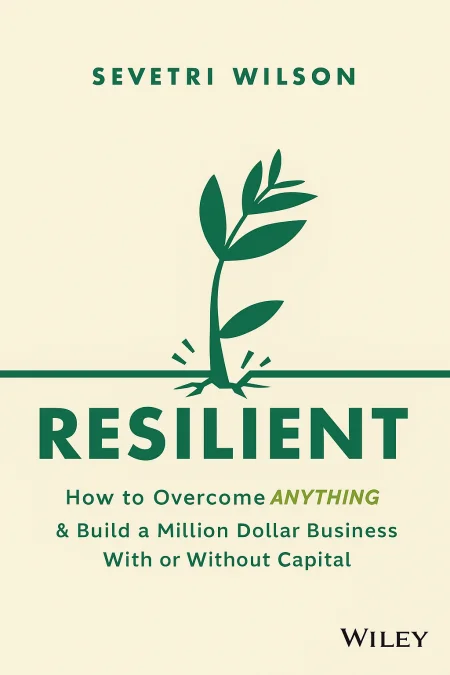
Resilient
How to Overcome Anything and Build a Million Dollar Business With or Without Capital
Book Edition Details
Summary
Chart the odyssey of resilience and innovation with "Resilient," a riveting chronicle of Sevetri Wilson's entrepreneurial metamorphosis. This narrative isn't just ink on paper; it's a masterclass in turning visions into ventures, capturing the raw grit of bootstrapping to the calculated finesse of Series A fundraising. Wilson opens her personal journal, offering a rare glimpse into the mind of a trailblazer who transcends the ordinary. From the humble beginnings of self-funding her first enterprise to the strategic navigation of venture capital waters for her second, her journey resonates with aspiring founders and startup aficionados alike. The book's heart lies in its pragmatic revelations, including Wilson's own SAFE agreement and pioneering pitch deck. "Resilient" isn't just a book—it's a catalyst for those daring to dream and determined to succeed, serving as an indispensable companion for anyone poised to scale the peaks of business innovation.
Introduction
In the heart of Louisiana, where tech dreams seemed impossible and venture capital was a foreign concept, a young woman would defy every statistic stacked against her. Sevetri Wilson emerged from a small town outside New Orleans, carrying the weight of being a first-generation college student from a single-parent household where her mother raised four children on $26,000 a year. Yet this same woman would go on to bootstrap her first company to seven figures without a single dollar of outside investment, then raise over $10 million in venture capital for her second venture, becoming Louisiana's most successful female founder in terms of capital raised. Wilson's journey unfolds against the backdrop of systemic barriers that historically excluded Black women from the tech industry's highest echelons. Her story illuminates three profound dimensions of entrepreneurial resilience: the gritty determination required to build something from nothing when traditional resources remain out of reach, the strategic acumen needed to navigate complex funding landscapes while maintaining control and vision, and the leadership wisdom necessary to build sustainable enterprises that create opportunities for others. Through her experiences, readers will discover how authentic purpose can fuel business success, how creative problem-solving can overcome seemingly insurmountable obstacles, and how one person's breakthrough can pave pathways for entire communities to follow.
From Humble Beginnings to Entrepreneurial Vision
Sevetri Wilson's entrepreneurial consciousness awakened not in a Stanford dorm room or Silicon Valley garage, but in the aftermath of profound personal loss. When her mother passed away just four days before Christmas during Wilson's graduate school years, the trajectory of her life shifted fundamentally. The woman who had worked tirelessly as an assistant manager at Kmart, running their gardening department with unwavering excellence, had instilled in her daughter a work ethic that would become the foundation of everything to follow. The transition from grief to purpose happened gradually, then suddenly. Wilson found herself questioning the traditional career path that had seemed so certain just months before. Her mother's death had taken away the person she most wanted to provide for, the driving force behind her academic achievements and professional ambitions. In that void, a new vision emerged: what if she could create opportunities not just for herself, but for others who faced similar barriers and limitations. Her first venture into entrepreneurship came through B-NOW, an online newspaper she created while still at Louisiana State University. The project brought together students from her predominantly white institution with those from neighboring Southern University, a historically Black college. It was a modest beginning, funded by a professor's $150 check, but it contained the DNA of everything that would follow: using innovation to bridge divides, creating platforms for underrepresented voices, and building something meaningful from minimal resources. The lessons from those early days proved invaluable when Wilson launched Solid Ground Innovations in 2009, just six months after her mother's funeral. Without access to traditional funding sources or extensive business networks, she had to develop an intuitive understanding of what her community needed most. The company began as a strategic communications and management agency, but its heart lay in helping nonprofits and community organizations build capacity and deliver better outcomes for the people they served.
Bootstrapping to Seven Figures Without Capital
The art of building without resources became Wilson's specialty, born from necessity rather than choice. When Solid Ground Innovations launched, there was no friends-and-family round, no angel investors, and certainly no venture capital on the horizon. Instead, there was determination, creativity, and an unwavering commitment to delivering exceptional value to every client, no matter how small the initial contract. Wilson's approach to bootstrapping differed significantly from the lean startup methodology popularized in Silicon Valley. Rather than building a minimum viable product and iterating based on user feedback, she had to generate revenue immediately to keep the lights on. This meant taking on whatever work was available, learning new skills on the fly, and gradually building expertise and credibility in her chosen market. The company's first major breakthrough came through an unexpected source: a Louisiana state website that listed certified small businesses. Aetna Better Health found Solid Ground Innovations through that listing while searching for local partners to help them establish operations in Louisiana as part of a Medicaid contract. The resulting seven-figure, multi-year agreement transformed Wilson's company from a scrappy startup into a legitimate player in the government contracting space. But success brought new challenges: managing cash flow when payments could take months to arrive, building operational capacity quickly enough to deliver on larger contracts, and navigating the complex world of media buying and vendor relationships. The experience taught Wilson crucial lessons about the relationship between risk and reward. Taking on contracts that stretched her company's capabilities beyond its comfort zone provided growth opportunities that would have been impossible to achieve through organic expansion alone. However, it also required careful financial management and the wisdom to recognize when certain opportunities might actually threaten the company's survival rather than accelerate its growth.
Raising Millions in Venture Capital Despite Barriers
The transition from bootstrapped business owner to venture-backed founder required Wilson to learn an entirely new language and navigate systems designed by and for people who looked nothing like her. When she decided to launch Resilia, her technology platform serving the nonprofit sector, she knew that bootstrapping alone wouldn't provide the rapid growth necessary to capture market share in a competitive landscape. Her fundraising journey began with a pre-seed round of $400,000 raised entirely from Louisiana-based investors. These early supporters were betting on Wilson personally rather than on detailed financial projections or market analyses. They had witnessed her ability to deliver results in her first company and believed she possessed the determination and skill to succeed in an entirely new venture. The process required her to become comfortable asking for money for the first time in her entrepreneurial career, a psychological shift that proved as challenging as the technical aspects of fundraising. The seed round proved far more difficult, requiring Wilson to venture beyond her local network and compete for attention in markets where she had no established relationships. Her first trips to Silicon Valley yielded valuable lessons about the importance of warm introductions and the subtle biases that could derail even the most promising pitch meetings. The breakthrough came through an unexpected connection: a partner at TPG Capital who had observed her presentation at a pitch competition she didn't win. Wilson's Series A fundraising process occurred during the early days of the COVID-19 pandemic, adding another layer of complexity to an already challenging process. By this time, she had learned to prepare meticulously for due diligence requests and could answer investor questions with the confidence that comes from deep market knowledge and proven execution. The $8 million round she ultimately raised validated not just her business model, but her belief that companies led by underrepresented founders could compete and win in even the most demanding markets.
Leading Through Crisis and Building Generational Wealth
The convergence of a global pandemic and nationwide protests following George Floyd's murder tested Wilson's leadership in ways no business school case study could have prepared her for. As cities shut down and economic uncertainty gripped the nation, she had to make rapid decisions about protecting her team while positioning her company to serve organizations dealing with unprecedented challenges in their own communities. Wilson's response drew from her understanding that authentic leadership requires showing up fully as yourself, especially during moments of crisis. Rather than avoiding difficult conversations about race and systemic inequality, she used her platform to educate her team and investors about the barriers facing Black entrepreneurs and the importance of creating equitable opportunities in contracting and procurement. Her willingness to be vulnerable about her own experiences with discrimination created deeper connections and demonstrated that business success and social justice advocacy could be mutually reinforcing rather than competing priorities. The concept of building generational wealth became central to Wilson's long-term vision as her company grew and her personal financial position improved. She recognized that true success wasn't just about personal achievement, but about creating systems and opportunities that would benefit others long after her own career ended. This perspective influenced everything from her hiring practices to her investment decisions, as she consistently sought ways to use her resources and platform to expand access and opportunity for other entrepreneurs from underrepresented backgrounds. Wilson's approach to wealth building extended beyond traditional financial metrics to encompass the creation of knowledge, networks, and institutional change. By demonstrating that companies led by Black women could raise significant venture capital and compete successfully in enterprise markets, she helped shift perceptions and create precedents that would benefit future generations of entrepreneurs. Her story became proof of possibility in communities where such examples had been scarce, inspiring others to pursue their own ambitious visions despite the barriers they might face.
Summary
Sevetri Wilson's journey from small-town Louisiana to venture-backed CEO illustrates that extraordinary achievement often emerges from ordinary circumstances when combined with extraordinary determination and authentic purpose. Her story demonstrates that the supposed disadvantages of starting without resources, connections, or industry insiders can actually become sources of strength, forcing entrepreneurs to develop creativity, resilience, and deep customer empathy that more privileged founders might never need to cultivate. The path from bootstrapping to venture capital success reveals how each stage of growth builds essential capabilities for the next, creating a foundation of practical experience that no amount of funding can replace. Perhaps most importantly, Wilson's experience shows how individual success can catalyze systemic change when leaders choose to use their platforms and resources to expand opportunities for others. Her willingness to speak openly about the barriers facing underrepresented entrepreneurs, combined with her commitment to creating equitable practices within her own organization, demonstrates how business leadership and social impact can be seamlessly integrated. For aspiring entrepreneurs facing their own seemingly insurmountable barriers, Wilson's story offers both practical guidance and inspirational proof that with sufficient determination, strategic thinking, and authentic purpose, it is possible to build something meaningful from wherever you happen to start.
Related Books
Download PDF & EPUB
To save this Black List summary for later, download the free PDF and EPUB. You can print it out, or read offline at your convenience.
By Sevetri Wilson
