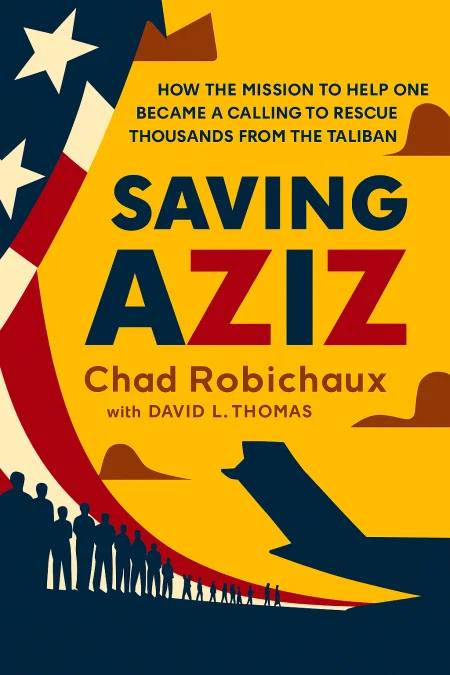
Saving Aziz
How the Mission to Help One Became a Calling to Rescue Thousands from the Taliban
byChad Robichaux, David Thomas
Book Edition Details
Summary
In the chaos of an Afghanistan collapsing back into the shadows, two warriors rise from the ashes of their shared past. "Saving Aziz" unfolds the harrowing tale of Chad Robichaux, a Force Recon Marine, and Aziz, his Afghan comrade who once safeguarded his life. As the U.S. abruptly exits, Chad faces a personal mission: rescue Aziz from the encroaching Taliban. What starts as a bond between brothers-in-arms evolves into a sweeping crusade that spotlights the humanity overshadowed by geopolitics. This gripping narrative transcends the battlefield, exploring themes of loyalty, sacrifice, and the extraordinary lengths one will travel to save a friend. Here lies a saga of courage and compassion that challenges indifference and celebrates the triumph of the human spirit against all odds.
Introduction
What would you do if your brother was trapped in enemy territory, hunted by terrorists who wanted to torture and kill him for helping you? This is the harrowing reality that faced Chad Robichaux, a former Force Recon Marine, when the Taliban regained control of Afghanistan in August 2021. His Afghan interpreter Aziz, who had saved his life multiple times during eight deployments, was now hiding with his family as the Taliban systematically hunted down anyone who had worked with American forces. This is a story that transcends military operations and political failures. It's about the unbreakable bonds forged in combat, the moral obligation we have to those who risked everything to stand beside us, and what happens when ordinary citizens are forced to do what their government won't. What began as one man's desperate mission to save his brother-in-arms evolved into the largest private rescue operation since World War II, ultimately saving over 17,000 lives from Taliban persecution. Through reading this account, you'll discover how crisis reveals character and how individual action can accomplish what bureaucracy cannot. You'll witness the power of international cooperation when people unite around shared humanity rather than political divisions. Most importantly, you'll understand that when faced with evil, silence and inaction are not options for those who claim to value human dignity and freedom.
When One Mission Becomes Thousands: The Aziz Rescue
The phone call that changed everything came in the early hours of August 15, 2021. Aziz's voice was different than Chad had ever heard it—the steady confidence of a seasoned warrior replaced by the trembling fear of a father watching his children's world collapse. "Brother, they are coming for us," Aziz whispered into his phone, describing how the Taliban had already captured and executed ten of their former teammates. The man who had once fearlessly walked point through Taliban territory, who had pulled Chad from burning vehicles and guided him through countless dangerous missions, was now hiding in basements with his wife and six children, moving every few hours to avoid capture. For six years, Chad had fought the bureaucratic maze of the Special Immigrant Visa process, trying to bring Aziz and his family to America legally. Despite letters from generals, documented proof of service, and clear evidence of the mortal danger Aziz faced for his work with American forces, the application remained stuck in an endless loop of missing paperwork and bureaucratic delays. The system designed to honor America's promise to those who served alongside our military had become a death sentence wrapped in red tape. As the Taliban systematically took control of Afghanistan's provinces with stunning speed, Chad realized that waiting for the government process meant watching his brother die. The time for official channels had passed. Within hours of Aziz's desperate call, Chad assembled a team of fellow special operations veterans, each driven by the same warrior code that had guided their service: leave no one behind. They would go to Afghanistan, not as soldiers this time, but as private citizens determined to honor promises their government had abandoned. When faced with bureaucracy that fails to match the urgency of human crisis, individual action becomes the only moral response. The bonds forged in combat carry obligations that transcend politics and paperwork. True loyalty means being willing to risk everything when those who stood beside you need you most, regardless of what official channels tell you is possible or proper.
Into the Fire: Ground Operations in Taliban Territory
The scene at Kabul's airport was unlike anything the seasoned operators had witnessed in decades of combat. Thousands of desperate Afghans pressed against Taliban checkpoints, holding crying babies above their heads, pleading with gunmen who beat them back with rifle stocks. The stench of fear, sweat, and death filled the air as families made impossible choices about who might have the best chance of reaching the gates alive. Taliban fighters, many of them freed prisoners from Bagram, roamed through the crowds identifying former interpreters and allies, dragging them away for public executions that served as warnings to others. Chad's team worked in shifts around the clock, establishing ratlines through the chaos. Tim Kennedy, the former Green Beret and UFC fighter, cut through fences and picked locks to create secret passages. Sean, the career Special Forces officer, coordinated with sympathetic US military personnel still inside the airport. Each rescue required split-second timing—a WhatsApp message to confirm location, a sprint through Taliban-controlled streets, a prayer that the person at the pickup point was who they claimed to be and not a Taliban trap. The team saved 150 people on their first day, including a young woman named Narna who was literally being dragged away by Taliban fighters when American special operators intervened just in time. The most heartbreaking aspect wasn't the danger they faced, but the impossible mathematics of rescue. For every successful extraction, dozens of desperate messages flooded their phones from people they couldn't reach in time. They developed a triage system based on urgency and documentation, but ultimately found themselves in the unbearable position of choosing who lives and who dies based on limited resources and time. Each rescue was a victory that felt like defeat because of the thousands they couldn't save. Crisis demands that we move beyond the paralysis of perfect solutions to take imperfect action. When systems collapse, individual courage and innovation become the difference between life and death for those depending on you. The military principle of accomplished over perfect becomes a moral imperative when human lives hang in the balance.
Against All Odds: Border Crossings and Desperate Escapes
After the last American flight left Kabul, Chad and Marine Staff Sergeant Dennis Price found themselves hiking through the mountains between Tajikistan and Afghanistan, mapping river crossing points for refugees still trapped inside Taliban territory. The Panj River, frigid from mountain snowmelt and patrolled by Chinese, Russian, and Taliban forces, represented the final barrier between captivity and freedom for thousands of Afghans. Chad and Dennis spent nights swimming across this river in near-freezing temperatures, dodging spotlights and sniper fire, measuring depths and currents to create detailed reports for families attempting the crossing with pregnant women and small children. The most harrowing moment came when they prepared to rescue an Afghan commando and his pregnant wife who had traveled for days through Taliban checkpoints to reach a predetermined crossing point. Everything that could go wrong did: their drivers abandoned them at the last minute, Russian military patrols increased, and electronic surveillance indicated their position had been compromised. As Chad and Dennis watched through night vision from across the river, the family waited behind a stone wall just yards away—so close they could have shouted to each other, yet separated by an impossible gulf of military force and international borders. The mission forced them to confront the brutal reality that good intentions and tactical skill cannot overcome every obstacle. The family had to return to Kabul, where the mother would give birth under Taliban rule. But the intelligence they gathered enabled other families to successfully escape through routes they mapped, proving that even failed missions can serve larger purposes. Their detailed reports of river depths, crossing points, and patrol patterns became life-saving information for other rescue organizations and families attempting the journey on their own. Sometimes the greatest victory lies not in the success of a single mission, but in creating the conditions for others to succeed. When direct action becomes impossible, gathering and sharing actionable intelligence can multiply your impact far beyond what you could accomplish alone. Courage is often measured not by dramatic success, but by the willingness to attempt what others consider impossible.
The Calling Continues: Lessons from Afghanistan's Fall
The wedding should have been the perfect respite from months of rescue operations, but as Chad walked his daughter down the aisle, his phone buzzed with messages from Maryam and Zahra, two young Afghan women whose pastor father had been murdered by the Taliban for his Christian faith. The sisters, aged 21 and 22, had fled to Pakistan where they remained hidden in a safe house, still hunted by networks that crossed international borders. Even at his daughter's wedding, the mission continued—because for those still trapped, there is no pause button on terror and persecution. The scope of need seemed to expand endlessly. The FIFA girls soccer team, ranging from 14 to 16 years old, faced forced marriage to Taliban fighters as "war brides." Abdul Wasi Sharifi, Afghanistan's premier MMA promoter, hid with his young daughters as the Taliban issued death threats for promoting a sport they considered too barbaric—a grotesque irony from an organization that publicly executed people for minor infractions. Each rescue revealed dozens more who needed help, creating an ever-expanding web of moral obligation that could easily consume a lifetime. What sustained the effort was the tangible reality of lives saved and families reunited. Watching children play freely in the UAE humanitarian center, seeing the relief in parents' eyes when they realized their daughters would never be sold into slavery, witnessing the profound gratitude of people who had lost everything except their lives—these moments provided the emotional fuel necessary to continue when the scale of remaining need threatened to overwhelm. Every person rescued represented not just an individual life saved, but a victory against the systematic evil that sought to crush human dignity. Moral clarity emerges when you focus on the individual faces behind overwhelming statistics. The work of justice requires both the strategic thinking to maximize impact and the personal commitment to never become numb to individual suffering. When you find yourself in a position to help, the question is not whether you can save everyone, but whether you will save the ones you can.
Summary
The greatest missions often begin with the simplest motivation: a promise to a friend who saved your life, and the refusal to let bureaucratic failure become a death sentence for those who trusted in American honor. Take action when systems fail the people they were designed to serve—individual courage can accomplish what institutional dysfunction cannot. Build networks of trust and capability before crisis strikes, because when emergency arrives, there is no time to develop the relationships and resources needed for effective response. Never underestimate the power of ordinary citizens united by shared moral purpose to achieve what governments claim is impossible, and remember that the bonds forged through shared sacrifice create obligations that transcend politics, nationality, and convenience. The work of rescue and justice is never finished, but every life saved, every family reunited, and every person freed from oppression proves that evil does not have the final word when good people choose to act. The calling continues not because we can save everyone, but because we can save someone, and that someone deserves our very best effort.
Related Books
Download PDF & EPUB
To save this Black List summary for later, download the free PDF and EPUB. You can print it out, or read offline at your convenience.
By Chad Robichaux
