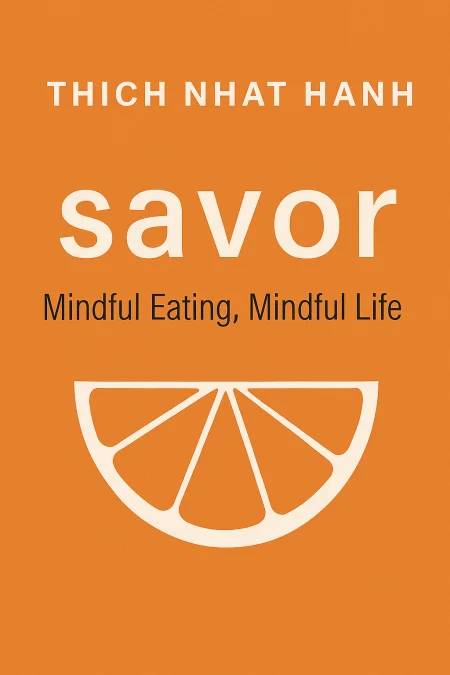
Savor
Mindful Eating, Mindful Life
Book Edition Details
Summary
A dance of mindfulness and nutrition awaits in "Savor," where Zen master Thich Nhat Hanh and Harvard's Dr. Lilian Cheung unveil a path to lasting well-being. Gone are the cycles of guilt and shame over diet missteps; here is a sanctuary where inner peace meets practical change. This isn't just another diet book; it's a harmonious blend of ancient wisdom and modern science, offering a transformative approach to weight loss. Through mindful living and personalized strategies, readers are gently guided to a state of consciousness that transcends mere physical health. Embrace the richness of every moment, and let this enlightening guide lead you to a life of balanced fulfillment and joy.
Introduction
Sarah stood in her kitchen at midnight, staring into the open refrigerator, its cold light illuminating her tear-streaked face. She had just finished another day of "perfect" eating, only to find herself here again, reaching for comfort in the familiar glow of processed foods. This wasn't about hunger—her body was satisfied from dinner hours ago. This was about something deeper, a disconnection between her mind, body, and the very act of nourishing herself. Like millions of others, Sarah had tried every diet, counted every calorie, and measured every portion, yet the struggle with weight remained as persistent as ever. What Sarah didn't realize was that her battle wasn't really with food at all. It was with mindfulness—or rather, the lack of it. In our fast-paced world, we've forgotten how to truly inhabit our bodies, to listen to their wisdom, and to eat with awareness and gratitude. We consume not just food, but experiences, emotions, and even our own thoughts in a state of unconscious autopilot. The ancient practice of mindfulness offers a revolutionary approach to weight management, one that doesn't rely on restriction or deprivation, but on awakening to the present moment and developing a compassionate relationship with ourselves and our nourishment. This journey toward mindful weight management isn't about perfection—it's about presence, discovering that when we eat with awareness, move with intention, and breathe with consciousness, our bodies naturally find their way to health and balance.
Breaking Free from Diet Culture Through Mindful Awareness
Maria had tried everything. The cabbage soup diet, the grapefruit cleanse, the no-carb revolution—each promising to be the final solution to her weight struggles. Yet here she was, twenty pounds heavier than when she started her first diet five years ago, sitting in a mindfulness workshop feeling defeated and hopeless. The teacher began by sharing an ancient story about a man riding a galloping horse, appearing to rush toward some urgent destination. When a bystander called out, "Where are you going?" the rider replied, "I don't know! Ask the horse!" The teacher explained that this horse represents our habit energy—the unconscious patterns that drive us through life, including our relationship with food and our bodies. Maria recognized herself in this story immediately. She had been riding the horse of diet culture for years, galloping from one quick fix to another, never stopping to ask where she was actually trying to go or why. The teacher introduced the Four Noble Truths as they apply to weight management: first, acknowledging that carrying excess weight causes suffering; second, understanding the root causes of this suffering; third, recognizing that healing is possible; and fourth, following a mindful path toward health. For the first time, Maria began to see that her weight wasn't the enemy—it was a teacher, pointing toward deeper patterns of disconnection and unconscious living. The path forward wasn't about finding the perfect diet or exercise routine. It was about stopping the runaway horse of habit energy and learning to live with awareness. When we approach weight management through the lens of ancient wisdom, we shift from fighting our bodies to befriending them, from seeking external solutions to cultivating internal wisdom. This compassionate framework offers an alternative to the cycle of restriction and rebellion that keeps so many trapped in an endless struggle with their weight.
Transforming Our Relationship with Food and Body Wisdom
Chef Sati invited his dinner guests to participate in an unusual experiment. Before serving the meal, he placed a single apple in each person's hands and asked them to eat it as if they had never tasted an apple before. The guests were instructed to examine its color, feel its weight, inhale its fragrance, and take the first bite with complete attention. What followed was a revelation. As they chewed slowly, savoring each bite, they began to taste not just the apple, but the sunshine that had ripened it, the rain that had nourished it, and the earth that had supported its growth. This simple apple became a gateway to understanding the interconnected web of life that brings all food to our tables. The dinner that followed was prepared entirely from plant-based ingredients, yet the dishes were so flavorful and satisfying that guests couldn't believe they contained no animal products. Chef Sati explained that mindful eating isn't just about what we consume, but how we consume it. When we eat with awareness, we naturally make choices that honor both our health and the health of our planet. We begin to see that every meal is an opportunity to practice gratitude, to connect with the natural world, and to nourish not just our bodies, but our souls. Even the act of washing dishes became a meditation, as guests learned to approach each plate with the same care they would use to bathe a beloved child. Through this experience, they discovered that mindfulness transforms every aspect of eating—from shopping and cooking to consuming and cleaning up. When we bring full attention to our meals, we find that we need less food to feel satisfied, we make healthier choices naturally, and we develop a profound appreciation for the miracle of nourishment that sustains all life.
Finding Balance Through Mindful Movement and Daily Practice
David had always viewed exercise as punishment for eating, a necessary evil to burn off calories and shrink his body into submission. His relationship with physical activity was fraught with judgment, comparison, and the constant pressure to achieve measurable results. Then he discovered walking meditation, a practice that transformed his understanding of what it means to move mindfully. Instead of rushing toward a destination, he learned to arrive with each step, to feel his feet connecting with the earth, and to synchronize his movement with his breath. As David practiced the walking meditation phrases—"I have arrived, I am home"—something profound shifted. His body was no longer an adversary to be conquered, but a wise companion to be honored. Each step became an opportunity to return to the present moment, to release the anxieties of the day, and to touch the peace that exists within. He began to extend this mindful approach to other forms of movement, finding meditation in gardening, dancing, and even simple stretching exercises. Physical activity transformed from a chore into a celebration of what his body could do. The practice revealed that mindful movement serves a purpose far beyond weight loss or fitness goals. When we move with awareness, we develop a deeper relationship with our bodies, learning to listen to their signals and respond with compassion rather than force. We discover that exercise can be a form of meditation in motion, a way to cultivate presence and gratitude for the miracle of embodied life. This shift in perspective naturally leads to more consistent, enjoyable, and sustainable patterns of physical activity that honor both our need for movement and our capacity for joy.
Creating Community Through Individual Awakening and Shared Nourishment
The story of how one person's mindfulness practice can ripple outward to create positive change is beautifully illustrated by the experience of a small community garden in an urban neighborhood. What began as a simple desire by residents to grow their own food evolved into a powerful example of how individual awakening can transform collective consciousness. The garden's founder, an elderly woman named Grace, had been practicing mindful eating and meditation for several years when she noticed the lack of fresh, affordable produce in her neighborhood. Rather than simply complaining about the problem, Grace applied the principles of mindfulness to community organizing. She began by listening deeply to her neighbors' concerns and dreams, creating space for authentic dialogue about food security, health, and connection. The garden became more than just a place to grow vegetables; it became a sanctuary where people could practice presence, share knowledge, and support one another's well-being. Children learned where their food comes from, families discovered the joy of cooking together, and elderly residents found purpose in passing down traditional growing wisdom. As the garden flourished, its influence extended beyond the immediate community. Local restaurants began sourcing produce from the garden, schools incorporated visits into their curriculum, and other neighborhoods started similar projects. The practice of mindful consumption that began with individual awareness had grown into a movement that addressed systemic issues of food justice, environmental sustainability, and social connection. Grace often reflected on how the simple act of paying attention to her own eating habits had led to such far-reaching change, understanding that transformation begins within each person but naturally extends outward when we recognize our fundamental interconnectedness.
Summary
The journey toward mindful weight management reveals a profound truth: our struggles with food and body image are invitations to awaken to a deeper way of living. Through the lens of ancient wisdom, we discover that lasting transformation comes not from external control or restriction, but from cultivating awareness, compassion, and presence in each moment. The stories of individuals who found freedom from diet culture remind us that suffering points toward healing, that understanding our patterns creates space for change, and that mindfulness offers a gentle yet powerful path forward. When we learn to eat with gratitude and awareness, we naturally make choices that nourish both our bodies and our planet. When we move with intention and presence, exercise becomes a celebration rather than a punishment. When we breathe with consciousness throughout our days, we develop the capacity to respond rather than react to life's challenges. These practices work together to create a sustainable approach to health that honors the interconnected nature of all life. The invitation is simple yet revolutionary: to stop riding the runaway horse of unconscious habits and instead choose to live with awareness. In doing so, we discover that the path to a healthy weight is also the path to a healthy life—one filled with presence, gratitude, and the deep satisfaction that comes from truly savoring each precious moment we are given.
Related Books
Download PDF & EPUB
To save this Black List summary for later, download the free PDF and EPUB. You can print it out, or read offline at your convenience.
By Thich Nhat Hanh
