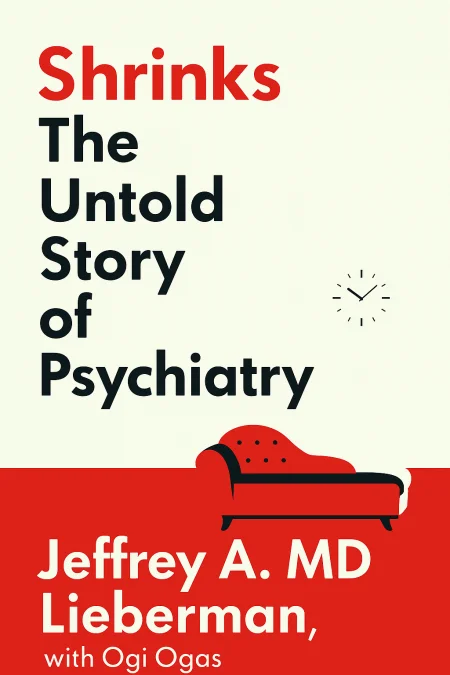
Shrinks
The Untold Story of Psychiatry
byJeffrey A. Lieberman, Ogi Ogas
Book Edition Details
Summary
A revolution in understanding awaits within the pages of "Shrinks," where the turbulent saga of psychiatry unfolds with relentless intrigue. Once dismissed as mere charlatans, the architects of mental health have clawed their way from the shadows of antiquated asylums to the forefront of medical science. In this riveting narrative, Jeffrey Lieberman, MD, former president of the American Psychiatric Association, guides us through the seismic shifts that have redefined a field once teetering on the brink of obsolescence. With each turn, Lieberman paints vivid portraits of trailblazers like Freud and Kandel, whose groundbreaking insights forged a path from stigma to salvation. "Shrinks" is not just a chronicle but a clarion call to perceive mental illness with the same gravity as physical ailments—a transformative perspective that promises to change lives.
Introduction
Few medical fields have undergone such dramatic transformation as psychiatry. Once dismissed as the "stepchild of medicine," populated by alienists who merely warehoused the mentally ill in asylums, psychiatry has evolved into a sophisticated science of the brain. This remarkable journey spans over two centuries of false starts, dangerous treatments, and revolutionary breakthroughs that fundamentally changed how we understand the human mind. The story begins in the early 1800s when mental illness was attributed to moral failings or mysterious magnetic forces. Patients endured treatments ranging from spinning chairs to ice-pick lobotomies, while practitioners debated whether madness originated in the soul or the brain. Through decades of scientific progress, bitter ideological battles, and the gradual accumulation of evidence, psychiatry finally emerged as a legitimate medical discipline capable of diagnosing and treating mental disorders with remarkable precision. This transformation reveals profound questions about human nature itself. How do we distinguish between normal quirks and pathological conditions? What role do biology, psychology, and social factors play in mental health? The answers illuminate not just the history of medicine, but the evolution of our understanding of what makes us human. Anyone interested in science, medicine, or the human condition will find this journey both fascinating and deeply relevant to our current debates about mental health.
From Mesmerism to Freudian Analysis: The Early Struggles
The early years of psychiatry were marked by desperate attempts to understand conditions that seemed to defy rational explanation. In the late 1700s, Franz Anton Mesmer pioneered the first systematic approach to mental illness, proposing that invisible magnetic forces flowing through the body could become disrupted, causing psychological disturbances. His treatment involved manipulating these supposed magnetic channels through touch and suggestion, often inducing dramatic "crises" that he claimed would restore mental balance. While Mesmer's theories seem absurd today, they represented a crucial shift from viewing mental illness as divine punishment to seeing it as a medical condition with treatable causes. This transition accelerated with Philippe Pinel's revolutionary work at Parisian asylums, where he literally unchained mental patients and advocated for humane treatment based on moral therapy rather than physical restraint. The real watershed came with Sigmund Freud's development of psychoanalysis in the early 1900s. Freud proposed that mental illness stemmed from unconscious conflicts rooted in childhood experiences and sexual development. His talking cure promised to unlock the mysteries of the mind through dream interpretation, free association, and the exploration of repressed memories. The elegance and apparent explanatory power of psychoanalytic theory captivated practitioners worldwide. However, this early period also revealed psychiatry's fundamental vulnerability to charismatic theories unsupported by evidence. From Mesmer's animal magnetism to Freud's Oedipal complexes, practitioners repeatedly embraced elaborate explanations that seemed profound but lacked scientific validation. This pattern of theoretical overreach would plague the field for decades, creating a reputation for unscientific speculation that psychiatry is still working to overcome.
The Discovery of Psychopharmacology and Brain Imaging
The most transformative period in psychiatric history began quite by accident in the 1950s. Henri Laborit, a French surgeon experimenting with compounds to reduce surgical shock, discovered that chlorpromazine had remarkable calming effects on patients. When psychiatrists tested this drug on psychotic patients, they witnessed something unprecedented: for the first time in history, a medication could directly reduce the hallucinations and delusions that had previously condemned patients to lifelong institutionalization. This breakthrough opened the floodgates for pharmaceutical research. Roland Kuhn's serendipitous discovery of imipramine created the first antidepressant, while John Cade's work with lithium provided the first effective treatment for manic-depressive illness. By 1960, psychiatrists possessed reliable medications for all three major categories of severe mental illness. The impact was immediate and profound: mental hospital populations began declining for the first time in over a century as patients returned to their communities. Parallel advances in brain imaging technology revolutionized psychiatric research. The development of CT scans in the 1970s, followed by MRI and PET scanning, finally allowed scientists to peer inside living brains and observe the structural and functional abnormalities associated with mental illness. These tools revealed enlarged ventricles in schizophrenic brains, hyperactive regions in depressed patients, and overactive fear circuits in anxiety disorders. Perhaps most importantly, psychopharmacology challenged the theoretical foundations of psychoanalysis. If mental illness truly stemmed from unconscious conflicts and childhood trauma, how could simple chemicals provide such dramatic relief? The success of medications suggested that mental disorders had biological underpinnings that could be targeted directly, setting the stage for psychiatry's transformation from a psychological discipline into a medical science.
Modern Psychiatry: Evidence-Based Practice and Future Promise
Contemporary psychiatry represents the culmination of two centuries of scientific progress. The development of the DSM-III in 1980 marked a pivotal moment when the field finally established reliable, symptom-based diagnostic criteria that could be used consistently across different practitioners and institutions. This diagnostic revolution, led by Robert Spitzer, rejected theoretical speculation in favor of observable evidence and created the foundation for modern psychiatric practice. Today's psychiatrists embrace what researchers call "pluralistic psychiatry" - an approach that simultaneously addresses biological, psychological, and social factors in mental illness. They use sophisticated brain imaging to understand neural abnormalities, prescribe precisely targeted medications, and employ evidence-based psychotherapies like cognitive-behavioral therapy that have been validated through rigorous clinical trials. The integration of neuroscience research has revealed the biological mechanisms underlying conditions like PTSD, while genetic studies are beginning to unlock the hereditary components of psychiatric disorders. The field continues to advance rapidly with promising developments in personalized medicine, brain stimulation therapies, and digital health applications. Researchers are developing genetic tests to guide medication selection, using smartphones to monitor patients' symptoms in real-time, and exploring how specific brain circuits can be targeted with magnetic stimulation or deep brain stimulation devices. Perhaps most importantly, modern psychiatry has achieved something that seemed impossible just decades ago: the ability to offer genuine hope for recovery. Patients with conditions that once guaranteed lifelong institutionalization can now expect to live productive, fulfilling lives with appropriate treatment. This transformation represents not just a medical achievement, but a profound expansion of human possibility.
Summary
The evolution of psychiatry reveals a fundamental tension between humanity's desire to understand the mind and the extraordinary complexity of mental phenomena. For nearly two centuries, the field oscillated between reductionist biological approaches and elaborate psychological theories, with each generation of practitioners convinced they had found the ultimate explanation for mental illness. The real breakthrough came when psychiatrists learned to embrace both perspectives simultaneously, recognizing that the mind and brain are inseparable aspects of human experience. This history offers profound lessons for navigating any field grappling with complex, poorly understood phenomena. First, maintain scientific humility - the most confident theories often prove most wrong. Second, prioritize evidence over elegance - effective treatments matter more than beautiful explanations. Third, embrace pluralistic approaches that integrate multiple perspectives rather than seeking single-cause explanations for multifaceted problems. The transformation of psychiatry from a scorned pseudoscience into a respected medical discipline demonstrates that even the most troubled fields can undergo fundamental renewal through persistent scientific effort. As we face current challenges in areas ranging from artificial intelligence to climate science, psychiatry's journey reminds us that progress requires both intellectual courage to challenge established paradigms and the patience to build knowledge incrementally through careful observation and rigorous testing.
Related Books
Download PDF & EPUB
To save this Black List summary for later, download the free PDF and EPUB. You can print it out, or read offline at your convenience.
By Jeffrey A. Lieberman
