
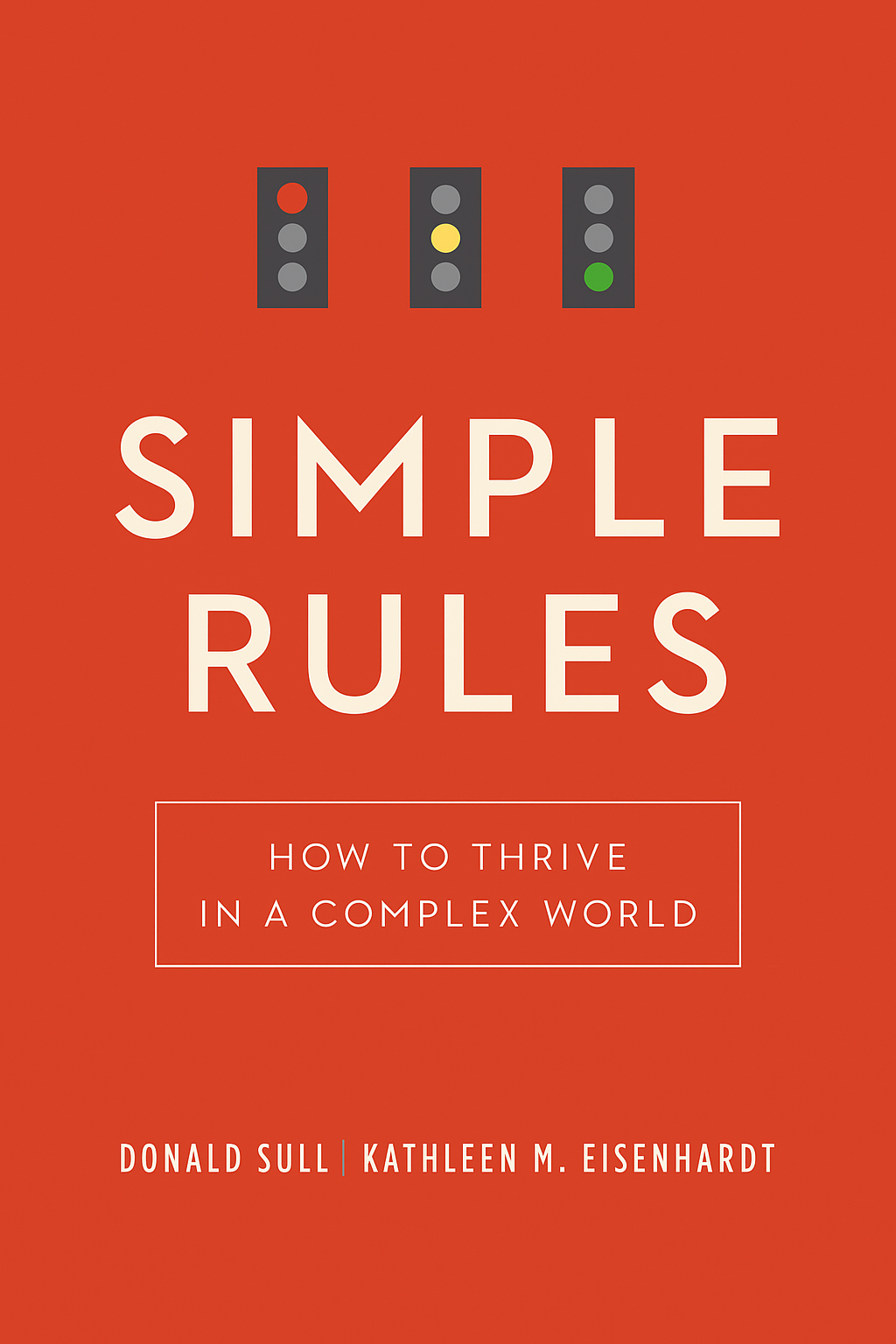
Simple Rules
How to Thrive in a Complex World
byDonald Sull, Kathleen M. Eisenhardt
Book Edition Details
Summary
Life teeters on a tightrope of chaos, and "Simple Rules" by Sull and Eisenhardt offers the balance pole. Buried beneath the mountain of emails and tangled regulations lies an elegant truth: simplicity is a scalpel cutting through the thicket of complexity. With wit and wisdom, the authors invite us on a journey where rules aren’t burdens but beacons—guiding creativity, efficiency, and sanity. Uncover the magic of six transformative rules, from Tina Fey's comedic commandments to the burglar's pragmatic principles, each crafted to turn disorder into clarity. This book isn't just about reducing complexity; it's a manifesto for thriving amid it, gifting readers the tools to conquer the chaos of modern life with grace and insight.
Introduction
In our increasingly complex world, we face an endless stream of decisions that can overwhelm even the most analytical minds. From choosing investment strategies to managing teams, from navigating career changes to maintaining relationships, the sheer volume of variables and potential outcomes can paralyze our decision-making abilities. Traditional approaches often suggest gathering more data, creating comprehensive plans, or developing sophisticated models to handle complexity. Yet research reveals a counterintuitive truth: the most effective decision-makers often rely on surprisingly simple guidelines that cut through complexity rather than match it with elaborate solutions. This framework of simple rules represents a fundamental shift in how we approach complex problems. Rather than attempting to anticipate every possible scenario or analyze every variable, simple rules provide just enough structure to guide effective action while maintaining the flexibility needed to adapt and seize opportunities. The theory demonstrates how a handful of well-crafted guidelines can outperform complex algorithms, lengthy procedures, and detailed regulations across diverse domains. These rules work not by eliminating complexity, but by helping us navigate it more effectively, focusing our attention on what matters most while filtering out distracting noise.
Why Simple Rules Work Better Than Complex Solutions
Simple rules succeed because they address three fundamental challenges that complex solutions often fail to overcome: they provide flexibility without chaos, improve decision quality under uncertainty, and enable coordination without central control. Unlike rigid procedures that attempt to dictate every action, simple rules establish boundaries within which judgment and creativity can flourish. They work by capturing the essential patterns that drive success while ignoring peripheral details that can overwhelm decision-makers. The effectiveness of simple rules stems from their ability to avoid the trap of overfitting to past circumstances. Complex models often perform poorly because they mistake noise for signal, incorporating random correlations that don't reflect genuine cause-and-effect relationships. Simple rules, by contrast, focus on the most critical variables that consistently matter across different scenarios. This selective focus prevents the paralysis that can result from trying to weigh dozens of factors simultaneously, while ensuring that the most important considerations receive appropriate attention. Perhaps most importantly, simple rules facilitate action rather than just analysis. Research consistently shows that people are more likely to follow guidelines they can easily remember and understand. When rules are too complex, individuals either ignore them entirely or become so focused on compliance that they lose sight of the underlying objectives. Simple rules strike the optimal balance between providing guidance and preserving the human capacity for judgment that remains essential in navigating unexpected situations. The power of simple rules becomes evident when we observe how they enable groups to coordinate effectively without requiring extensive communication or central planning. Just as birds in a flock can navigate complex aerial maneuvers by following a few basic guidelines about spacing and direction, teams and organizations can achieve sophisticated outcomes through the collective application of straightforward principles.
Six Types of Rules for Better Decisions and Actions
Effective simple rules fall into six distinct categories, each serving different purposes in the decision-making process. Boundary rules help distinguish between acceptable and unacceptable options, creating clear criteria for what to pursue and what to avoid. These rules act as filters, quickly eliminating possibilities that don't meet fundamental requirements while ensuring that attention focuses on viable alternatives. For instance, a venture capital firm might use boundary rules to screen investment opportunities based on market size, growth potential, or management experience. Prioritizing rules determine the order in which resources should be allocated when multiple good options compete for limited attention or funding. Unlike boundary rules that create binary choices, prioritizing rules establish hierarchies among acceptable alternatives. These rules prove especially valuable when facing resource constraints or time pressures, helping ensure that the most important opportunities receive attention first. A manufacturing company might prioritize production based on profit margins, customer strategic importance, or inventory levels. Stopping rules specify when to abandon a current course of action, preventing the escalation of commitment that often leads to throwing good money after bad. These rules counter the natural human tendency to persist with failing strategies, especially when significant resources have already been invested. Professional poker players, for example, use stopping rules to fold hands when the odds no longer justify continued betting, regardless of how much they've already wagered. How-to rules provide guidance on execution methods, offering structure for completing tasks while preserving flexibility in implementation. These rules capture best practices and proven approaches without becoming overly prescriptive procedural manuals. A software development team might use how-to rules for code reviews that ensure quality standards while allowing developers to apply their creativity and expertise. Coordination rules enable multiple actors to work together effectively without requiring constant communication or supervision. These rules establish expectations about how different parties will behave, making it possible to achieve collective outcomes through individual actions. Online marketplaces, for instance, use coordination rules to help buyers and sellers interact smoothly despite never meeting face-to-face. Timing rules determine when to take specific actions, recognizing that the same decision can yield very different outcomes depending on its timing. These rules can be based on external events, calendar schedules, or sequential dependencies. A pharmaceutical company might use timing rules to determine when to advance drug candidates through different phases of clinical trials based on safety data and regulatory requirements.
Creating and Improving Your Personal Simple Rules
Developing effective simple rules begins with clarity about objectives and identifying the specific bottlenecks that prevent achieving those goals. Rather than trying to create rules that address everything at once, the most successful approach involves focusing on a single critical activity or decision that significantly impacts outcomes. This requires honest assessment of where current approaches fall short and which activities consume disproportionate time or energy relative to their results. The process starts with defining what success looks like in concrete, measurable terms. Vague aspirations like "being healthier" or "improving relationships" must be translated into specific outcomes such as "exercising four times per week" or "having meaningful conversations with family members daily." This specificity makes it possible to identify the particular behaviors or decisions that most influence whether these outcomes are achieved. Once the critical bottleneck is identified, effective rules emerge from systematic analysis of past experience, research into proven approaches, and insights from others who have succeeded in similar situations. The most powerful rules often come from combining these sources, using personal experience to customize general principles for specific circumstances. For example, someone developing rules for better time management might combine research on productivity with analysis of their own daily patterns and advice from successful colleagues. Testing and refinement represent crucial phases often overlooked in rule development. Initial rules rarely prove optimal and should be treated as hypotheses to be validated through experience. This requires establishing metrics to track progress and regularly reviewing whether the rules are producing desired outcomes. Successful rule users maintain flexibility, adjusting their guidelines as circumstances change or as they gather new evidence about what works best. The improvement process follows predictable patterns, with rules typically becoming more strategic and abstract over time as understanding deepens. Early rules often focus on obvious, surface-level factors, while mature rules capture subtler patterns that prove more widely applicable. This evolution requires patience and systematic reflection, as the most powerful insights often emerge only after extended experience with preliminary versions.
Breaking Rules When Disruption Demands Change
Even the most effective simple rules eventually become obsolete when circumstances change dramatically. Recognizing when to abandon existing rules and develop new ones represents one of the most challenging aspects of rule-based decision-making. This challenge intensifies because successful rules can create psychological investment, making it difficult to acknowledge when they no longer serve their intended purpose. Major disruptions often reveal the limitations of current rules by changing the fundamental assumptions on which they were based. A company's customer acquisition rules may become ineffective when new technologies alter how people discover and evaluate products. Personal financial rules developed during stable economic periods may prove inadequate during market volatility. The key lies in distinguishing between temporary setbacks that require patience and fundamental shifts that demand new approaches. Breaking existing rules successfully requires deep understanding of the changed environment rather than superficial reactions to new circumstances. This involves studying the underlying forces driving change and their implications for previously successful strategies. Simply abandoning old rules without understanding why they no longer work often leads to ineffective replacements that fail to address the new reality. The process of rule replacement works best when approached systematically, treating the transition as an opportunity to apply lessons learned from previous rule development experiences. Rather than attempting to modify existing rules incrementally, which often creates awkward compromises between old and new approaches, complete replacement usually proves more effective. This requires courage to abandon familiar methods and tolerance for the temporary performance decline that typically accompanies major transitions. Successful rule breakers also recognize that disruption can be proactive rather than merely reactive. Instead of waiting for external forces to invalidate current approaches, they actively seek opportunities to change the game by focusing on neglected aspects of their situation that could become competitive advantages. This forward-looking perspective transforms rule-breaking from a defensive response to disruption into an offensive strategy for creating new possibilities.
Summary
The most profound insight from simple rules theory is that complexity is best conquered not by matching it with complicated solutions, but by identifying the essential patterns that drive success and translating them into actionable guidelines that preserve human judgment while providing clear direction. This approach represents a fundamental shift from the prevailing assumption that complex problems require complex solutions, demonstrating instead that well-designed simplicity can outperform sophisticated alternatives across virtually every domain of human activity. The theory's enduring significance lies in its potential to transform how individuals, organizations, and societies navigate an increasingly complex world, offering a path toward more effective decision-making that enhances rather than replaces human capabilities.
Related Books
Download PDF & EPUB
To save this Black List summary for later, download the free PDF and EPUB. You can print it out, or read offline at your convenience.
By Donald Sull
