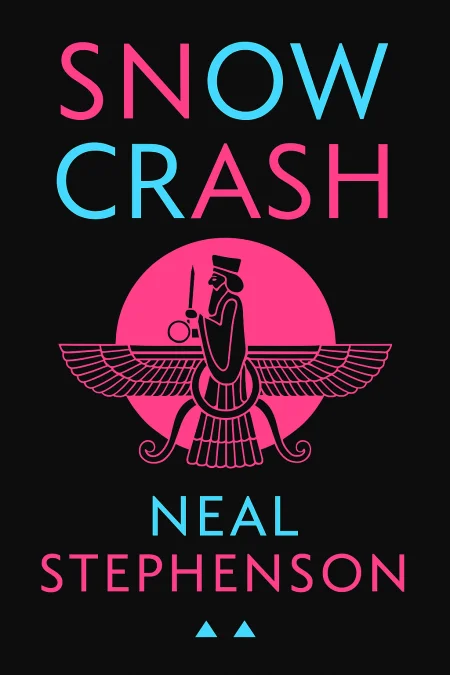
Snow Crash
Enter the Virtual World With This Cyberpunk Epic
Book Edition Details
Summary
In the realm of pixels and code, where neon dreams flicker against the backdrop of a dystopian future, Hiro Protagonist isn't just a name—it's a destiny. By day, Hiro slices through urban chaos delivering pizzas with the precision of a samurai’s blade. By night, he roams the digital expanse of the Metaverse as a formidable warrior. But when a mysterious virus named Snow Crash begins its insidious spread, collapsing minds in both the physical and virtual worlds, Hiro must partner with the audacious skateboard courier, Y.T., to untangle a conspiracy woven from ancient myth and digital peril. This techno-thriller unravels a reality that is unnervingly familiar yet extraordinarily twisted—a quintessential cyberpunk odyssey that challenges the boundaries of technology, identity, and survival.
Introduction
What happens when a simple pattern of black and white pixels on your computer screen can literally crash your mind? In our hyperconnected age, we've become so integrated with digital systems that the boundary between human consciousness and machine code has begun to dissolve in ways we barely comprehend. Every day, we process thousands of digital signals, algorithmic recommendations, and viral content without questioning how this constant stream of information might be rewiring our neural pathways and reshaping our capacity for independent thought. This exploration reveals the hidden mechanisms by which information itself becomes weaponized, transforming from neutral data into active agents of consciousness manipulation. You'll discover how ancient patterns of linguistic control have evolved into sophisticated digital warfare, why the very technologies designed to connect us might be making us more vulnerable to mental programming, and how corporate and political powers exploit our neurological vulnerabilities through carefully crafted information campaigns. Most crucially, you'll learn to recognize the subtle signs of cognitive manipulation and develop the mental defenses necessary to preserve your autonomy in an age where your attention, beliefs, and decision-making processes have become the ultimate battleground for competing forces seeking to control human civilization.
The Deliverator's Fall: When Perfect Systems Breed Perfect Failures
Hiro Protagonist speeds through the fractured landscape of corporate America, his sleek delivery car cutting through traffic as the digital timer on his dashboard counts down mercilessly. As a Deliverator for CosaNostra Pizza, he belongs to an elite brotherhood bound by an sacred oath: thirty minutes or less, or the customer receives their order free. Tonight, everything that can go wrong does go wrong. A malfunctioning piece of equipment at the franchise delays his pickup by precious minutes, traffic algorithms route him into an unexpected construction zone, and his high-tech vehicle's guidance system leads him directly into a suburban maze where his car ultimately crashes into an empty swimming pool, ending his career in a spectacular explosion of twisted metal and shattered dreams. The crash represents far more than one man's professional downfall. In this hyper-franchised world where every aspect of life has been optimized, systematized, and reduced to measurable performance metrics, Hiro's failure cascades through interconnected networks of surveillance and evaluation. The same sophisticated tracking technology designed to ensure quality service becomes the instrument that documents his inadequacy and seals his fate. His employer's digital monitoring systems, which promised to support and enhance human performance, instead become the mechanism of his professional execution. This scenario illuminates a fundamental vulnerability in our technology-dependent society: the more we integrate our lives with systems that demand perfection, the more catastrophic our inevitable human failures become. When we allow our survival to depend on maintaining flawless performance within technological frameworks designed by others, we surrender our resilience and adaptability. The key insight is not to reject technological assistance, but to maintain multiple pathways to success and never allow any single system to become so critical to your wellbeing that its failure would destroy you completely. Always cultivate skills, relationships, and resources that exist independently of the platforms and networks that currently sustain you.
Snow Crash Virus: How Ancient Code Hacks Modern Minds
Da5id stares at the mysterious hypercard called Snow Crash, its surface flickering with what appears to be random static—meaningless black and white pixels dancing across the screen. Within moments of focusing on this seemingly innocuous pattern, his avatar begins convulsing violently in the virtual nightclub, and in the physical world, paramedics find his body collapsed beside his computer, his consciousness trapped in a catatonic state that no conventional medicine can explain. The static wasn't random at all, but a carefully engineered sequence of visual information designed to exploit the deep neurological pathways that hackers develop through years of programming intensive work. The Snow Crash virus represents the ultimate convergence of information warfare and biological vulnerability. Unlike traditional computer viruses that merely corrupt data, this digital pathogen attacks the fundamental structures of human consciousness by overwhelming the visual cortex with binary patterns that trigger cascade failures in the brain's language processing centers. The virus works because expert programmers literally rewire their neural architecture through years of thinking in code, creating new pathways that make them susceptible to informational attacks that would be harmless to non-technical individuals. Investigation reveals that this weapon has ancient origins, tracing back to Sumerian priest-kings who understood that language itself could function as a form of mental programming. These early civilizations developed what they called "me"—linguistic formulas that could bypass conscious thought and directly program human behavior, from simple tasks like bread-making to complex social rituals. The biblical story of the Tower of Babel wasn't about divine punishment for human pride, but about the release of a counter-virus that shattered humanity's shared linguistic programming and forced people to think independently for the first time in history. This revelation should terrify anyone who spends significant time interfacing with digital systems, social media platforms, or algorithmic content feeds. Our increasing integration with information technology creates new vulnerabilities that we barely understand, as our neural pathways adapt to process digital information in ways that can be exploited by those who understand how consciousness responds to specific patterns of data. The lesson is not to fear technology, but to maintain awareness of how digital experiences shape your thinking patterns and to diversify your mental inputs to prevent any single information source from gaining excessive influence over your cognitive processes.
The Raft Conspiracy: Corporate Control Through Digital Religion
L. Bob Rife surveys his empire from the command center of his media conglomerate, controlling vast networks of fiber optic cables that carry the world's information while orchestrating the most audacious corporate takeover in human history. Floating on the Pacific Ocean, a massive agglomeration of refugee boats called the Raft carries millions of desperate people toward American shores, but these aren't ordinary asylum seekers. Rife has systematically infected many of them with both biological and memetic versions of the Snow Crash virus through his network of Reverend Wayne's Pearly Gates franchises, transforming them into programmable human resources who respond to his transmitted commands with religious fervor. The refugees experience genuine spiritual awakening as they speak in tongues and feel divine presence, not realizing that their ecstatic religious experiences are actually symptoms of neurological programming. Rife's genius lies in recognizing that the most effective form of control doesn't feel like control at all—it satisfies real human needs for meaning, community, and transcendence while gradually eroding the capacity for independent thought. The combination of economic desperation, social isolation, and neurological vulnerability creates perfect conditions for mass programming, turning humanitarian crisis into strategic weapon. By the time the Raft reaches American shores, Rife commands an army of millions who will carry out his instructions with unwavering devotion, believing themselves to be instruments of divine will rather than corporate assets. His followers aren't suffering in any conventional sense—they're content, even blissful, in their simplified state of consciousness, freed from the burden of complex decision-making and the anxiety of uncertainty. In exchange, they've surrendered the very thing that makes them human: their capacity for independent thought and moral reasoning. This scenario reveals how humanitarian crises can be weaponized, how spiritual hunger can be exploited for political ends, and how the most vulnerable populations often become the instruments of their own oppression. The most dangerous forms of control are those that satisfy genuine human needs while hiding their true cost. When authority figures provide meaning, belonging, and security, questioning their methods becomes not just difficult but seemingly ungrateful and self-destructive. Recognize that any system demanding uniformity of thought or expression, especially one that promises belonging and purpose in exchange for compliance, represents a potential threat to your mental autonomy.
Breaking Babel: Cognitive Diversity as Liberation
In the climactic confrontation, Hiro discovers that the ancient Sumerian god Enki—history's first hacker—had created not just the original linguistic programming system but also its antidote. Hidden in cuneiform tablets that Rife had excavated and hoarded, the nam-shub of Enki contains active code that can still reprogram minds in the present day, breaking Snow Crash's hold over human consciousness by restoring linguistic and cognitive diversity. When Y.T., despite being captured and held hostage, manages to steal the crucial tablet and deliver it to Hiro at the moment of greatest need, her act of individual courage disrupts even the most carefully planned system of mass control. The final battle takes place simultaneously in the physical world and cyberspace, as Hiro races to broadcast Enki's counter-virus before Rife can complete his invasion. When the ancient code activates, its effects are immediate and dramatic: the programmed refugees suddenly begin speaking in their original languages instead of the unified tongue that had made them controllable. The spell breaks, the invasion collapses, and Rife's empire crumbles as his human drones regain their capacity for independent thought and cultural identity. The resolution reveals that the most powerful weapon against mental control isn't superior technology or greater force, but the restoration of diversity in how people think, communicate, and understand reality. When individuals can process information through different linguistic frameworks, maintain different cultural perspectives, and express themselves in multiple ways, they become immune to any single system of programming. The confusion of tongues that seemed like humanity's curse turns out to be its greatest protection against tyranny. This victory carries profound implications for our current digital age, where algorithmic feeds and viral content increasingly homogenize how people think and communicate. The antidote to memetic warfare and consciousness manipulation isn't better filters or stronger defenses, but the deliberate cultivation of cognitive diversity and the preservation of multiple ways of understanding the world. The greatest threat to mental freedom isn't external control but internal homogenization—the gradual convergence toward a single way of processing information and making sense of reality.
Summary
The ultimate revelation cuts to the core of human consciousness: in an age where information travels at light speed and viral content can reshape entire societies overnight, whoever controls the programming language of human thought controls reality itself. The most insidious forms of mental control don't announce themselves as oppression but disguise themselves as convenience, community, and spiritual fulfillment while gradually eroding our capacity to think independently and question the systems that shape our daily experience. Cultivate cognitive diversity by deliberately exposing yourself to different languages, cultures, and ways of thinking, as your mental immune system depends on this variety to resist homogenization and manipulation. Question any system that demands uniformity of thought or expression, especially when it promises belonging and purpose in exchange for compliance, and maintain multiple independent sources of meaning and identity that exist outside digital platforms and algorithmic feeds. Most importantly, remember that the price of mental freedom is constant vigilance against those who would hack your consciousness for their own ends, whether they present themselves as spiritual leaders, corporate innovators, or social media influencers promising to make sense of an increasingly complex world.
Related Books
Download PDF & EPUB
To save this Black List summary for later, download the free PDF and EPUB. You can print it out, or read offline at your convenience.
By Neal Stephenson
