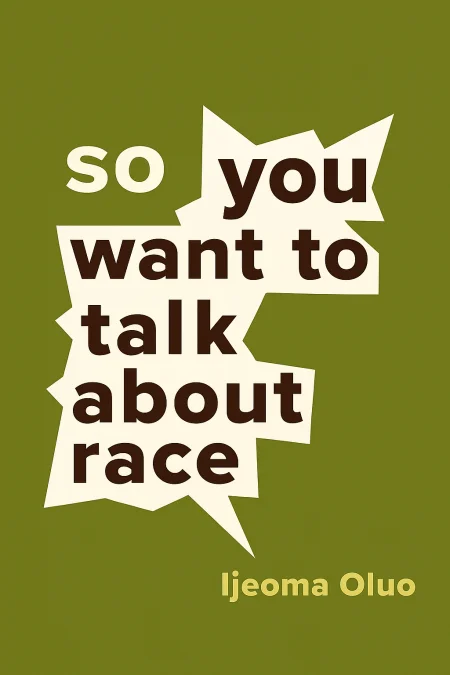
So You Want to Talk About Race
An examination of the complex system of racism in the United States
Book Edition Details
Summary
In "So You Want to Talk About Race," Ijeoma Oluo fearlessly untangles the intricate tapestry of racial dynamics in America with a wit that disarms and a clarity that illuminates. Delving into the uncomfortable truths of white privilege, police brutality, and micro-aggressions, Oluo offers a lifeline for those eager to engage in meaningful conversations about race. Her candid exploration doesn't just inform—it empowers readers to confront systemic injustice with newfound understanding. A voice as incisive as it is compassionate, Oluo stands alongside luminaries like Ta-Nehisi Coates and Roxane Gay, crafting a guide that is both a call to action and a bridge across the chasm of racial misunderstanding. This is not just a book—it's a catalyst for change.
Introduction
Race remains one of the most challenging and divisive topics in contemporary American society, yet avoiding these conversations perpetuates the very systems of oppression that demand our urgent attention. The reluctance to engage with racial issues stems not from malice but from a fundamental lack of framework for understanding how racism operates as a pervasive system rather than merely individual prejudice. This systemic nature of racial oppression manifests in every institution, from education and healthcare to criminal justice and employment, creating cumulative disadvantages that span generations. The approach taken here moves beyond surface-level discussions of good intentions and individual bias to examine the structural mechanisms that maintain racial hierarchies. Through personal narratives interwoven with institutional analysis, readers encounter both the lived reality of racial oppression and the systemic forces that enable its persistence. The methodology combines intersectional analysis with practical guidance, recognizing that meaningful change requires both deep understanding and actionable strategies. This examination challenges readers to move past defensive reactions toward productive engagement with uncomfortable truths. The goal extends beyond mere awareness to equip individuals with tools for dismantling racist systems in their daily lives, workplaces, and communities. Success demands confronting the ways privilege operates invisibly while developing genuine empathy for experiences vastly different from one's own.
Understanding Systemic Racism: Power, Privilege, and Intersectionality
Systemic racism operates as a comprehensive network of policies, practices, and cultural norms that create and maintain racial hierarchies across all social institutions. Unlike individual prejudice, which involves personal attitudes and beliefs, systemic racism functions through institutional power structures that consistently produce racially disparate outcomes regardless of individual intentions. This distinction proves crucial because addressing systemic racism requires examining how institutions operate rather than simply focusing on changing hearts and minds. The concept of privilege emerges as a key analytical tool for understanding how advantages accrue to some groups while others face systematic barriers. White privilege operates not as a guarantee of success but as freedom from race-based obstacles that consistently impede people of color. This privilege manifests in countless daily interactions, from assumptions about competence and belonging to access to opportunities and networks. Recognizing privilege requires moving beyond defensive reactions to examine honestly how one's social position provides unearned advantages. Intersectionality provides the framework for understanding how multiple identity categories interact to create unique experiences of oppression and privilege. A Black woman faces discrimination that differs qualitatively from both racism directed at Black men and sexism experienced by white women. Her experience cannot be understood simply by adding together separate forms of oppression but requires recognizing how race and gender intersect to create distinct challenges and barriers. The power of intersectional analysis lies in its ability to reveal how systems of oppression reinforce each other while highlighting the experiences of those most marginalized within marginalized communities. This approach prevents oversimplified solutions and ensures that efforts toward equality address the needs of those facing multiple forms of discrimination rather than only those with the most privilege within oppressed groups.
Manifestations of Racial Oppression: Education, Police, and Cultural Appropriation
The school-to-prison pipeline exemplifies how racial bias operates through seemingly neutral institutional processes to produce devastating outcomes for students of color. Black students face suspension and expulsion at rates dramatically higher than their white counterparts, often for subjective infractions like "disrespect" or "defiance." These disparities cannot be explained by differences in behavior but reflect how educators interpret and respond to student actions through racialized lenses that view Black children as more threatening and less deserving of patience and understanding. Zero-tolerance policies amplify these biases by removing discretion and mandating punitive responses to minor infractions. The presence of police officers in schools further criminalizes normal childhood behavior, transforming disciplinary issues into legal matters. Students who are suspended or expelled fall behind academically, lose connection to school communities, and face increased likelihood of future involvement with the criminal justice system. This pipeline systematically funnels young people of color away from educational opportunities and toward incarceration. Police brutality represents another manifestation of systemic racism, rooted in the historical role of law enforcement as controllers of Black bodies rather than protectors of Black communities. The disparate rates at which people of color are stopped, searched, arrested, and killed by police reflect institutional biases embedded in training, policies, and culture. These statistics cannot be dismissed as coincidental but reveal how implicit bias combines with qualified immunity and police union protection to create a system where Black and brown lives are consistently devalued. Cultural appropriation operates as a more subtle form of racial oppression, allowing dominant groups to profit from and receive credit for cultural innovations created by marginalized communities. When white artists adopt elements of Black culture, they often gain mainstream acceptance and financial success that remains elusive for Black creators of those same cultural forms. This dynamic reinforces existing power hierarchies while erasing the cultural contributions of communities that continue to face discrimination.
Addressing Common Objections and Defensive Reactions to Racism Discussions
Conversations about racism often derail when participants prioritize comfort over truth, demanding that discussions of oppression remain polite and non-threatening to those who benefit from existing systems. Tone policing emerges as a common deflection tactic, shifting focus from the substance of racial grievances to the manner in which they are expressed. This demand for palatability places an additional burden on those experiencing oppression to manage the emotions of those who perpetuate it, effectively silencing legitimate anger and frustration. The mythology surrounding historical figures like Martin Luther King Jr. serves to sanitize the radical nature of civil rights activism, creating false dichotomies between "good" and "bad" approaches to fighting racism. This sanitized version of history suggests that racial progress comes through polite requests rather than sustained pressure and disruption. Contemporary activists who employ direct action or express anger at injustice are dismissed as divisive, while the sanitized memory of past movements is used to delegitimize present struggles. Microaggressions represent the daily accumulation of small insults and invalidations that people of color endure, each individual incident easily dismissed as insignificant while the cumulative effect proves psychologically and professionally damaging. These interactions reinforce broader systems of oppression by constantly reminding people of color that they do not fully belong in mainstream spaces. The tendency to minimize microaggressions reflects a broader pattern of dismissing the experiences of marginalized people when those experiences challenge comfortable assumptions about fairness and equality. Defensive reactions to being called racist reveal how investment in a positive self-image can prevent genuine learning and growth. The fear of being labeled racist often proves more powerful than concern about perpetuating racist harm, leading to explosive reactions that center the accused person's feelings rather than the impact of their actions. Moving past defensiveness requires accepting that everyone raised in a racist society has internalized racist ideas and that being called out represents an opportunity for growth rather than a character assassination.
From Conversation to Action: Moving Beyond Talk Toward Real Change
While conversations about race provide necessary foundation for understanding, they cannot substitute for concrete action to dismantle oppressive systems. The comfortable distance of discussion allows people to feel engaged with racial justice without risking anything or challenging power structures in meaningful ways. Genuine commitment requires moving beyond the satisfaction of saying the right things to the discomfort of disrupting systems that provide privilege to some at the expense of others. Effective action begins locally, where individual influence can create measurable impact. Voting in local elections, attending school board meetings, and engaging with city council proceedings provide opportunities to influence policies that directly affect community members. These venues often lack the attention given to national politics while possessing significant power over issues like police budgets, school funding, and housing development. Sustained local engagement can produce concrete victories while building skills and networks for larger struggles. Economic action through spending choices, investment decisions, and workplace organizing leverages the power that individuals possess as consumers and workers. Supporting businesses owned by people of color, divesting from companies that profit from oppression, and pressuring employers to address discriminatory practices transforms daily economic activity into tools for social change. Labor unions provide particular leverage for addressing workplace discrimination while building solidarity across racial lines. The goal extends beyond individual behavior modification to systemic transformation that makes equality the default rather than the exception. This requires building coalitions across difference, developing political power within existing institutions, and creating alternative structures that embody justice values. Success depends on understanding that racial oppression operates through systems that require collective action to dismantle, not individual virtue to overcome.
Summary
The fundamental insight driving this examination is that racism in America operates as an interlocking system of institutional practices, cultural norms, and individual behaviors that maintains white supremacy through both explicit exclusion and subtle bias, requiring not just awareness but sustained collective action to dismantle. The analytical framework provided demonstrates how seemingly separate issues connect through common roots in racialized power structures, while the practical guidance offers concrete steps for moving from understanding toward meaningful change in daily life and community engagement.
Related Books
Download PDF & EPUB
To save this Black List summary for later, download the free PDF and EPUB. You can print it out, or read offline at your convenience.
By Ijeoma Oluo
