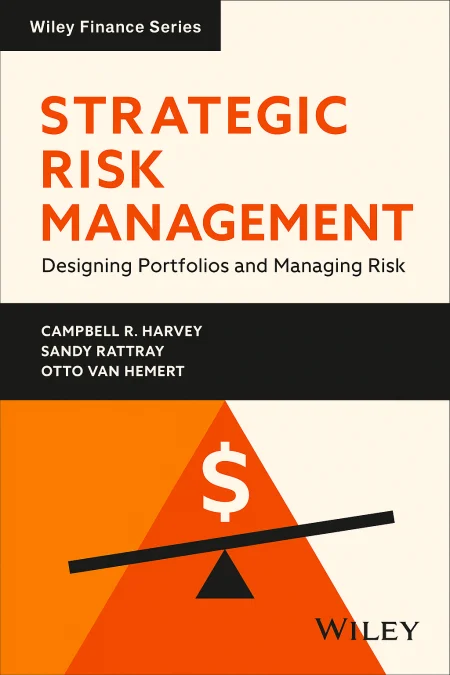
Strategic Risk Management
Designing Portfolios and Managing Risk
byCampbell R. Harvey, Sandy Rattray, Otto Van Hemert
Book Edition Details
Summary
In a world where financial storms loom large, "Strategic Risk Management" emerges as a beacon for modern investors navigating turbulent markets. Campbell R. Harvey, Sandy Rattray, and Otto Van Hemert unravel the traditional dichotomy between investment and risk management, proposing a groundbreaking synthesis that transforms risk from a mere oversight into a strategic ally. This innovative framework, honed at the renowned Man Group, integrates defensive tactics and volatility controls into the core of portfolio design. Learn the art of balancing risk and reward as you explore real-world applications that proved resilient amid the COVID-19 market upheaval. Perfect for asset managers, policymakers, and proactive investors alike, this book is a call to revolutionize how risk is perceived and managed in today's dynamic financial landscape.
Introduction
How can investors navigate the treacherous waters of financial markets while protecting their wealth during inevitable downturns? This fundamental challenge has intensified as traditional risk management approaches repeatedly fail when protection is most desperately needed. The conventional wisdom of static diversification and buy-and-hold strategies often crumbles precisely when markets experience their most severe stress, leaving investors exposed to devastating losses that can take years to recover from. The framework presented here revolutionizes risk management by introducing dynamic strategies that adapt to changing market conditions rather than maintaining rigid positions. At its core lies the concept of crisis alpha, strategies that generate positive returns during market turmoil while contributing to long-term performance. This approach integrates volatility targeting mechanisms that automatically adjust position sizes based on market stress levels, creating portfolios that breathe with market conditions rather than fighting against them. The theoretical foundation addresses three transformative questions that reshape modern portfolio construction. How can time-series momentum strategies provide option-like protection without the crushing cost of premium decay? What role should volatility play in determining optimal position sizes rather than maintaining static allocations that ignore changing risk levels? How can strategic rebalancing and systematic drawdown controls create portfolios that not only survive market crises but potentially thrive during periods when traditional approaches fail most spectacularly?
Crisis Alpha and Time-Series Momentum Strategies
Crisis alpha represents a paradigm shift from viewing protection as a necessary cost to recognizing it as a potential source of returns. This concept challenges the fundamental assumption that investors must sacrifice long-term performance to achieve downside protection, instead identifying strategies that naturally generate positive returns precisely when traditional portfolios suffer their worst losses. Time-series momentum forms the backbone of crisis alpha implementation, systematically capturing trends across multiple asset classes and timeframes. The strategy operates by analyzing price movements over various lookback periods, typically combining short-term signals of one to four months with longer-term patterns spanning nine to twelve months. This multi-timeframe approach creates a sophisticated trend detection system that can identify both rapid market dislocations and gradual structural shifts in asset prices. The mathematical elegance of momentum strategies lies in their ability to replicate option-like payoffs without paying option premiums. During market crises, these strategies automatically reduce exposure to declining assets while potentially increasing positions in safe-haven instruments. Consider the 2008 financial crisis, where traditional diversified portfolios suffered as correlations spiked toward unity. Momentum strategies systematically reduced equity exposure as markets declined while maintaining or increasing positions in government bonds, providing natural portfolio protection through dynamic rebalancing. The power of crisis alpha extends beyond equity markets to encompass bonds, currencies, and commodities, creating truly diversified protection mechanisms. When interest rates rise rapidly, momentum strategies reduce duration exposure. When currencies experience sharp directional moves, they position accordingly. This adaptability proves particularly valuable in an uncertain world where the next crisis may emerge from unexpected quarters, whether geopolitical tensions, pandemic disruptions, or technological upheavals that traditional hedging approaches cannot anticipate or address effectively.
Volatility Targeting and Dynamic Portfolio Construction
Volatility targeting fundamentally transforms portfolio construction by maintaining consistent risk levels rather than constant notional exposures, recognizing that market volatility varies dramatically across different regimes. This approach acknowledges that a portfolio maintaining fixed position sizes experiences wildly fluctuating risk levels as market conditions change, creating suboptimal outcomes during both calm and turbulent periods. The implementation mechanism involves scaling position sizes inversely to recent volatility estimates, effectively reducing exposure when markets become turbulent and increasing exposure during calm periods. When an asset's volatility doubles, the strategy halves the position size to maintain consistent risk contribution. This creates natural momentum-like behavior, as volatility spikes typically coincide with negative returns, causing the strategy to automatically reduce exposure to declining assets while increasing exposure during favorable conditions. The theoretical foundation exploits the persistent nature of volatility clustering, where high volatility periods tend to be followed by continued elevated volatility, while low volatility environments typically persist. This persistence makes recent volatility a valuable predictor of near-term risk levels, enabling more sophisticated position sizing decisions than static allocation approaches. The strategy works particularly well for risk assets like equities and credit, which exhibit negative correlations between returns and volatility changes. Real-world applications demonstrate volatility targeting's practical value across various market environments. During the 2020 COVID-19 market crash, portfolios using volatility targeting automatically reduced equity exposure as volatility spiked to unprecedented levels, providing natural downside protection. Conversely, during the remarkably calm markets of 2017, these same portfolios increased exposure to capture available upside potential. This dynamic adjustment occurs systematically without requiring subjective market timing decisions, making it particularly valuable for institutional investors who must justify their risk management approaches to stakeholders and regulatory authorities.
Strategic Rebalancing and Drawdown Control Mechanisms
Strategic rebalancing challenges the conventional wisdom that mechanical rebalancing to fixed portfolio weights represents optimal portfolio maintenance, recognizing that traditional approaches can amplify losses during trending markets. While rebalancing prevents portfolio drift and maintains diversification benefits, it introduces negative convexity that systematically forces investors to buy declining assets and sell appreciating ones, potentially magnifying losses during extended market downturns. The negative convexity inherent in mechanical rebalancing creates a payoff profile similar to selling straddle options on relative asset performance, benefiting from mean reversion but suffering during persistent trends. This characteristic becomes particularly problematic during crisis periods when asset correlations increase and trends persist longer than normal market conditions. Strategic rebalancing addresses these limitations by incorporating trend-following signals into rebalancing decisions, delaying rebalancing when assets exhibit strong momentum, particularly during periods of negative performance. Drawdown control mechanisms provide systematic approaches to managing the path-dependent nature of investment losses, recognizing that the sequence of returns matters as much as their statistical properties. The framework identifies key drivers of drawdown probability, including evaluation horizon, strategy Sharpe ratio, and return persistence. Understanding these relationships enables more sophisticated approaches to risk management that go beyond simple volatility measures to address the behavioral and practical challenges associated with sustained portfolio declines. The integration of strategic rebalancing with drawdown control creates robust portfolio management systems that adapt to changing market conditions while maintaining long-term diversification benefits. During the 2018 fourth-quarter selloff, portfolios using these combined approaches recognized the persistent negative trend and delayed typical rebalancing trades that would have continuously increased equity exposure throughout the decline. This dynamic adjustment mechanism can reduce maximum drawdowns by several percentage points while preserving the fundamental benefits that make diversification attractive, creating more behaviorally sustainable investment experiences that help investors maintain discipline during challenging periods.
Summary
Strategic risk management transforms portfolio construction from static allocation to dynamic adaptation, creating resilient investment approaches that thrive across diverse market environments through the systematic integration of crisis alpha strategies, volatility targeting mechanisms, and sophisticated rebalancing techniques that respond intelligently to changing market conditions. This comprehensive framework offers profound implications for investors at all levels, demonstrating that protection need not come at the expense of returns when implemented with proper understanding of market dynamics and behavioral finance principles, ultimately leading to more consistent outcomes and superior long-term wealth preservation in an inherently uncertain financial world.
Related Books
Download PDF & EPUB
To save this Black List summary for later, download the free PDF and EPUB. You can print it out, or read offline at your convenience.
By Campbell R. Harvey
