
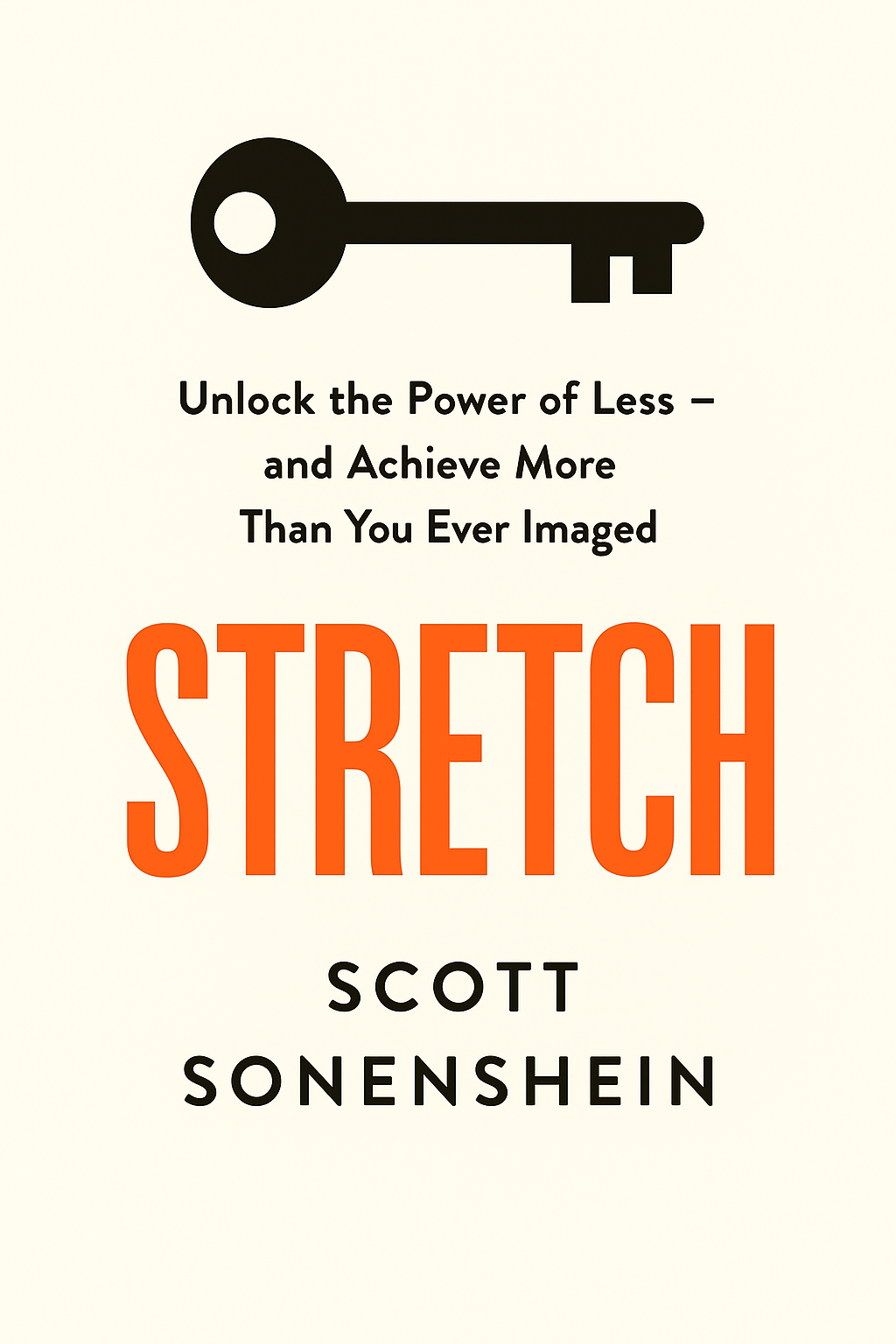
Stretch
Unlock The Power of Less and Achieve More Than You Ever Imagined
Book Edition Details
Summary
What if the secret to thriving isn't in acquiring more, but in mastering the art of enough? In "Stretch," Scott Sonenshein turns conventional wisdom on its head by revealing the unexpected power of constraints. Through riveting tales and insightful research, this thought-provoking exploration uncovers why businesses, educators, athletes, and creatives alike flourish not by amassing endless resources, but by ingeniously leveraging what they already possess. Sonenshein’s compelling narrative dissects the difference between the futile chase for more and the liberating practice of stretching. This book is a clarion call for anyone seeking to unearth their potential, offering a transformative perspective on living and working smarter, not harder. Discover how true success lies not in abundance, but in the creative alchemy of limited resources.
Introduction
Modern society operates under a seemingly logical assumption: more resources inevitably lead to better outcomes. Whether in business, education, or personal life, we instinctively believe that additional funding, staff, equipment, or time will solve our problems and enhance our performance. This fundamental belief shapes countless decisions, from corporate strategies to individual career choices, yet mounting evidence suggests this resource-accumulation mindset often produces disappointing results. The phenomenon extends far beyond simple organizational inefficiency. Companies with abundant funding frequently fail while resource-constrained competitors thrive. Individuals blessed with every advantage sometimes underperform those facing significant limitations. Educational institutions with generous budgets don't necessarily produce better outcomes than their underfunded counterparts. These paradoxes reveal a deeper truth about human performance and organizational success that challenges conventional wisdom. Rather than dismissing these contradictions as anomalies, a systematic examination reveals an alternative approach to achievement. This perspective shifts focus from acquiring more resources to maximizing the potential of existing assets. Through careful analysis of psychological research, organizational behavior studies, and real-world case studies, a compelling argument emerges for resourcefulness over resource accumulation. The exploration that follows traces the cognitive biases that trap us in endless acquisition cycles, examines the unexpected advantages of constraint-driven creativity, and demonstrates how individuals and organizations can achieve remarkable results by fundamentally reimagining their relationship with available resources.
The Chasing Trap: Why More Resources Don't Equal Better Results
The pursuit of additional resources creates a psychological trap that undermines the very success it promises to deliver. This "chasing" mentality stems from deeply embedded cognitive biases that distort our perception of what drives performance. Social comparison theory reveals how individuals constantly measure their resources against others, creating an endless cycle of dissatisfaction regardless of absolute wealth or capability. The phenomenon explains why lottery winners often report decreased happiness over time and why executives earning millions still feel financially inadequate when comparing themselves to billionaire peers. Functional fixedness compounds this problem by limiting how we perceive resource utility. When focused on acquiring more, we develop tunnel vision that prevents us from recognizing the full potential of existing assets. Research demonstrates that people primed to think about scarcity actually become more creative in resource utilization, while those with abundant resources tend to use them in conventional, less innovative ways. The irony becomes clear: the very mindset intended to solve resource limitations actually reduces our capacity to work resourcefully. The accumulation trap manifests most dramatically in corporate environments where "more is better" thinking drives decision-making. Organizations pursue growth through acquisition, increased budgets, and expanded headcount without examining whether these additions create proportional value. Historical analysis reveals that companies achieving sustainable success often do so through efficient resource utilization rather than resource accumulation. The dot-com bubble provides a stark illustration: well-funded startups with massive resources frequently collapsed while bootstrapped competitors survived and thrived. This pattern extends beyond business into personal achievement. Studies tracking career satisfaction over decades show that individuals focused on acquiring more—higher salaries, better titles, larger offices—report lower long-term satisfaction than those who develop resourcefulness skills. The chasing mentality creates a hedonic treadmill where each acquisition simply raises the baseline for future desires, leaving people perpetually unsatisfied despite objective improvements in their circumstances.
The Stretching Mindset: Maximizing Value from Existing Resources
Stretching represents a fundamental shift from resource acquisition to resource optimization. This mindset treats constraints not as problems to overcome but as creative catalysts that spark innovation and efficiency. Psychological ownership plays a crucial role in this transformation, as individuals who feel genuine control over their resources naturally become more inventive in their application. The phenomenon explains why employees given autonomy over limited budgets often outperform those with larger but externally controlled allocations. Constraint-induced creativity challenges the intuitive belief that limitations stifle performance. Research across diverse fields demonstrates that moderate constraints actually enhance creative output by forcing individuals to think beyond conventional solutions. Artists working within formal restrictions often produce more innovative work than those with unlimited freedom. Similarly, entrepreneurs operating under tight budget constraints frequently develop more elegant and sustainable business models than their well-funded counterparts. The stretching mindset embraces what researchers term "bricolage"—the art of making do with whatever resources are at hand. This approach requires developing comfort with improvisation and accepting that optimal solutions often emerge through experimentation rather than extensive planning. Organizations that cultivate stretching cultures encourage employees to view every challenge as an opportunity to discover new applications for existing resources rather than a justification for requesting additional funding. Frugality becomes a virtue rather than a limitation within the stretching framework. The distinction between frugality and cheapness proves crucial: frugal individuals and organizations find pleasure in maximizing resource efficiency, while cheap entities experience pain from any expenditure. This psychological difference drives entirely different behaviors, with frugal actors investing strategically in areas that multiply their existing capabilities rather than simply hoarding resources. The stretching mindset transforms scarcity from a barrier into a strategic advantage that fosters resilience and adaptability.
Building Stretching Skills: Outsider Perspective and Creative Constraints
Expertise, while valuable, can create cognitive blindness that prevents individuals from recognizing unconventional resource applications. The "curse of knowledge" leads specialists to approach problems through established frameworks, limiting their ability to see fresh possibilities. Outsiders, lacking deep domain expertise but possessing diverse experience, often identify solutions that experts overlook entirely. This phenomenon explains why cross-industry innovations frequently emerge from individuals who combine knowledge from seemingly unrelated fields. The multi-context rule suggests that breadth of experience provides strategic advantages over narrow specialization in complex, rapidly changing environments. Professionals who develop expertise across multiple domains maintain cognitive flexibility that enables creative resource application. Research tracking executive compensation reveals significant pay premiums for leaders with diverse functional experience, particularly during periods requiring innovative problem-solving. This pattern holds across industries and organizational levels, suggesting fundamental value in perspective diversity. Creative constraints emerge as powerful tools for stretching existing resources. When individuals face limitations—whether in time, budget, materials, or personnel—they naturally begin questioning assumptions about how resources must be used. Studies demonstrate that people operating under moderate constraints generate more innovative solutions than those with unlimited resources. The key lies in finding the optimal level of constraint: too little provides no creative pressure, while too much becomes paralyzing. Improvisation skills prove essential for effective stretching. Rather than following predetermined scripts, stretching requires comfort with uncertainty and ability to adapt in real-time based on evolving circumstances. Organizations that cultivate improvisation capabilities develop greater resilience and responsiveness to unexpected challenges. The jazz metaphor illustrates this principle: while symphony orchestras follow detailed scores, jazz ensembles create compelling music through skilled improvisation within structural frameworks. Both approaches produce excellent results, but improvisation provides flexibility crucial for navigating unpredictable environments.
Avoiding Overstretching: Finding the Right Balance in Resource Management
Effective stretching requires recognizing the boundaries between resourcefulness and counterproductive extremes. The distinction between frugality and miserliness becomes critical when resource constraints threaten essential investments in capabilities, infrastructure, or talent development. Organizations that push cost-cutting too far often damage their long-term competitiveness by undermining the very resources that enable stretching. Finding the optimal balance requires understanding which resources genuinely require investment versus those that benefit from creative reallocation. Excessive diversity in experience or focus can lead to wandering without clear direction. While breadth provides valuable perspective, establishing core competencies remains essential for building credibility and creating value. The research suggests following an incremental approach to diversification: developing strong foundational expertise before gradually expanding into adjacent areas. This strategy prevents the dilution of capabilities while building the cross-functional knowledge that enables creative resource application. The temptation to act without adequate learning creates another stretching hazard. While planning can become excessive, completely abandoning systematic evaluation leads to repeated mistakes and resource waste. Effective stretching requires balancing action orientation with reflective learning, using rapid experimentation cycles to test assumptions while maintaining overall strategic coherence. The key lies in learning quickly from small failures rather than betting everything on untested approaches. High expectations, while generally beneficial, can create performance pressure that undermines the very creativity stretching requires. When individuals feel excessive pressure to deliver results with limited resources, they may default to safe, conventional approaches rather than exploring innovative possibilities. Managing expectations involves setting challenging but achievable goals while creating psychological safety for experimentation and occasional failure. This balance enables the risk-taking essential for discovering new resource applications while maintaining accountability for results.
Summary
The fundamental insight emerging from this analysis challenges one of management and personal development's most persistent assumptions. Superior results arise not from accumulating more resources but from developing the capability to extract greater value from existing assets. This principle applies across contexts, from individual career development to organizational strategy, suggesting that resourcefulness represents a more sustainable path to success than resource accumulation. The cognitive shifts required—embracing constraints, developing comfort with improvisation, seeking diverse perspectives, and maintaining optimism about existing capabilities—create lasting advantages that compound over time. Rather than remaining trapped in endless pursuit of additional resources, individuals and organizations that master stretching principles discover remarkable potential hidden within their current circumstances, achieving both superior performance and greater satisfaction through creative resource optimization.
Related Books
Download PDF & EPUB
To save this Black List summary for later, download the free PDF and EPUB. You can print it out, or read offline at your convenience.
By Scott Sonenshein
