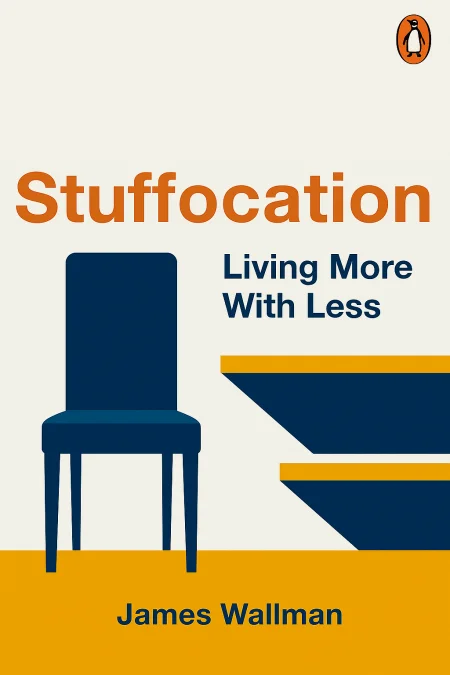
Stuffocation
Living More with Less
Book Edition Details
Summary
Overwhelmed by the relentless march of consumerism, many find their lives buried under mountains of unused gadgets and unworn clothes, leading to an epidemic of 'stuffocation.' James Wallman, an insightful trend forecaster, tackles this crisis with a transformative manifesto that challenges our obsession with material wealth. Instead of accumulating possessions, Wallman advocates for a shift towards enriching experiences—think meaningful travel and cherished moments with loved ones. Through compelling stories and sharp analysis, he reveals how this paradigm shift can liberate us from stress, foster happiness, and even contribute to a healthier planet. "Stuffocation" is not just a book; it's a call to live more fully by owning less.
Introduction
Contemporary society confronts an unprecedented paradox where material abundance has generated not satisfaction but a peculiar form of suffocation. The very consumer culture that promised happiness through acquisition now produces widespread anxiety, environmental degradation, and homes so cluttered with possessions that they impair rather than enhance daily life. This crisis emerges from a fundamental misalignment between human psychology evolved for scarcity and an artificial environment of endless accumulation that has dominated Western civilization for nearly a century. The investigation employs a multidisciplinary framework, integrating anthropological observations of modern living spaces, psychological research on happiness and consumption patterns, and economic data revealing shifting spending behaviors across developed nations. Rather than accepting conventional wisdom about consumer preferences or dismissing emerging alternatives as fringe movements, this analysis traces the evolution of post-materialist values through systematic examination of changing social practices and their underlying motivations. The exploration unfolds through interconnected arguments that first establish material overconsumption as a societal crisis, then examine the historical transformation from thrift to consumption culture, followed by analysis of emerging alternatives to materialism, and finally present evidence for a fundamental shift toward experience-based values. This progression reveals not merely individual lifestyle adjustments but the emergence of a new cultural paradigm that prioritizes experiential richness over material accumulation while remaining compatible with modern life's practical requirements and social structures.
The Crisis of Stuffocation: How Material Excess Undermines Well-being
Material abundance has created an unexpected crisis manifesting in both physical spaces and psychological well-being. Research reveals that contemporary homes contain more possessions than any previous generation in history, with typical households managing tens of thousands of objects that create measurable stress responses. Studies tracking cortisol levels demonstrate that women living in cluttered environments exhibit stress patterns associated with chronic fatigue and depression, while cognitive research shows that excessive possessions impair decision-making capacity and emotional regulation. The health implications extend beyond individual psychology to encompass broader safety concerns. Emergency responders now confront increasingly dangerous fires that spread faster and burn hotter due to synthetic materials and sheer volume of possessions in modern homes. Mental health professionals document rising rates of anxiety and depression linked to material overwhelm, while organizational industries have emerged to address what previous generations would have recognized as unprecedented luxury rather than burden. This convergence of personal and social costs reveals a systematic mismatch between human psychology and the material environment we have created. The neural pathways that evolved to drive resource acquisition during millennia of scarcity now compel continued accumulation even when storage space, financial resources, and emotional capacity have been exhausted. The result resembles a material equivalent of an obesity epidemic, where natural drives produce harmful outcomes in an artificially abundant environment. The environmental dimension compounds these personal costs through resource extraction that accelerates climate change and biodiversity loss at unprecedented scales. Meanwhile, the psychological promise of materialism increasingly fails to deliver, as studies consistently demonstrate that beyond meeting basic needs, additional material wealth contributes little to life satisfaction. This systematic failure of consumer culture's core premise demands recognition that our relationship with possessions has become fundamentally dysfunctional, requiring solutions that address underlying values rather than surface behaviors.
From Minimalism to Experientialism: Evolution of Post-Material Values
The minimalist movement represents the most visible rejection of material excess, with practitioners deliberately reducing possessions to extreme limits while documenting their journeys for millions of online followers. These experiments demonstrate that dramatic reduction in material goods can indeed increase happiness, reduce stress, and create space for more meaningful activities. The movement's appeal lies in its immediate practicality and measurable results, proving that contemporary abundance far exceeds actual needs for comfortable living. However, minimalism functions primarily as a reaction against materialism rather than a comprehensive alternative philosophy. Its focus on counting and eliminating possessions keeps material goods at the center of attention, albeit in negative terms. This approach works well for individuals seeking escape from excess stuff but offers limited appeal to broader populations who view possessions as tools for self-expression and practical functionality. The movement's emphasis on deprivation rather than abundance makes it inherently restrictive and difficult to sustain long-term. More promising approaches maintain minimalism's insights about material excess while shifting focus toward positive alternatives. Simple living advocates seek harmony with natural rhythms and reduced environmental impact, though often requiring sacrifices of modern conveniences that most people find unacceptable. The medium chill philosophy embraces moderation and work-life balance, rejecting relentless pursuit of career advancement and material accumulation in favor of present-moment satisfaction and family time. These various post-materialist approaches share a crucial insight: experiences provide more lasting satisfaction than possessions. Whether through minimalist decluttering, simple living practices, or medium chill lifestyle choices, practitioners consistently report that happiness depends more on activities and encounters than on ownership. This convergence points toward a fundamental shift in values that prioritizes experiential richness over material accumulation while remaining compatible with modern life's practical requirements and social structures.
The Psychology of Experience: Scientific Evidence for Experiential Advantage
Scientific research has definitively established that experiences provide greater happiness than material possessions, with multiple studies across diverse populations consistently demonstrating this experiential advantage. When people reflect on significant purchases, those involving activities, adventures, and encounters generate more satisfaction, fewer regrets, and longer-lasting positive emotions than acquisitions of physical objects. This finding transcends individual personality differences, cultural backgrounds, and purchase prices, suggesting a fundamental aspect of human psychology rather than mere preference variation. The psychological mechanisms underlying experiential superiority operate through several distinct pathways that address core human needs more effectively than material goods. Experiences resist the hedonic adaptation that quickly diminishes pleasure from possessions, maintaining emotional impact through memory and anticipation rather than fading into background familiarity. They prove more resistant to unfavorable social comparisons, as experiential purchases are inherently more subjective and personal than standardized consumer products that invite direct comparison. Perhaps most significantly, experiences integrate more readily into personal identity and strengthen social connections in ways that material possessions cannot achieve. Activities and adventures become part of who we are rather than merely what we own, while shared experiences create bonds between participants and generate stories worth telling. Even solitary experiences often involve other people indirectly and provide material for social conversation that proves more engaging than discussions of possessions. The experiential advantage extends beyond individual psychology to encompass broader life satisfaction and meaning. Experiences challenge us to develop skills, overcome obstacles, and expand capabilities in ways that passive ownership cannot provide. They create memories that grow richer over time rather than depreciating like physical goods, and they resist the comparison-driven status anxiety that characterizes much material consumption. These findings suggest that prioritizing experiences over possessions represents not just lifestyle preference but an evidence-based strategy for human flourishing that addresses fundamental psychological needs more effectively than material accumulation.
Building an Experience-Centered Society: Implementation and Future Challenges
The transition from materialism to experientialism is already underway, visible in shifting consumer spending patterns, changing status symbols, and evolving social behaviors that prioritize sharing experiences over displaying possessions. Younger generations increasingly choose access over ownership, preferring streaming services to physical media collections and ride-sharing to car ownership. Urban living patterns reflect these preferences through smaller spaces that accommodate fewer possessions while providing greater access to cultural amenities and entertainment options. Social media platforms have fundamentally altered how status is communicated, making experiences more visible and valuable as social currency than physical possessions. The ability to instantly share adventures and encounters with global networks has restored the social signaling power that experiences possessed in pre-industrial communities. This digital transformation enables experiential consumption to fulfill the status and identity functions that material goods served in the twentieth century while offering greater authenticity and personal meaning. Economic indicators support this cultural shift, with developed nations showing declining consumption of physical goods even as overall spending increases. The peak stuff phenomenon suggests that material consumption has reached its zenith in wealthy countries, with future growth concentrated in services, experiences, and intangible goods. This transition offers potential solutions to environmental challenges, resource constraints, and the psychological burdens that characterize contemporary consumer culture. However, scaling experientialism beyond affluent early adopters faces significant challenges that must be addressed for widespread adoption. Many meaningful experiences require time, money, and cultural capital that remain unevenly distributed, potentially creating new forms of inequality based on access to enriching activities rather than material possessions. The commercialization of experiences risks reproducing the manipulative marketing practices and artificial scarcity that characterize material consumption. Successfully building an experience-centered society requires careful attention to accessibility, authenticity, and preservation of intrinsic rather than purely commercial motivations for experiential engagement while maintaining the economic vitality that supports modern civilization.
Summary
The fundamental insight emerging from this analysis reveals that human wellbeing depends more on the quality of our experiences than the quantity of our possessions, a truth confirmed through rigorous scientific investigation and observable social change. The crisis of material excess stems not from individual failings but from systematic mismatch between evolved human psychology and contemporary consumer culture, requiring solutions that address underlying values rather than surface behaviors. The transition toward experientialism represents necessary adaptation to the realities of abundance, environmental constraints, and fundamental requirements of human flourishing, offering hope for resolving consumer capitalism's contradictions while preserving its benefits and creating space for meaningful lives that prioritize connection over accumulation and quality over quantity.
Related Books
Download PDF & EPUB
To save this Black List summary for later, download the free PDF and EPUB. You can print it out, or read offline at your convenience.
By James Wallman
