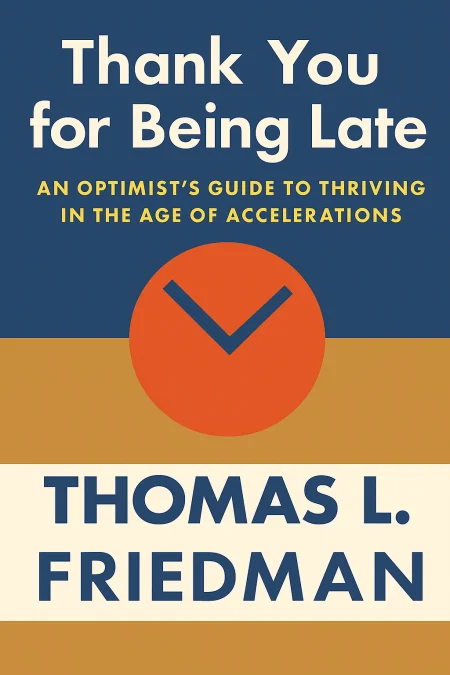
Thank You for Being Late
An Optimist’s Guide to Thriving in the Age of Accelerations
Book Edition Details
Summary
The twenty-first century is a whirlwind, and Thomas L. Friedman hands you the compass. In "Thank You for Being Late," Friedman untangles the hyper-speed chaos of our era—where technology races ahead, economies intertwine in intricate dances, and nature shifts under the weight of human impact. From the snowy peaks of Minnesota nostalgia to the digital revolution's cutting edge, Friedman paints a vivid picture of a world where opportunities to innovate or disrupt abound, yet true leadership becomes increasingly elusive. Amidst this dynamic landscape, he urges us to balance speed with reflection, fairness with adaptation. With a sharp wit and keen insight, this essential guide offers a blueprint for navigating the complexities of modern life, challenging readers to not just survive but thrive in times of unprecedented change.
Introduction
In 2007, while most of the world focused on financial markets beginning their dramatic collapse, three far more profound forces were quietly converging to reshape the trajectory of human civilization. Technology reached a critical inflection point where smartphones, cloud computing, and artificial intelligence transformed from expensive novelties into ubiquitous tools. Global flows of information, commerce, and ideas exploded through digital networks, connecting billions of people in ways that transcended traditional boundaries of geography, culture, and economics. Meanwhile, Earth's climate systems began exhibiting clear signs of entering uncharted territory, with feedback loops accelerating beyond the stable patterns that had sustained human development for millennia. This convergence represents humanity's entry into what scientists call the "second half of the chessboard," where exponential growth creates effects so powerful they fundamentally alter the rules of economics, politics, and survival itself. The old linear models of progress no longer apply when a single tweet can topple governments, when artificial intelligence begins making decisions that affect millions of lives, and when human activity becomes a geological force capable of triggering irreversible planetary changes. Understanding these interconnected accelerations has become essential for anyone seeking to navigate a world where the pace of change itself has changed. This exploration reveals how technological breakthroughs, global integration, and environmental transformation feed off each other in ways that create both unprecedented opportunities for human flourishing and existential challenges that demand entirely new approaches to adaptation, governance, and stewardship. Whether you're a business leader grappling with digital disruption, an educator preparing students for an uncertain future, or simply someone trying to understand why everything feels like it's moving so fast, grasping these forces has become crucial for thriving in our rapidly transforming world.
2007: The Inflection Point When Three Forces Converged
The year 2007 marked a pivotal moment when three separate trajectories of change suddenly intersected to create what can only be described as a perfect storm of transformation. While headlines focused on the emerging financial crisis, far more significant developments were unfolding beneath the surface of public awareness. The iPhone launched in January, fundamentally altering how humans interact with information and each other. Facebook opened its platform beyond college students, beginning the era of global social networking. Meanwhile, atmospheric carbon dioxide levels crossed 380 parts per million, entering territory not seen for millions of years. This convergence was no accident but rather the inevitable result of exponential growth curves that had been building for decades finally reaching critical mass simultaneously. Moore's Law had accumulated enough computing power to make artificial intelligence practical for everyday applications. Global trade networks had become so interconnected that disruptions in one region could cascade worldwide within hours. Human industrial activity had reached such scale that it began triggering feedback loops in Earth's climate systems that operated on their own accelerating timelines. The deeper significance of 2007 lies in how it marked the transition from a world where change happened gradually over generations to one where transformation occurs within years or even months. Traditional institutions built for stability found themselves operating in an environment of permanent disruption. Educational systems designed to prepare students for predictable careers suddenly faced the challenge of teaching skills for jobs that didn't yet exist. Democratic governments accustomed to deliberating policy over years confronted problems that demanded immediate global coordination. This inflection point created what experts now recognize as the defining challenge of our era: the gap between exponential technological change and linear human adaptation. While our tools and systems began operating at superhuman speed and scale, our social institutions, governance structures, and individual capacity for processing change remained fundamentally human in their limitations and timescales.
The Digital Supernova: Moore's Law Transforms Global Connectivity
The emergence of cloud computing around 2007 represented more than just a new way to store data or run software—it marked the beginning of what can only be described as a supernova of digital capability that would democratize access to tools once available only to governments and large corporations. For fifty years, Moore's Law had steadily doubled computing power every eighteen months, but the convergence of mobile devices, high-speed internet, and distributed computing created a qualitative leap that transformed quantity into an entirely new quality of human capability. Suddenly, a teenager with a smartphone possessed more computing power than entire universities had commanded just decades earlier. The cloud made storage infinite and accessible, while social platforms made global communication effortless and immediate. Software developers could access the same infrastructure that powered multinational corporations, while individuals could organize global movements from their living rooms. This represented a fundamental shift from technology as a specialized tool to technology as an extension of human consciousness itself. The implications extended far beyond Silicon Valley innovation labs. Small businesses gained access to global markets overnight, while traditional gatekeepers in media, finance, and education found their monopolies on information and access suddenly obsolete. A single programmer could create applications used by millions, while collaborative platforms enabled thousands of people to work together on projects that would have required massive corporate or government resources in previous eras. The barriers between local and global, individual and institutional, amateur and professional began dissolving. Yet this digital supernova also introduced unprecedented vulnerabilities and complexities. The same networks that enabled global collaboration could be weaponized by malicious actors, while the speed of digital communication often outpaced human judgment and institutional safeguards. As societies became more connected, they also became more interdependent, creating systemic risks where failures in one part of the network could cascade across the entire system. The challenge became learning to harness these new capabilities while building resilience against their inherent risks.
Planetary Boundaries and Geopolitical Disruption: New World Order
While digital technology was democratizing access to information and tools, Earth's natural systems were beginning to respond to human activity in ways that would fundamentally alter the geopolitical landscape. Climate change, driven by the same industrial processes that enabled global prosperity, began manifesting not as a distant future threat but as a present reality reshaping everything from agricultural productivity to political stability across entire regions. The concept of planetary boundaries emerged from scientific recognition that human activity had pushed several of Earth's critical systems beyond the stable ranges that had supported civilization for eleven thousand years. Rising sea levels threatened coastal cities, changing precipitation patterns disrupted agricultural regions, and extreme weather events became routine rather than exceptional. These environmental changes began triggering mass migrations, resource conflicts, and political upheavals that traditional diplomatic and military tools proved inadequate to address. This environmental acceleration intersected with technological and economic forces to create a new geopolitical reality characterized by what experts termed "weak states" and "super-empowered individuals." Traditional nation-states found themselves struggling to govern challenges that transcended borders, while small groups or even individuals gained unprecedented power to influence global events through digital networks and access to advanced technologies. A single hacker could disrupt critical infrastructure, while climate refugees could destabilize entire regions. The result was a world where the most dangerous threats often emerged not from rival superpowers but from the breakdown of order itself. Failed states became breeding grounds for extremism and transnational crime, while environmental disasters triggered cascading effects that could reach global markets within hours. Managing this complexity required entirely new approaches to governance and international cooperation, recognizing that in an interconnected world, instability anywhere could quickly become instability everywhere.
Adaptation Strategies: From Community Resilience to Global Solutions
The simultaneous acceleration of technology, globalization, and environmental change created an unprecedented challenge: how could human societies adapt to exponential change while maintaining the stability and social cohesion necessary for prosperity and wellbeing. The most successful responses emerged not from grand institutional reforms but from communities that learned to combine innovation with deep-rooted values of trust, collaboration, and mutual support. Successful adaptation required what researchers identified as "dynamic stability"—the ability to maintain core values and social bonds while continuously evolving practices and institutions. This meant building educational systems that taught adaptability rather than fixed knowledge, creating governance structures that could respond rapidly to emerging challenges, and fostering cultures that embraced experimentation while preserving essential human connections. The key insight was that resilience came not from resisting change but from developing the capacity to dance gracefully with disruption. At the individual level, thriving in this accelerated environment demanded what experts called "learning how to learn"—developing meta-skills that remained valuable even as specific technologies and job requirements evolved rapidly. This included critical thinking, emotional intelligence, creativity, and the ability to collaborate across cultural and disciplinary boundaries. The most successful people treated their careers as ongoing entrepreneurial ventures, constantly acquiring new capabilities while building networks of relationships that provided both opportunities and support. The global dimension of these challenges required unprecedented levels of international cooperation, yet traditional diplomatic institutions struggled to keep pace with the speed and complexity of interconnected problems. New forms of collaboration emerged through networks of cities, corporations, and civil society organizations that could move more quickly than national governments. The future belonged to those who could operate simultaneously at local and global scales, building community resilience while contributing to planetary solutions for challenges that transcended any single nation's capacity to address alone.
Summary
The central theme running through our current historical moment is the collision between exponential technological change and linear human adaptation, creating both unprecedented opportunities and existential challenges that demand entirely new approaches to learning, governance, and cooperation. The three great accelerations of technology, globalization, and climate change aren't separate phenomena but interconnected forces that amplify each other's effects, creating compound challenges that require compound solutions involving every level of human organization from individuals to global institutions. The historical lesson emerging from this convergence is clear: periods of rapid transformation favor those who can adapt without losing their essential character, just as successful biological species evolve while maintaining their core functions. This requires moving beyond false choices between embracing change and preserving stability, instead developing what might be called "conscious evolution"—the deliberate cultivation of new capacities for learning, collaboration, and stewardship that match the scale and speed of current challenges while preserving the values and relationships that make us human. For individuals and communities navigating this accelerated world, three principles emerge as essential: first, invest in lifelong learning and adaptability while maintaining deep roots in community and values; second, build bridges across differences rather than walls against change, recognizing that diversity of perspectives strengthens resilience; and third, take ownership of both local problems and global challenges, understanding that in an interconnected world, everyone's flourishing depends on everyone else's. The future belongs not to those who can move fastest, but to those who can maintain their humanity while helping others find stability and purpose in an age of perpetual transformation.
Related Books
Download PDF & EPUB
To save this Black List summary for later, download the free PDF and EPUB. You can print it out, or read offline at your convenience.
By Thomas L. Friedman
