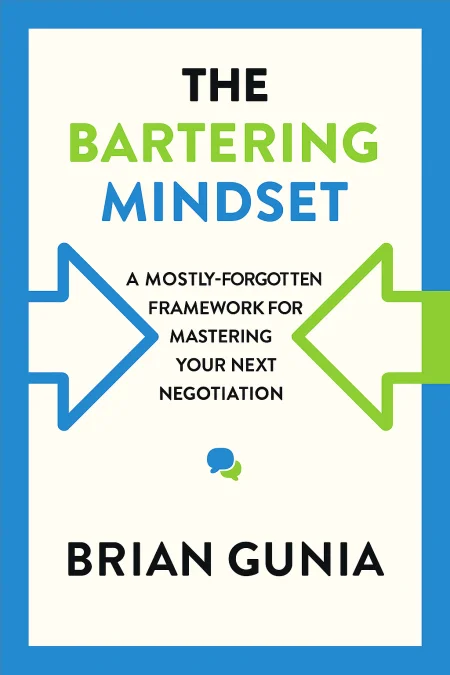
The Bartering Mindset
A Mostly Forgotten Framework for Mastering Your Next Negotiation
Book Edition Details
Summary
In a world where cash rules every transaction, "The Bartering Mindset" dares to ask: What if our obsession with money is the very thing holding us back in negotiations? This provocative exploration peels back the layers of our economic thinking, revealing a forgotten art of deal-making from the past. By revisiting the barter economies of old, where goods and services traded hands in a delicate dance of needs and haves, the book unearths a strategic wisdom lost to modernity. It challenges readers to shed their monetary blinkers, offering a fresh perspective that transforms adversarial bargaining into a collaborative quest. With its eye-opening five-step process, this compelling guide equips negotiators to rise above the mundane, promising richer results in both personal and professional arenas. Dive into a narrative that reshapes how you see value, exchange, and the true currency of human connection.
Introduction
In our money-driven world, we've become prisoners of a singular way of thinking about problems and solutions. When faced with challenges, we instinctively reach for our wallets or demand payment from others, trapped in what we might call the "monetary mindset." This approach works fine for simple transactions like buying coffee or paying rent, but it fails spectacularly when applied to our most important negotiations and complex problems. The result is a world filled with unnecessary conflicts, disappointing compromises, and missed opportunities for mutual benefit. The theoretical framework presented here challenges this dominant paradigm by resurrecting an ancient yet sophisticated approach to problem-solving. By examining how pre-monetary societies navigated the complex challenge of bartering, we discover a fundamentally different way of thinking about human exchange and collaboration. This "bartering mindset" doesn't advocate for abandoning money, but rather for adopting the psychological orientation that made bartering successful. This mindset transforms negotiation from a zero-sum battle into a collaborative search for mutual value creation, offering a systematic approach to understanding ourselves, our potential partners, and the powerful partnerships that can emerge when we think beyond simple monetary exchange.
From Monetary to Bartering Mindset
The monetary mindset represents our default psychological orientation shaped by countless daily transactions involving money. This mindset operates on five core assumptions that seem natural in monetary exchanges but become limiting when applied to complex problems. We assume we occupy one side of a transaction, face a single counterpart with opposing interests, want one thing while they want the opposite, can only win at their expense, and must resort to compromise to avoid conflict. While these assumptions work perfectly when buying groceries or paying for services, they create artificial constraints when applied to important negotiations like career changes, business partnerships, or organizational challenges. The monetary mindset encourages distributive behaviors focused on claiming value rather than creating it, leading to competitive dynamics that often leave everyone dissatisfied. The bartering mindset offers a radically different framework. Born from the necessity of navigating complex exchanges without money, this approach assumes we operate on both sides of transactions, engage with multiple parties simultaneously, recognize that everyone has diverse needs and offerings, understand that creating mutual value is the path to personal success, and build trust through collaborative exchange rather than compromise. This mindset emerged from the practical challenges faced by pre-monetary societies, where successful exchange required sophisticated psychological strategies to overcome what economists call the "double coincidence of wants."
Understanding Yourself and Your Market
The foundation of effective bartering lies in comprehensive self-knowledge that extends far beyond surface-level awareness of what we want. The bartering mindset demands that we deeply understand our true needs by asking "why" repeatedly until we uncover underlying motivations, and broadly understand our needs by exploring all possible approaches to satisfying them. This deep and broad analysis often reveals that our perceived problems mask more fundamental issues, and our assumed solutions represent just one path among many possibilities. Equally important is understanding our offerings through the same lens of depth and breadth. Deep understanding means recognizing the value we currently provide to others, while broad understanding involves envisioning new forms of value we could offer. This process transforms us from supplicants asking for help into valuable partners bringing solutions to others' problems. Consider someone facing job dissatisfaction. The monetary mindset might focus narrowly on salary negotiations with a current boss. The bartering mindset would first explore whether the real need is more money, better work conditions, career advancement, or life balance. It would then identify all the value currently provided to employers, colleagues, and the broader professional network, as well as potential new forms of value. This comprehensive self-understanding becomes the foundation for identifying powerful partnerships that serve everyone's interests simultaneously.
Building Powerful Partnerships
The bartering mindset revolutionizes how we identify and engage potential partners by expanding our view of who might help us and whom we might help. Rather than focusing on obvious counterparts, this approach systematically maps the full landscape of individuals and organizations whose needs we might meet and who might address our diverse requirements. This mapping process reveals unexpected partnership opportunities that remain invisible under the monetary mindset's narrow focus. The framework distinguishes between standard partnerships and "power partnerships" that satisfy both parties' needs extensively and inexpensively. Power partnerships emerge when we identify parties whose abundant resources align with our priority needs, while our abundant resources address their priority concerns. These relationships create exponential value rather than simple exchanges, transforming scarcity-based thinking into abundance-based collaboration. Building these partnerships requires a structured approach to cultivation that begins with establishing trust and openly exploring mutual needs and offerings. Rather than immediately proposing specific deals, the bartering mindset emphasizes understanding the full potential of each relationship before committing to particular arrangements. This patient approach often reveals creative solutions that exceed what either party initially envisioned, creating sustainable partnerships that continue generating mutual value over time.
Integrating Mindsets for Modern Negotiations
The ultimate sophistication of the bartering mindset lies not in replacing monetary thinking but in skillfully integrating both approaches to maximize effectiveness in modern negotiations. After using bartering principles to identify the most powerful partnerships and understand mutual needs comprehensively, we must transition into value-claiming behaviors that ensure favorable terms within those collaborative relationships. This integration requires strategic use of multi-issue offers that maintain collaborative spirit while achieving advantageous outcomes. Rather than negotiating issues sequentially through aggressive single-issue demands, the integrated approach presents multiple issues simultaneously, continuing information exchange while positioning for favorable agreements. Multiple Equivalent Simultaneous Offers represent an advanced technique that provides counterparts with meaningful choices while revealing their priorities and maintaining negotiating advantage. The key insight is timing and sequencing. Premature adoption of competitive behaviors destroys trust and limits creative problem-solving, while excessive collaboration can result in suboptimal personal outcomes. The integrated approach uses bartering principles to create maximum mutual value, then employs refined competitive techniques to claim an appropriate share of that expanded value. This combination produces agreements that are both more valuable overall and more favorable personally than either mindset could achieve alone.
Summary
The bartering mindset reveals that our greatest negotiating power comes not from competing more effectively, but from understanding more completely how to create mutual value before claiming our share. This framework transforms negotiation from a battle over fixed resources into a collaborative search for exponential value creation, where everyone's success becomes the foundation for our own optimal outcomes. By adopting the sophisticated psychological orientation that enabled our ancestors to thrive through complex exchanges, we unlock solutions to modern problems that seemed intractable under conventional competitive thinking.
Related Books
Download PDF & EPUB
To save this Black List summary for later, download the free PDF and EPUB. You can print it out, or read offline at your convenience.
By Brian Gunia
