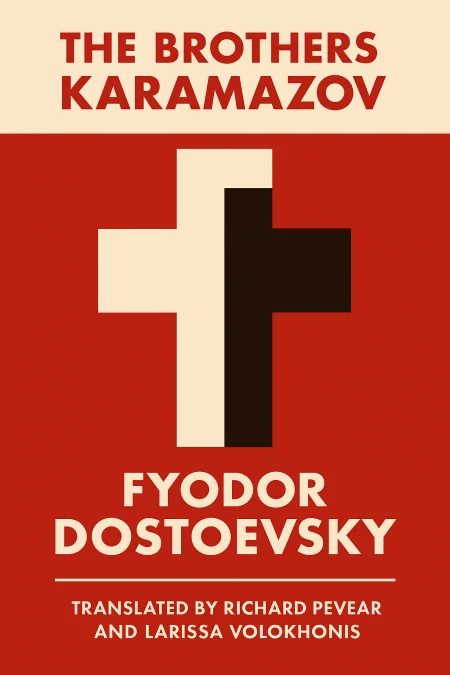
The Brothers Karamazov
A Tragic Murder Mystery on the Burden of Free Will and Morality
byFyodor Dostoevsky, Richard Pevear, Larissa Volokhonsky
Book Edition Details
Summary
An electrifying tapestry of mystery and philosophical inquiry, "The Brothers Karamazov" pits raw human passions against the backdrop of a rapidly changing Russia. Within this intricate familial web lies Fyodor Pavlovich Karamazov, a man of conflicting desires, and his sons: Dmitri, driven by emotion and desire; Ivan, the embodiment of reason; and Alyosha, the spiritual novice. Their lives converge in a tale of murder, forbidden love, and existential wrestling, capturing the soul of a nation on the brink of transformation. Richard Pevear and Larissa Volokhonsky’s masterful translation preserves Dostoevsky’s vibrant prose, delivering an epic that is both timeless and achingly modern. In just four tumultuous days, readers are invited to navigate the profound depths of faith, doubt, and the human condition, making this a novel of enduring power and urgency.
Introduction
In the flickering candlelight of a Russian monastery, an elder's death unleashes a spiritual earthquake that will shatter a family and expose the deepest fault lines running through Imperial Russian society. As traditional Orthodox faith collides with Western rationalism, as patriarchal authority crumbles under the weight of moral corruption, and as passionate desires override sacred duties, we witness the birth pangs of a new era that would ultimately transform not just Russia, but the entire world. This profound exploration reveals how the breakdown of religious certainty and social hierarchy creates a vacuum that can be filled either by nihilistic despair or by a deeper, more authentic understanding of human responsibility and divine love. The story illuminates three crucial historical forces that shaped the late nineteenth century: the crisis of religious authority in an age of scientific materialism, the collapse of traditional family structures under the pressure of individualistic values, and the emergence of new forms of moral consciousness that would eventually challenge existing political and social orders. These themes speak directly to anyone grappling with questions of meaning and morality in times of rapid change, those interested in the psychological roots of social transformation, and readers seeking to understand how personal spiritual crises can become catalysts for broader historical upheavals. The narrative demonstrates how individual moral choices ripple outward to shape the destiny of entire civilizations, offering profound insights for navigating our own era of uncertainty and transformation.
The Dissolution of Patriarchal Authority and Traditional Bonds
The moral decay begins in the 1860s and 1870s, as the emancipation of the serfs and the influx of Western ideas undermined the traditional foundations of Russian society. At the center of this collapse stands Fyodor Pavlovich Karamazov, whose very existence embodies the corruption of patriarchal authority that had once provided stability and meaning to Russian life. His abandonment of his children, his shameless pursuit of pleasure, and his complete abdication of moral responsibility represent the transformation of the father from protector into predator, from moral guide into source of corruption. The three sons, scattered and neglected, develop radically different responses to their father's moral vacuum, each representing a different path available to Russian society as it grappled with the collapse of traditional authority. Dmitri embodies the passionate, instinctive Russia that seeks meaning through immediate experience and sensual gratification. Ivan represents the intellectual elite that turns to Western rationalism and philosophical systems to fill the void left by discredited religious beliefs. Alyosha symbolizes those who attempt to preserve spiritual values while adapting them to new circumstances and challenges. This familial breakdown reflects the broader disintegration of social bonds that had held Russian communities together for centuries. The traditional relationships between masters and serfs, parents and children, clergy and laity were all undergoing fundamental transformation, creating a society where individuals could no longer rely on inherited roles and expectations for guidance. The father's house becomes a battleground where competing worldviews clash without resolution, where love is corrupted into manipulation and duty becomes a mockery of its former meaning. The consequences of this dissolution extend far beyond individual families to encompass the entire social order. When children cannot trust their fathers, when authority becomes arbitrary and self-serving, the very foundations of civilization begin to crumble. This pattern would prove prophetic for Russia's future, as the breakdown of traditional authority would eventually contribute to revolutionary upheaval and the complete transformation of Russian society in ways that few could have anticipated.
The Confrontation Between Orthodox Faith and Western Rationalism
The monastery emerges as both sanctuary and battleground in the escalating war between traditional Russian spirituality and modern European skepticism that defined the 1870s intellectual landscape. The dying elder Zossima represents the mystical, compassionate heart of Russian Orthodoxy, with his emphasis on active love and universal responsibility, while his critics embody the more rigid, institutional approach to faith that had dominated the church for centuries. This internal religious conflict mirrors the larger cultural struggle between indigenous Russian spiritual traditions and imported Western philosophical systems that was tearing at the fabric of educated society. Ivan Karamazov's philosophical rebellion crystallizes this conflict in its most acute and dangerous form. His famous declaration that "if God does not exist, everything is permitted" captures the terrifying logic of a world without divine foundation, yet his intellectual atheism brings him no peace, only increasing torment and psychological fragmentation. His "Grand Inquisitor" parable reveals the sophisticated nature of modern doubt, which attacks not the existence of God but the goodness of divine governance in a world filled with innocent suffering. This represents a new form of religious crisis, one that cannot be answered by traditional apologetics or institutional authority. The elder's teachings about universal love and responsibility offer a counter-vision to Ivan's rational despair, but they too face challenges from within the religious community itself. The tension between different approaches to faith, between mystical experience and doctrinal orthodoxy, between compassionate engagement with the world and ascetic withdrawal from it, shows how even believers struggle to maintain their convictions in an age of unprecedented questioning. The scandal following Zossima's death, when his body decomposes normally rather than manifesting miraculous preservation, demonstrates how fragile faith becomes when it depends on supernatural validation rather than inner transformation. This confrontation between faith and reason would prove decisive for Russia's future development. The inability to synthesize traditional spiritual wisdom with modern intellectual insights created a polarization that would eventually contribute to the radical rejection of all religious values by revolutionary movements, leading to decades of persecution and the attempted destruction of Russia's spiritual heritage.
The Eruption of Violence and Moral Breakdown
The simmering tensions within Russian society explode into open violence during the late 1870s, as the absence of moral restraint and the collapse of traditional authority create conditions ripe for catastrophe. Dmitri's passionate nature, unchecked by either paternal guidance or religious conviction, drives him toward increasingly desperate acts that mirror the broader social chaos of the period. His rivalry with his father over Grushenka transforms love into a weapon of mutual destruction, while his financial desperation pushes him toward actions that compromise his honor and integrity, reflecting the economic pressures that were destabilizing traditional social relationships throughout Russia. The murder that ultimately occurs represents more than a personal tragedy; it symbolizes the death of the old moral order itself and the birth of a new era where violence becomes an acceptable means of resolving conflicts. When children can contemplate killing their fathers, when passion overrides all ethical considerations, when the bonds of family and community dissolve into mutual hostility, society has reached a point of moral collapse from which recovery becomes extraordinarily difficult. The violence that erupts follows logically from the systematic erosion of moral foundations that has been building throughout the preceding decades. The investigation and trial that follow reveal the inadequacy of legal institutions to address the deeper spiritual and moral dimensions of the crisis. The prosecutors and defense attorneys, trained in Western legal methods, struggle to comprehend the psychological and spiritual complexities that have led to this tragedy. Their focus on material evidence and logical consistency blinds them to the more subtle truths about character, motivation, and the web of relationships that have created this situation. The courtroom becomes a theater where different conceptions of justice, responsibility, and human nature compete for dominance without achieving resolution. This breakdown of moral restraint and the resort to violence as a solution to personal and social problems would soon become a defining characteristic of Russian life. The willingness to use extreme measures to achieve desired ends, whether in personal relationships or political struggles, would eventually contribute to decades of revolutionary terror, civil war, and social upheaval that would transform Russia beyond recognition.
The Search for Justice and Redemption in a Fractured Society
In the aftermath of violence and moral collapse, the surviving characters must confront the consequences of their choices and search for paths toward redemption in a society where traditional sources of meaning and guidance have been discredited. Alyosha's journey from the protected environment of the monastery into the chaotic world of family conflict and social breakdown represents the challenge facing all those who seek to preserve spiritual values while engaging with the practical demands of a transformed society. His commitment to love and service offers a potential foundation for rebuilding, but the forces of cynicism and despair remain powerful and pervasive. The trial that follows the murder becomes a microcosm of Russian society's struggle to establish justice and truth in a world where moral certainties have crumbled and competing narratives vie for acceptance. The legal proceedings reveal how difficult it becomes to determine responsibility and assign punishment when the basic frameworks of moral understanding have broken down. The various interpretations of events offered by different witnesses and advocates show how the same facts can support radically different conclusions about guilt and innocence, truth and falsehood, justice and mercy. The verdict and its aftermath expose the limitations of purely legal approaches to addressing moral and spiritual crises. While the formal machinery of justice may assign guilt and impose punishment, it cannot heal the deeper wounds that have torn apart the fabric of family and community relationships. The escape plan that emerges represents not a rejection of justice but a recognition that true healing requires something beyond what legal institutions can provide, something that addresses the spiritual dimensions of human existence and the need for forgiveness and redemption. Yet even in this dark aftermath, possibilities for renewal emerge through the bonds of genuine love and compassion that develop between characters who have learned from their suffering. The final scenes, particularly Alyosha's speech to the schoolboys at young Ilusha's funeral, point toward a future where a new generation might learn from the mistakes of their elders and build something better from the ruins of the old order. This fragile hope reflects the broader possibility that societies can emerge from periods of moral chaos with renewed wisdom and stronger foundations for human flourishing, though the path to such renewal requires immense patience, courage, and commitment to values that transcend immediate self-interest.
Summary
The chronicle of moral and spiritual crisis in late Imperial Russia reveals the central tragedy of modern civilization: the collision between traditional foundations of meaning and authority and the corrosive effects of unchecked individualism, rational skepticism, and social fragmentation. When patriarchal authority becomes corrupt, when religious faith loses its power to guide behavior, and when passionate desires override ethical restraints, the result is not liberation but destruction on a scale that encompasses not only individual families but entire societies. The breakdown of the Karamazov family serves as a prophetic warning about what happens when civilizations abandon their moral moorings without finding adequate replacements, creating conditions that make violence and chaos inevitable. The historical lessons embedded in this narrative remain urgently relevant for contemporary societies facing similar challenges. First, the importance of maintaining moral education and character formation even as societies evolve and change, recognizing that intellectual sophistication without ethical grounding leads to spiritual emptiness and social chaos. Second, the recognition that genuine renewal requires not just the destruction of corrupt institutions but the patient work of rebuilding human relationships based on love, responsibility, and mutual care. Third, the understanding that the synthesis of traditional wisdom and modern insights demands both respect for inherited values and openness to new forms of understanding that can address contemporary challenges. These insights offer guidance for navigating our own era's moral challenges and building more resilient foundations for human community that can withstand the pressures of rapid change while preserving what is most valuable from our spiritual and cultural heritage.
Related Books
Download PDF & EPUB
To save this Black List summary for later, download the free PDF and EPUB. You can print it out, or read offline at your convenience.
By Fyodor Dostoevsky
