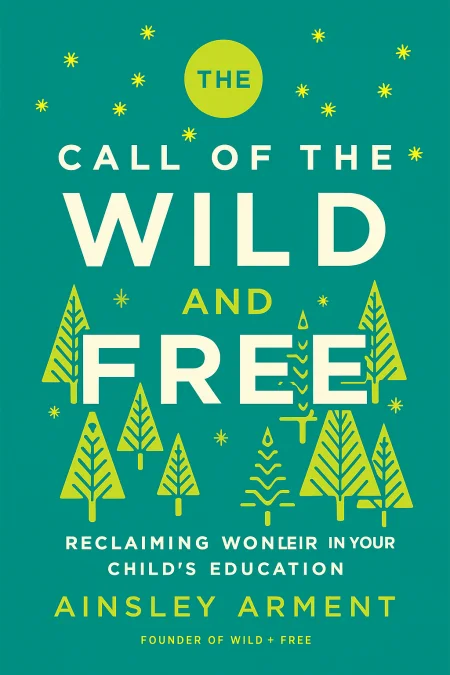
The Call of the Wild and Free
Reclaiming Wonder in Your Child's Education
Book Edition Details
Summary
Unshackle the bounds of conventional education with "The Call of the Wild and Free," where Ainsley Arment, inspired by the liberating wisdom of Thoreau, invites you to reimagine homeschooling. Embrace a world where curiosity reigns supreme, and the boundaries between classroom and living room blur into a tapestry of learning woven through nature, literature, and play. This transformative guide dismantles outdated stereotypes, presenting a vibrant alternative that celebrates the wonder of childhood. Whether you're contemplating homeschooling or seeking to enrich a traditional education, this book is your compass to a journey that awakens the mind and ignites the spirit, nurturing children who are not just educated, but truly alive.
Introduction
Sarah watched her five-year-old son climb onto the school bus, his small frame disappearing into a world of rigid schedules and standardized expectations. That evening, she noticed something different in his eyes—a dimming of the spark that once made him pause to examine every butterfly and ask endless questions about the world around him. The light of natural curiosity was slowly being extinguished by an educational system that valued conformity over wonder. This moment of recognition catalyzes a profound journey that countless families are embarking upon today. In an era where childhood has become increasingly structured and adult-directed, a growing movement of parents is choosing to step away from conventional education and embrace a radically different approach. They are discovering that true learning happens not in sterile classrooms, but in living rooms filled with laughter, backyards transformed into laboratories, and nature trails that become history lessons. The path these families choose isn't always easy, but it offers something precious that traditional schooling cannot: the preservation of childhood itself. Through their stories, we glimpse a world where education flows naturally from a child's inherent desire to explore, create, and understand. This is a world where morning conversations over breakfast can spark weeks of discovery, where a walk in the woods becomes a science lesson, and where children learn to think for themselves rather than simply memorize what others have decided they should know. It's a call to remember that the most profound education happens when we honor the wild and free spirit that exists within every child.
When the Light Goes Out: A Mother's Call to Action
The morning ritual felt ordinary enough—backpack check, lunch money, quick kiss goodbye. But as Ainsley watched her son Wyatt board the school bus for first grade, something profound shifted in her understanding of childhood itself. What began as a typical school day would become the catalyst for a complete reimagining of how learning could unfold in their family's life. Weeks passed, and subtle changes began to emerge in Wyatt's demeanor. The boy who once spent hours building elaborate forts and creating imaginative worlds now seemed hurried, anxious about homework, and increasingly concerned with what his peers thought of him. His natural rhythm of discovery had been replaced by the artificial pace of institutional learning. Most heartbreaking of all, the light of wonder that had always danced in his eyes began to dim, replaced by something that looked disturbingly like resignation. The transformation wasn't immediate or dramatic, but rather a slow erosion of the qualities that had made Wyatt uniquely himself. He began speaking differently, adopting phrases and attitudes that seemed foreign to his gentle nature. The child who had once been content to spend an entire afternoon watching ants build their colonies now rushed through activities, always aware of the next scheduled event. Something precious was being lost, and Ainsley felt powerless to stop it. This gradual dimming of childhood's natural radiance reveals a deeper crisis in how our society approaches education and child development. When we prioritize compliance over curiosity and conformity over creativity, we risk losing the very qualities that make learning joyful and meaningful. The call to action becomes clear: it's time to reclaim childhood from the forces that would rush it away, and to create spaces where wonder can flourish once again.
Breaking Free from Educational Myths and Social Expectations
The decision to homeschool brought an unexpected avalanche of doubts, not just from concerned relatives but from deep within Ainsley's own mind. Society had taught her that proper education required professional teachers, standardized curricula, and age-segregated classrooms. The very idea that she, a mother without formal teaching credentials, could adequately educate her children seemed presumptuous, even dangerous. What if she ruined their chances for college? What if they fell behind their peers? What if she simply wasn't qualified? These fears were amplified by well-meaning friends and family members who questioned every aspect of her decision. The socialization myth loomed largest—how would her children learn to interact with others if they weren't in traditional school? The qualification myth followed close behind—surely only trained professionals could properly educate children. Each objection felt like a weight added to an already heavy burden of responsibility. Yet as Ainsley began to research and observe, a different picture emerged. She discovered that homeschooled children often excelled academically and socially, developing stronger relationships with people of all ages rather than being confined to narrow peer groups. She learned that the requirement for teaching credentials was more bureaucratic than educational—that loving, attentive parents had been successfully educating their children for millennia before formal schooling existed. The breakthrough came when she realized that these myths served a system that benefited from keeping education mysterious and professional, rather than recognizing it as the natural relationship between caring adults and curious children. Breaking free from these expectations wasn't just about choosing a different educational path; it was about trusting in the fundamental human capacity to learn and grow in environments filled with love, attention, and genuine engagement with the world.
Finding Your Path: Styles, Rhythms, and Family Culture
The homeschooling world presented Ainsley with an overwhelming array of choices—Charlotte Mason's living books, Classical education's rigorous trivium, Montessori's prepared environment, Waldorf's artistic integration. Each approach had passionate advocates who spoke of their method as if it held the key to educational paradise. The pressure to choose the "right" style felt almost as constraining as the traditional school system she had left behind. Initially, Ainsley tried to follow curricula to the letter, believing that structure would ensure her children received a legitimate education. But something magical happened when she began to pay more attention to her children's natural rhythms and interests than to prescribed lesson plans. She noticed that her son learned math concepts more easily when they arose naturally from cooking projects or building activities. Her daughter absorbed history when it was woven into stories rather than presented as isolated facts and dates. Gradually, their family developed its own unique rhythm—mornings filled with nature walks and discovery, afternoons of reading aloud together, evenings devoted to creative projects and meaningful conversations. This wasn't a method she had learned from a book or borrowed from an expert; it was an organic response to her children's needs and her family's values. The revelation was profound: the best educational approach wasn't something to be adopted from others, but something to be created through careful attention to the unique personalities and interests of her own children. The journey taught them that family culture couldn't be purchased or prescribed—it had to be cultivated through intentional choices about how time was spent, what values were emphasized, and how learning was integrated into the fabric of daily life. When families trust their instincts and create environments that honor both structure and freedom, both individual interests and shared values, education becomes not a burden to be endured but a joy to be celebrated.
The Natural Classroom: Wonder, Story, Play, and Curiosity
The transformation was most evident during their nature walks, when questions arose organically from observation and wonder. Why do leaves change colors? How do birds know where to migrate? What makes the ocean waves? Rather than consulting textbooks for answers, they would spend days or weeks pursuing these inquiries through books, experiments, art projects, and conversations. Learning became an adventure rather than an assignment, driven by genuine curiosity rather than external requirements. Stories became the golden thread that wove all subjects together. History came alive through biographical narratives, science concepts crystallized through nature tales, and mathematical principles emerged from adventure stories. Rather than compartmentalizing knowledge into separate subjects, they discovered how everything connected when approached through the natural human love of narrative. Children who might have struggled with abstract concepts grasped them easily when they were embedded in compelling stories. Play, far from being a distraction from learning, revealed itself as learning's most powerful engine. Through imaginative play, children processed experiences, developed problem-solving skills, and built the neural pathways that would support formal academics later. When education honored rather than suppressed the natural tendency to play, children remained enthusiastic learners rather than reluctant students. Most remarkable was watching curiosity blossom when given space and time to develop. Questions that might have been quickly answered in traditional settings were allowed to percolate and grow, leading to investigations that spanned weeks or months. Children learned not just facts, but how to research, experiment, and think critically about the world around them. This approach revealed that the most powerful curriculum isn't found in any textbook, but in the natural wonder that every child brings to the world. When we trust these innate capacities and provide rich environments for them to flourish, we discover that learning is not something we must force upon children, but something that emerges naturally from their engagement with a fascinating world.
Summary
The journey from traditional schooling to wild and free learning reveals a profound truth about childhood and education: the most meaningful learning happens not when we constrain children's natural impulses, but when we create environments where their innate curiosity and wonder can flourish. Through countless stories of families who chose to trust their instincts over institutional expectations, we see that education is fundamentally about relationships, not systems—about fostering a love of learning rather than compliance with curricula. The path requires courage, as it means stepping away from social conventions and trusting in approaches that honor childhood rather than rushing it. Yet the rewards are immeasurable: children who maintain their natural enthusiasm for discovery, families who grow closer through shared adventures in learning, and communities that value depth over breadth, understanding over memorization. Most importantly, this approach recognizes that each child is unique, deserving of an education tailored to their individual gifts and interests rather than standardized expectations. The call to embrace this wild and free approach to learning extends beyond homeschooling families to anyone who cares about children's wellbeing and development. Whether in homes, schools, or communities, we can create spaces where wonder is preserved, where nature is valued as a teacher, where stories connect us to deeper truths, and where play is recognized as the serious work of childhood. In doing so, we give children not just knowledge, but wisdom—not just information, but the capacity to think, create, and contribute meaningfully to the world they will inherit.
Related Books
Download PDF & EPUB
To save this Black List summary for later, download the free PDF and EPUB. You can print it out, or read offline at your convenience.
By Ainsley Arment
