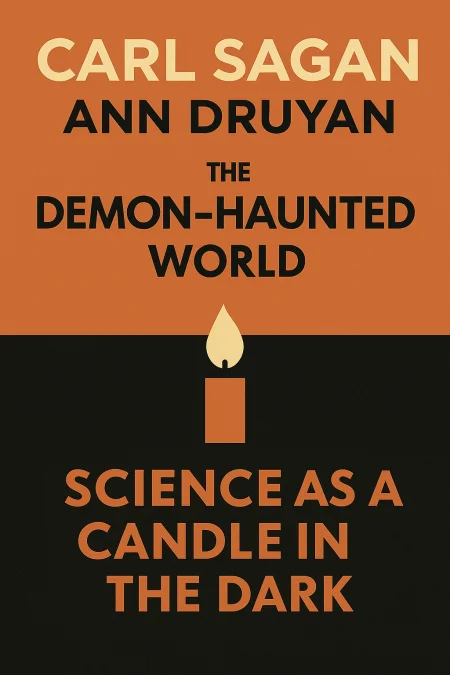
The Demon-Haunted World
Science as a Candle in the Dark
Book Edition Details
Summary
When ancient myths clash with modern truths, the stakes are nothing less than our freedom. In "The Demon-Haunted World," Carl Sagan, the visionary mind behind many scientific revelations, confronts the shadowy allure of pseudoscience. From witch hunts to UFO sightings, Sagan unravels the tapestry of unreason that captivates even the sharpest minds today. With the precision of an astronomer and the passion of a guardian of truth, he illuminates the tools of critical thinking, urging society to embrace science not just as a discipline but as a cornerstone of democratic vitality. Sagan's work is a clarion call to pierce the fog of superstition, ensuring that rationality prevails in the age of information.
Introduction
Picture yourself scrolling through social media late at night when you encounter a video claiming that scientists have discovered alien artifacts on Mars, complete with blurry photographs and testimonials from supposed experts. Your heart races with excitement at the possibility, but something feels off about the presentation. This moment perfectly captures the modern dilemma we all face: living in an age where genuine scientific breakthroughs happen alongside elaborate hoaxes, where life-saving medical discoveries compete for attention with dangerous misinformation, and where our natural curiosity can lead us toward either profound truth or costly deception. The ability to distinguish between reliable knowledge and clever fiction has never been more crucial for navigating our complex world. This exploration reveals how scientific thinking serves as our most powerful tool for separating fact from fantasy, why our minds are naturally vulnerable to believing extraordinary claims, and how we can develop the critical thinking skills necessary to embrace genuine wonder while protecting ourselves from those who would exploit our desire to believe in something greater than ourselves.
The Scientific Method vs Pseudoscience: Distinguishing Fact from Fiction
The scientific method operates like a rigorous quality control system for human knowledge, constantly testing ideas against reality and discarding those that fail to measure up. At its heart, science follows a deceptively simple process: observe something interesting, propose an explanation, design experiments to test that explanation, and then accept or reject the idea based on what the evidence reveals. What makes this approach so powerful isn't its complexity, but its built-in willingness to admit error and change course when new evidence emerges. Pseudoscience, by contrast, works backward from its desired conclusions. Instead of following evidence wherever it leads, pseudoscientific thinking begins with appealing beliefs and then searches for supporting evidence while dismissing or explaining away anything that contradicts the preferred narrative. Where science welcomes challenges and peer review as essential quality controls, pseudoscience often portrays skepticism as narrow-mindedness or conspiracy. This creates echo chambers where believers become increasingly isolated from reality checks, surrounding themselves with confirming information while avoiding genuine scrutiny. The practical consequences of this distinction extend far beyond academic debates. In medicine, the difference between scientific rigor and pseudoscientific wishful thinking can literally determine whether treatments save lives or cause harm. When we abandon the careful methodology that has given us antibiotics, vaccines, and surgical techniques in favor of unproven alternatives promoted through testimonials and marketing, we risk returning to an era when preventable diseases claimed countless lives. The beauty of scientific thinking lies not in claiming absolute certainty, but in its honest acknowledgment of uncertainty and limitation. Science expresses confidence through statistical measures and openly admits the boundaries of current knowledge, providing the best available approximation of truth while remaining open to revision. This intellectual humility, rather than weakening scientific conclusions, actually strengthens them by preventing the overconfidence that leads to dangerous mistakes and stagnant thinking.
UFOs and False Memories: When Our Minds Deceive Us
The modern UFO phenomenon began in 1947 when pilot Kenneth Arnold reported seeing nine mysterious objects flying near Mount Rainier, describing their motion as resembling saucers skipping across water. This single eyewitness account launched a cultural obsession that has persisted for decades, evolving from simple sightings into elaborate narratives of alien visitation, abduction, and systematic study of human beings by extraterrestrial scientists. Alien abduction accounts follow remarkably consistent patterns across different reports: small gray beings with large eyes, medical examinations aboard spacecraft, missing time periods, and mysterious scars or implants left behind. These experiences feel completely real to those who report them, often emerging through hypnotic regression therapy designed to recover supposedly buried memories. However, hypnosis is notoriously unreliable for memory recovery, frequently producing vivid but false recollections that feel more real than actual experiences. Courts have banned hypnotically recovered testimony precisely because of its demonstrated unreliability. The human brain, despite its remarkable capabilities, operates more like a creative storyteller than a perfect recording device. It constantly reconstructs memories, filling gaps with plausible details and sometimes creating entirely false experiences that feel authentic. Sleep paralysis, a well-documented neurological phenomenon, can produce terrifying hallucinations of intruders in one's bedroom, complete with the sensation of being unable to move. These experiences often occur during the transition between sleep and wakefulness, when the brain's reality-testing mechanisms are temporarily compromised. What makes the abduction phenomenon particularly revealing is its cultural specificity. The vast majority of reports come from North America, and the described aliens closely match creatures from science fiction rather than showing the biological diversity we might expect from genuinely extraterrestrial life. This suggests that cultural contamination plays a significant role in shaping these experiences, with our minds drawing upon familiar imagery to construct meaningful narratives from ambiguous sensory input or altered states of consciousness.
Critical Thinking Tools: Building Your Baloney Detection Kit
Developing effective critical thinking skills requires assembling what we might call a "baloney detection kit" of intellectual tools that help us evaluate claims systematically. The most fundamental tool involves asking probing questions: What evidence supports this claim? Are there alternative explanations that might account for the same observations? Who benefits if this claim is accepted as true? Has the claim been tested independently by researchers without conflicts of interest? Understanding the difference between correlation and causation represents another crucial skill in our analytical toolkit. Just because two events occur together doesn't mean one causes the other. Ice cream sales and drowning deaths both increase during summer months, but this doesn't mean ice cream consumption causes drowning. Both phenomena are related to a third factor: warm weather that brings people to beaches and pools while also increasing demand for frozen treats. This type of logical fallacy appears everywhere from health scares to political arguments, and learning to recognize it prevents us from drawing incorrect conclusions. Critical thinking also demands that we examine information sources and potential conflicts of interest that might bias conclusions. When tobacco companies funded studies showing that smoking posed no health risks, the scientific community eventually recognized that financial incentives had corrupted the research process. Similarly, we should approach with healthy skepticism any studies funded by industries with vested interests in particular outcomes, whether they involve pharmaceuticals, environmental regulations, or consumer products. Perhaps most importantly, effective critical thinking requires intellectual humility and the recognition that changing our minds in response to new evidence represents wisdom rather than weakness. This can feel emotionally threatening because admitting error seems like personal failure, but it's essential for intellectual growth and accurate understanding of reality. The most reliable path toward truth involves constantly testing our beliefs against evidence and remaining willing to abandon cherished ideas when they fail to withstand scrutiny.
Democracy and Scientific Literacy: Protecting Wonder While Embracing Skepticism
Democratic societies depend fundamentally on informed citizens capable of evaluating competing claims and making reasoned decisions about complex issues that affect everyone. When voters lack scientific literacy, they become vulnerable to manipulation by those who exploit fear, ignorance, and prejudice for political or economic gain. Climate change, genetic engineering, nuclear energy, and public health policies all require citizens who can distinguish between legitimate scientific concerns and manufactured controversies designed to serve narrow interests. The relationship between science and democracy runs deeper than policy decisions, sharing core values that reinforce each other. Both systems embrace openness to new ideas, respect for evidence over authority, willingness to change course when proven wrong, and the belief that truth emerges through open debate rather than authoritarian decree. Scientists publish their methods and data so others can verify their work, just as democratic governments operate with transparency and accountability to the people they serve. One of the most persistent misconceptions about scientific thinking is that it somehow diminishes wonder and beauty in the natural world. Critics argue that explaining rainbows in terms of light refraction destroys their magic, or that understanding nuclear fusion makes sunsets less inspiring. This represents a profound misunderstanding of both science and wonder. In reality, scientific knowledge typically increases rather than diminishes our sense of awe at the universe's complexity and elegance. The key lies in recognizing that skepticism and wonder aren't opposites but partners in the quest for understanding. Skepticism protects us from being deceived by false claims, while wonder motivates us to keep exploring and questioning. Scientific thinking doesn't eliminate mystery from the world but reveals deeper and more profound mysteries that inspire continued exploration. When we understand that we're made of elements forged in dying stars, we don't feel diminished but connected to the cosmos in the most intimate way possible.
Summary
The most profound insight from this exploration is that scientific thinking represents far more than just a method for understanding the natural world—it serves as an essential tool for navigating reality itself and maintaining the democratic values that allow human societies to flourish and progress. In our age of information overload and manufactured controversy, the ability to distinguish between reliable knowledge and appealing nonsense has become a survival skill for both individuals and entire civilizations. The marriage of skepticism and wonder that characterizes good science offers a clear path forward through the confusion and manipulation that characterize so much of our public discourse, allowing us to protect ourselves from those who would exploit our fears and prejudices while remaining open to genuine discoveries that expand our understanding of the universe. How might our political conversations change if more citizens approached controversial issues with the same rigor that scientists bring to their research, and what would happen to conspiracy theories and pseudoscientific health claims if more people understood the difference between anecdotal evidence and controlled studies? For readers seeking to develop stronger critical thinking skills or anyone curious about the intersection of science, psychology, and human nature, this examination offers both practical tools and deeper insights into the eternal human challenge of balancing our need for meaning with our commitment to truth.
Related Books
Download PDF & EPUB
To save this Black List summary for later, download the free PDF and EPUB. You can print it out, or read offline at your convenience.
By Carl Sagan
