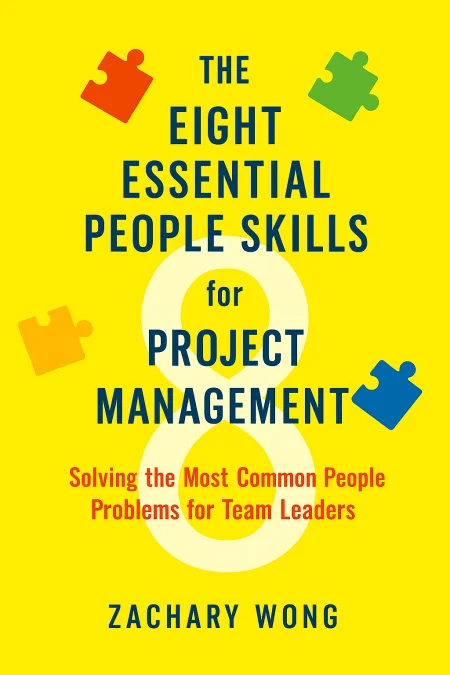
The Eight Essential People Skills for Project Management
Solving the Most Common People Problems for Team Leaders
Book Edition Details
Summary
Ever found yourself in the thick of a project, wondering how to navigate the tangled web of personalities and egos that can make or break your success? Enter Zachary Wong, a seasoned project manager and academic who has spent decades mastering the art of people management. In "The Eight Essential People Skills for Project Management," Wong distills years of experience into a dynamic guide designed to transform chaos into cohesion. This isn't just another management book; it's your roadmap to turning challenging team dynamics into a powerhouse of productivity. Packed with customizable strategies and vivid case studies, Wong equips you with the tools to motivate the unmotivated, realign the resistant, and bring out the best in every team member. Whether you're a seasoned leader or just starting out, this book promises to be your essential companion in the complex world of project management.
Introduction
Leading a project team today feels like trying to conduct an orchestra where every musician speaks a different language, plays from their own sheet music, and has their own idea about the tempo. You're expected to deliver results while navigating personality clashes, motivating underperformers, and keeping everyone aligned toward a common goal. The traditional command-and-control approach no longer works in our collaborative, diverse, and fast-paced work environment. Instead, success hinges on your ability to understand what makes people tick, how to bring out their best performance, and how to create an atmosphere where individuals thrive while contributing to something bigger than themselves. The challenges are real: team members who resist change, difficult conversations you've been avoiding, the delicate balance between being supportive and holding people accountable, and the constant pressure to deliver more with less. But here's the encouraging truth – these people challenges aren't insurmountable obstacles, they're skills waiting to be developed. With the right frameworks and approaches, you can transform workplace friction into collaborative energy, turn reluctant team members into engaged contributors, and create the kind of leadership presence that inspires others to do their best work.
The Wedge Model: Diagnose and Solve People Problems
The traditional organizational pyramid is dead. In today's workplace, we operate within what's better described as a wedge – a flatter, more agile structure that reflects how work actually gets done. The wedge has three distinct levels: individual contributors at the bottom, work teams in the middle, and management at the top, with each level representing increasing scope, authority, and leverage rather than just hierarchy. Consider Tony, a construction project team leader who had to delegate an important client email to Greg while asking Val to review it. What seemed like a straightforward task turned into interpersonal conflict when Greg dismissed Val's suggestions and sent the email without incorporating her feedback. Val felt disrespected and declared she wouldn't provide input on future drafts. The problem wasn't the work itself – it was that Tony failed to clarify what level of authority he was delegating to Greg and what role Val was expected to play. This situation demonstrates how unclear power dynamics create people problems. When Tony delegated the task, he needed to specify whether Greg and Val were working as equals or whether Greg had supervisory authority to make final decisions. By leaving this ambiguous, Tony inadvertently set up a conflict between two capable team members. The wedge model provides diagnostic tools for each level. For individual performance issues, use ERAM: Expectations (are they clear?), Resources (are they adequate?), Ability (do they have the skills?), and Motivation (do they want to do it?). For team problems, apply CPB: Content (shared purpose), Process (how work gets done), and Behavior (how people interact). For organizational challenges, consider MVVOS: Mission, Vision, Values, Objectives, and Strategies. Always take problems to the level with the best resources and authority to solve them. Policy violations go to management, team dynamics issues need team-level solutions, and individual performance problems require one-on-one intervention. Remember that motivation is the greatest lever for individual performance, process is the key lever for team effectiveness, and values provide the strongest leverage for organizational change.
The Three Hats: Balance Authority with Authenticity
Every project leader wears three distinct hats: the management hat (representing company policies and strategic direction), the supervisor hat (directing how work gets done), and the team member hat (partnering and collaborating with others). The key to effective leadership lies not in choosing one hat, but in knowing which hat the situation demands while remaining authentically yourself. Robert, a field services team leader, faced this challenge one foggy evening when he discovered Thomas, a respected supervisor, had driven his car into a culvert on company property. Thomas, who had been drinking, repeatedly asked Robert to simply pull his car out and let him handle the paperwork himself. Despite their friendship and Thomas's persuasive arguments, Robert kept his management hat firmly on, insisting on following company safety protocols. Thomas was subsequently found to have a blood alcohol level of 0.12, and alcohol was discovered in his workspace. This incident illustrates the courage required to wear the appropriate hat even when it's uncomfortable. Robert could have easily switched to his team member hat, treating the situation as a friend helping a friend. Instead, he recognized that company policy regarding safety and potential substance abuse required his management hat, regardless of the personal cost to his relationship with Thomas. The three hats framework requires understanding that each hat carries different levels of power, authority, and responsibility. Your management hat enforces policies and represents organizational interests. Your supervisor hat controls processes and ensures work quality. Your team member hat builds relationships and demonstrates partnership. Effective leaders move fluidly between hats but never compromise their authentic self in the process. The biggest mistake leaders make is letting their role define who they are rather than bringing their authentic self to whatever role they're playing. Jean, a laboratory team leader, fell into this trap by becoming rigid and rule-focused when she took on her leadership position, believing that being tough meant being impersonal. Her team's morale plummeted until she learned that genuine leadership means being yourself while wearing whatever hat the situation requires. Wear the hat that gives you the greatest strength and leverage to solve the problem, have the courage to wear the tough hat when necessary, and remember that your hats are tools for helping people succeed, not weapons for controlling them.
Building High-Performance Teams: The Loop of Inclusiveness
High-performing teams aren't just groups of talented individuals working toward a common goal – they're carefully cultivated environments where every person feels accepted, included, respected, relevant, recognized, and valued. This sense of belonging creates what can be visualized as a "loop" where team members feel safe, connected, and committed to something larger than themselves. Maria, a human resources manager, was tasked with consolidating two teams during a company merger. Despite her best efforts to keep everyone informed and engaged, a year-end survey revealed significant dissatisfaction. Employees felt excluded from decision-making, left to figure things out on their own, and dominated by a few opinionated individuals from the acquiring company. Several talented people left, citing reasons like "I couldn't see where I was going" and "I never felt comfortable in the new company." Maria's experience demonstrates how easily people can feel "out of the loop" even when leaders have good intentions. Exclusion isn't just about being left out of meetings or decisions – it's about feeling disconnected from the mission, uncertain about your value, and suspicious that others don't respect your contributions. When people feel excluded, they either withdraw their engagement or leave entirely. Creating an inclusive loop requires six critical behaviors that must be practiced by everyone on the team. First, mutual trust means believing others act with good intentions, especially when facts are unclear. Second, interdependence involves integrating work so tightly that team members rely on and support each other's success. Third, accountability extends beyond individual responsibility to team accountability, where everyone feels responsible for everyone else's success. Fourth, transparency involves sharing true motives and feelings for the benefit of the team. Fifth, learning means actively sharing knowledge, skills, and experiences with others. Sixth, valuing individuality recognizes that treating everyone the same is actually exclusionary – instead, treat people as they want to be treated. The "loop" becomes pressurized when these behaviors break down, leading to conflicts and exclusion. Consider the simple misunderstanding between Tom and Michelle over a tuna fish sandwich. Tom prepared a sandwich for himself but left extra tuna for Michelle. She misunderstood, took his sandwich, and when he discovered it missing, he faced a choice: demand justice or choose team unity. True inclusiveness emerges when team members consistently choose "we over me" – recognizing that team success ultimately serves individual interests better than individual competition serves team success.
The ABC Box: Motivate Right Behaviors for Success
Managing team behavior isn't about hoping people will do the right thing – it requires a systematic approach to defining desired behaviors, prompting them to occur, and reinforcing them when they do. The ABC Box model provides this framework: Antecedents (what prompts behavior), Behaviors (the specific actions you want), and Consequences (what happens after the behavior). Marty, an ambitious marketing manager, was tasked with expanding his telecommunications company into a new region. Under pressure to meet aggressive targets, he implemented an incentive system that rewarded sales volume without clearly defining how those sales should be achieved. His team dramatically exceeded expectations by writing generous, long-term contracts with heavy discounts and credits. While the numbers looked impressive initially, the contracts were ultimately discovered to be financially ruinrous, leading to the company's insolvency. Marty's failure illustrates the danger of focusing solely on outcomes without defining the behaviors that should drive those outcomes. He established the wrong antecedents (pressure to hit numbers at any cost), failed to specify the right behaviors (ethical, sustainable sales practices), and reinforced the wrong consequences (rewarding volume regardless of quality). Box A contains antecedents – the things that prompt desired behaviors. These include organizational values, team ground rules, performance metrics, training, and clear expectations. The most powerful antecedents are values because they provide the moral compass for making decisions when specific rules don't exist. Box B contains the specific critical success behaviors your team needs to demonstrate. These should be derived from both organizational values (top-down) and team member expectations (bottom-up). Box C contains consequences – the responses that determine whether behaviors get repeated or abandoned. There are four possible consequences: "Yay" (positive reinforcement that increases desired behavior), "Nay" (negative reinforcement that discourages unwanted behavior while encouraging preferred alternatives), "Nothing" (no consequence, which often feels negative), and "Ouch" (punishment designed to immediately stop dangerous or destructive behavior). Most workplace consequences are unfortunately "Nothing" or "Nay," creating a game where employees have less than a 25% chance of receiving positive reinforcement for good work. Successful leaders deliberately increase the frequency of "Yay" consequences while using "Nay" judiciously and "Ouch" only when absolutely necessary. To shape new behaviors, start with frequent positive consequences and gradually reduce their frequency as the behavior becomes habitual. Remember that consequences must be sincere, consistent, timely, values-based, and personalized to be effective. The goal is to create an environment where people want to demonstrate the right behaviors because they feel recognized and valued for doing so.
Summary
Project leadership success isn't about having all the answers – it's about developing the skills to bring out the best in people while navigating the inevitable challenges that arise when humans work together. These eight essential skills provide a comprehensive framework for diagnosing problems at their root, wearing the appropriate leadership role for each situation, creating inclusive environments where everyone contributes their best, maintaining positive team attitudes even during difficult times, helping struggling team members get back on track, systematically reinforcing the behaviors that drive success, managing the fear and uncertainty that come with change and challenge, and building strong relationships with those who have authority over your work. As the research clearly shows: "Your level of happiness, engagement, stress, frustration, and commitment is highly related to your relationship with your immediate supervisor." This principle works both ways – the relationships you build with your team members will largely determine their success and satisfaction, just as your relationship with your boss affects your own experience. Start today by choosing one team member who could benefit from more recognition and give them specific, sincere feedback about something they're doing well. The ripple effects of this simple action will demonstrate why people skills aren't just nice to have – they're the foundation upon which all other project success is built.
Related Books
Download PDF & EPUB
To save this Black List summary for later, download the free PDF and EPUB. You can print it out, or read offline at your convenience.
By Zachary Wong
