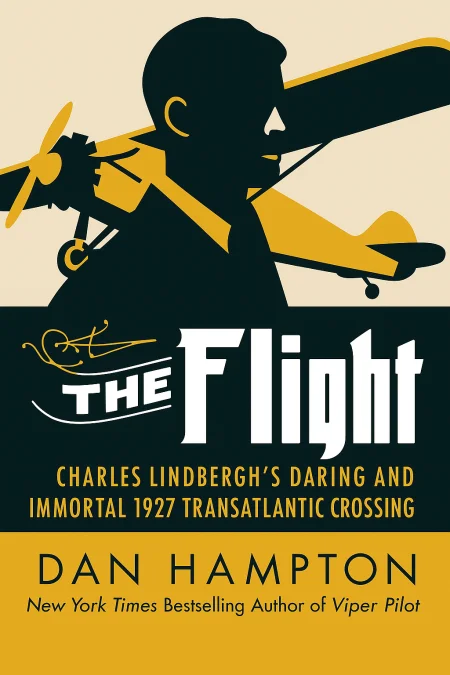
The Flight
Charles Lindbergh’s Daring and Immortal 1927 Transatlantic Crossing
Book Edition Details
Summary
Charles Lindbergh's audacious leap into the annals of history takes flight through the deft storytelling of Dan Hampton in "The Flight." On a fateful May morning in 1927, an ambitious young aviator, barely known outside the aviation circles, set his eyes on the skies, bound for Paris from New York in his trusty yet unproven monoplane, The Spirit of St. Louis. Amidst a backdrop of daring adventure and mortal peril—a challenge that had already claimed lives—Lindbergh faced the vast, uncharted expanse of the Atlantic without the comfort of radar. Hampton, drawing from his own experiences and meticulous research, delivers a pulse-pounding narrative that captures the raw essence of this death-defying feat. With a lens honed by his own flights along Lindbergh's path, Hampton transforms historical facts into a living, breathing saga that resonates with the spirit of human endeavor and ingenuity.
Introduction
On May 20, 1927, a young airmail pilot named Charles Lindbergh climbed into a silver monoplane at Roosevelt Field, carrying nothing but sandwiches, determination, and the dreams of an entire generation. Thirty-three hours later, he emerged from his cockpit in Paris as the most famous man on Earth, having accomplished what many deemed impossible: flying solo across the Atlantic Ocean. Yet this extraordinary feat represented far more than one man's triumph over distance and danger. This remarkable story reveals how a single flight became the catalyst for aviation's transformation from dangerous novelty to essential infrastructure of modern civilization. Through Lindbergh's journey, we witness the precise moment when human ambition, technological capability, and cultural necessity converged to reshape our world forever. The narrative explores three critical dimensions: the fierce competition and early failures that set the stage for this historic achievement, the harrowing thirty-three hours that tested human endurance against the vast Atlantic, and the profound global impact that launched the age of commercial aviation. This tale speaks to anyone fascinated by aviation history, the power of individual courage to change the world, and the moments when technological breakthroughs fundamentally alter human civilization. It offers timeless insights into how breakthrough achievements emerge from the intersection of meticulous preparation, calculated risk-taking, and unwavering commitment to seemingly impossible goals.
The Atlantic Challenge: Early Aviation Dreams and Prize Competition (1919-1927)
The quest to conquer the Atlantic by air began in 1919 with Raymond Orteig's audacious offer of $25,000 to the first aviator who could fly nonstop between New York and Paris. This prize sat unclaimed for nearly eight years, not from lack of interest, but because early aviation technology simply wasn't ready for such an enormous challenge. The Atlantic had become aviation's ultimate test, claiming the lives of several brave pilots who dared attempt the crossing. Throughout the early 1920s, aviation remained largely confined to short-distance flights and military applications. Commercial passenger service was virtually nonexistent, and public confidence in aircraft reliability remained low. The ocean crossing represented more than a sporting challenge; it would prove whether aviation could become a practical means of long-distance transportation or remain forever limited to brief hops between neighboring cities. By 1926, however, significant technological advances had made the crossing theoretically possible. Engine reliability had improved dramatically, particularly with the development of the Wright Whirlwind radial engine. Navigation instruments had become more sophisticated, and aircraft design had evolved to handle longer flights with heavier fuel loads. These improvements attracted serious competitors to the Orteig Prize, including well-funded expeditions led by famous aviators like Commander Richard Byrd and René Fonck. The competition intensified throughout early 1927, with multiple teams preparing elaborate multi-engine aircraft and experienced crews. Yet it was a relatively unknown airmail pilot from Minnesota who would ultimately seize the prize, not through superior resources or publicity, but through a radically different approach: flying alone in a single-engine aircraft, betting everything on simplicity, reliability, and individual skill over technological complexity.
Thirty-Three Hours Alone: The Historic Solo Flight Across Ocean
At 7:52 AM on May 20, 1927, the Spirit of St. Louis struggled into the air from Roosevelt Field, so heavily loaded with 450 gallons of gasoline that it barely cleared the telephone wires at the runway's end. Lindbergh faced a journey that would test every aspect of human endurance and mechanical reliability, flying alone over 3,600 miles of ocean with only basic instruments and his own skill to guide him safely to Paris. The flight became an epic battle against the elements and human limitations. Lindbergh navigated through ice storms that could have destroyed his fabric-covered aircraft, fought off sleep deprivation that produced dangerous hallucinations, and maintained course by dead reckoning across trackless ocean where a small error could prove fatal. His Wright Whirlwind engine performed flawlessly, making over fourteen million perfect combustions during the marathon flight, while Lindbergh himself pushed the boundaries of human endurance. The psychological challenges proved as daunting as the physical ones. Completely alone for over thirty hours, Lindbergh experienced profound isolation unlike anything in human experience. He later described conversations with phantom passengers who seemed to offer guidance during the darkest hours over the Atlantic, revealing the almost mystical nature of his communion with the elements and the extraordinary mental stress of solo flight across such vast distances. As dawn broke over Ireland on May 21st, Lindbergh's precise navigation became apparent when he made landfall just twenty-five miles north of his intended course. This remarkable accuracy after flying over 3,000 miles of ocean demonstrated that transoceanic flight was not a matter of luck but of skill, preparation, and reliable technology. When he finally touched down at Le Bourget Field in Paris, he had not merely crossed an ocean but had proven that the age of global aviation had truly begun.
From Hero to Revolution: Global Impact and Aviation's New Era
Lindbergh's landing at Le Bourget triggered an unprecedented global celebration that transcended national boundaries and cultural differences. Within hours, he had become the world's first truly international celebrity of the modern age, his achievement resonating with millions who saw in his flight a symbol of human potential unleashed. The modest young aviator found himself thrust into a role he never sought: global ambassador for the transformative power of aviation. The immediate impact on the aviation industry was revolutionary and far-reaching. Within months of Lindbergh's flight, applications for pilot licenses increased by 300 percent, aircraft sales soared, and investors poured millions into aviation companies that had struggled for years to attract serious capital. The flight proved definitively that long-distance air travel was not only possible but practical and profitable, setting in motion the rapid development of commercial airlines that would shrink the world in ways previously unimaginable. Beyond the technical achievements, Lindbergh's success validated a new approach to aviation that emphasized reliability over complexity. His single-engine aircraft had outperformed the elaborate multi-engine designs favored by other competitors, establishing new standards for aircraft design, navigation equipment, and fuel systems. More importantly, the flight demonstrated that commercial aviation could be both safe and economically viable, leading to the rapid expansion of passenger and mail services that would connect continents. The broader cultural impact extended far beyond aviation itself, helping to restore global confidence in technology and human progress at a time when many questioned whether modern civilization was worth preserving. Lindbergh's achievement suggested that technology, properly applied, could serve human aspirations rather than destroy them, offering hope to a generation still recovering from the devastation of World War I and searching for authentic heroes in an age of increasing mechanization and mass society.
Summary
Charles Lindbergh's transatlantic flight represents one of those rare historical moments when individual achievement perfectly captures the spirit of an entire era while simultaneously pointing toward the future. The flight succeeded not merely because of technical innovation or personal courage, but because it resolved a fundamental tension of the modern age: whether technology could serve human dreams rather than diminish them, and whether individual excellence remained relevant in an era of mass production and corporate power. The deeper lesson of Lindbergh's achievement lies in its demonstration that transformative change often emerges from individuals willing to take extraordinary risks in pursuit of seemingly impossible goals. His success required not just courage but meticulous preparation, technical competence, and an unwavering commitment to excellence. These qualities remain as relevant today as they were in 1927, offering a template for anyone seeking to accomplish something truly significant in our own age of rapid technological change. For our contemporary world, facing its own disruptions and uncertainties, Lindbergh's story provides both inspiration and practical guidance. It reminds us that progress requires pioneers willing to venture into the unknown, that careful preparation can overcome seemingly impossible odds, and that authentic achievement still has the power to unite people across all boundaries. Most importantly, it demonstrates that in any age of transformation, we need individuals who embody our highest aspirations while remaining grounded in competence, humility, and genuine service to human advancement.
Related Books
Download PDF & EPUB
To save this Black List summary for later, download the free PDF and EPUB. You can print it out, or read offline at your convenience.
By Dan Hampton
