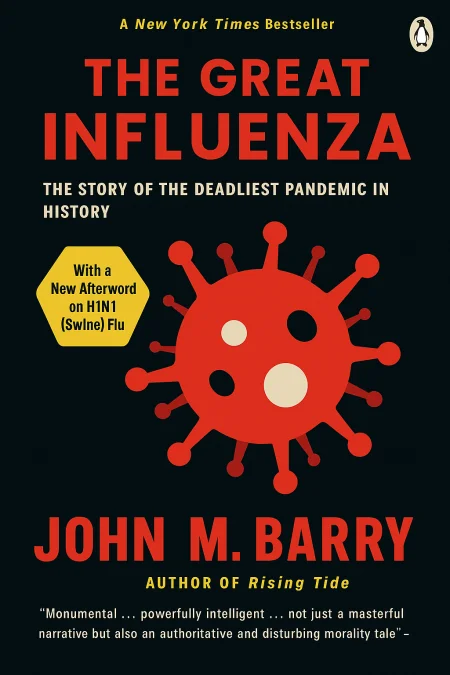
The Great Influenza
The Story of the Deadliest Pandemic in History
Book Edition Details
Summary
In the throes of World War I, an unseen killer emerged from a Kansas army camp, hitching a ride with American soldiers to ignite a global catastrophe. "The Great Influenza" by John M. Barry revisits 1918, a year marked not just by the ravages of war but by an influenza pandemic that would eclipse the Black Death and AIDS in its deadly reach. This is not just a history lesson; it is a gripping narrative that examines the intersection of science and human fallibility in the face of nature's wrath. Barry's exhaustive research reveals a world teetering on the edge, forced to reckon with the fragile balance between scientific advancement and human hubris. As we stand on the brink of potential new pandemics, Barry offers a haunting reflection on past missteps and a cautionary tale for the future, complete with a newly penned afterword that sharpens the focus on the lurking menace of avian flu.
Introduction
In the autumn of 1918, as the Great War neared its bloody conclusion, an invisible enemy emerged that would prove far deadlier than any human conflict. Within months, this microscopic killer swept across the globe with unprecedented speed and lethality, claiming more lives in a single year than the medieval Black Death had taken in a century. Yet this was no plague striking an ignorant world—this was the first great collision between nature's fury and the emerging power of modern scientific medicine. The story reveals how a generation of brilliant American scientists had spent decades revolutionizing medicine, building world-class research institutions, and preparing for exactly this kind of biological crisis. When the pandemic struck, they found themselves in a desperate race against an enemy that seemed to mock their most advanced knowledge. This tale illuminates profound questions about how societies balance truth and reassurance during existential threats, how scientific breakthroughs emerge from apparent failure, and what happens when political expediency collides with public health necessity. For anyone seeking to understand how pandemics unfold in modern societies, how scientific institutions respond under extreme pressure, or how the tension between transparency and panic shapes crisis response, this story offers both sobering lessons and unexpected insights about humanity's capacity to learn from its darkest hours and build better defenses against future threats.
Scientific Revolution and the Rise of American Medicine (1870s-1917)
The transformation of American medicine began with a revolutionary declaration of war against ignorance itself. In the decades following the Civil War, medical education in America was largely a commercial enterprise where anyone could hang out a shingle and call themselves a doctor. Most medical schools required no laboratory work, no hospital experience, and often granted degrees after just a few months of lectures. This system produced physicians who had never touched a patient or seen a cadaver, yet were expected to heal the sick. The revolution's unlikely leader was William Henry Welch, a portly, cigar-smoking bachelor who never practiced medicine on a single patient yet possessed an extraordinary gift for recognizing talent and inspiring greatness in others. After studying with Europe's leading scientists, Welch returned to transform Johns Hopkins University into a beacon that would illuminate all of American medicine. His laboratory became a pilgrimage site for ambitious young doctors who wanted to learn real science rather than the bloodletting and purgatives that still dominated medical practice. The movement gained unstoppable momentum as Welch and his allies systematically dismantled the old guard. They established the Rockefeller Institute for Medical Research, created rigorous standards for medical education, and began producing a generation of physician-scientists who could match their European counterparts. By 1910, Abraham Flexner's devastating report on American medical schools had closed more than half of them, leaving only those committed to scientific rigor. The transformation was so complete that European scientists began looking to America for leadership. This scientific awakening came not a moment too soon. As America prepared to enter the Great War, military leaders understood that epidemic disease had historically killed more soldiers than bullets. The medical establishment had built an army of scientific warriors, equipped with the most advanced knowledge of their era, but they had no idea how severely their preparations would soon be tested by nature's most formidable challenge.
The Virus Emerges: From Kansas to Global Catastrophe (1918)
The year 1918 created conditions that were perfect for pandemic disaster. President Wilson had transformed America into what he called "one white-hot mass" devoted entirely to winning the war. Millions of young men were crammed into hastily built military camps, often sleeping in overcrowded barracks through one of the coldest winters on record. The government had mobilized not just soldiers but entire communities, creating a vast network of interconnected populations that could spread disease with unprecedented speed. In this militarized society, the first whispers of an unprecedented threat emerged from the most unlikely place—Haskell County, Kansas, a sparsely populated farming region where a new influenza strain may have first jumped from animals to humans. Dr. Loring Miner, a country physician with scientific training, recognized something unprecedented in the violent symptoms he witnessed and issued the only warning published anywhere in the world about this emerging danger. When young men from Haskell traveled to nearby Camp Funston for military training, they carried more than patriotic duty with them. The virus that emerged defied every known pattern of infectious disease. Most influenza strains killed the very young and very old, but this one targeted healthy adults in their prime, creating a sinister W-shaped mortality curve instead of the usual U-shape. As it spread through military camps and then to Europe with American troops, it initially appeared mild—what soldiers dismissively called "three-day fever." But viruses exist as constantly mutating swarms, adapting with each passage through human hosts, and this particular strain was becoming increasingly efficient at what viruses do best. The war effort itself became the virus's greatest ally. The same transportation networks that moved troops and supplies also moved infection across continents. The same propaganda machine that demanded unwavering optimism also suppressed accurate information about the growing biological threat. By summer 1918, the stage was perfectly set for a catastrophe that would test every assumption about modern civilization's ability to protect itself from nature's ancient power.
Society Under Siege: Government Failure and Scientific Battle
September 1918 marked the moment when the smoldering biological fire erupted into a global conflagration of unprecedented horror. At Camp Devens outside Boston, what began as a few cases of apparent respiratory illness exploded within days into a medical nightmare that left even the most experienced physicians stunned into silence. When William Welch, America's most distinguished medical scientist, walked through the camp's overwhelmed hospital and witnessed the carnage firsthand, he could only mutter in bewilderment, "This must be some new kind of infection or plague." The scenes at Devens defied all medical understanding and human comprehension. Previously healthy young soldiers were turning blue from lack of oxygen, bleeding from their noses and ears, and dying within hours of their first symptoms. The hospital, designed for twelve hundred patients, was caring for more than six thousand. Bodies were stacked in corridors like cordwood, the morgue overflowed onto porches, and the medical staff themselves were collapsing at an alarming rate. Seventy of two hundred nurses fell ill, and many would never recover. Philadelphia provided a devastating case study in how political considerations could override public health wisdom with catastrophic results. Despite urgent warnings from medical experts, city officials allowed a massive Liberty Loan parade to proceed on September 28, with hundreds of thousands of spectators crowding together to support the war effort. Within seventy-two hours, every hospital bed in the city was filled. Within ten days, the daily death toll exceeded the city's normal weekly mortality from all causes combined. Bodies piled up in homes and morgues, families fought over scarce coffins, and the city's social fabric began to unravel completely. As society crumbled around them, a small army of scientists launched a desperate counterattack against the invisible enemy. Led by figures like Oswald Avery at the Rockefeller Institute and Paul Lewis in Philadelphia, these researchers abandoned normal scientific protocols and worked around the clock to identify the pathogen and develop treatments. They faced a cruel paradox: the very urgency of the crisis forced them to abandon the careful, methodical approaches that made good science possible, yet the stakes had never been higher for scientific success.
Legacy and Lessons: From Crisis to Modern Medical Preparedness
The pandemic ultimately burned itself out through the grim mathematics of epidemic disease—it simply ran out of susceptible hosts to infect. By 1920, the virus had killed somewhere between fifty and one hundred million people worldwide, making it the deadliest natural disaster in recorded human history. Yet from this unprecedented catastrophe emerged scientific knowledge and institutional wisdom that would prove invaluable for protecting future generations against similar biological threats. The crisis catalyzed a revolution in medical research that extended far beyond influenza itself. Scientists like Oswald Avery, initially focused on finding the pandemic's cause, pursued investigations that would ultimately lead to the discovery of DNA as the carrier of genetic information, fundamentally transforming our understanding of life itself. The pandemic experience convinced governments and philanthropists to invest heavily in medical research, leading to institutions and programs that would eventually conquer diseases like polio and develop the antibiotics that saved millions of lives. The disaster also revealed the critical importance of honest communication during public health emergencies, a lesson that resonates powerfully in our interconnected world. Communities that received truthful information about the pandemic's severity generally responded more effectively than those subjected to official lies and propaganda. The breakdown of trust between authorities and citizens proved nearly as dangerous as the virus itself, demonstrating that fear thrives in the absence of reliable information and that public cooperation depends on governmental honesty. Perhaps most importantly, the pandemic established the template for modern scientific response to emerging diseases. The collaborative networks formed during the crisis, the research methodologies developed under extreme pressure, and the institutional frameworks created in its aftermath would serve as the foundation for twentieth-century medicine's greatest triumphs. These systems continue to guide our response to new pandemic threats, proving that even humanity's darkest hours can illuminate the path toward a more prepared and resilient future.
Summary
The great influenza pandemic of 1918 represents the ultimate collision between humanity's growing scientific confidence and nature's indifferent power to humble even our greatest achievements. At its core, this story reveals the eternal tension between our desire to control the natural world and the sobering reality that invisible forces can still bring modern civilization to its knees in a matter of weeks. The pandemic struck precisely when American medicine was experiencing unprecedented success, yet it exposed vast gaps between laboratory knowledge and practical solutions, between institutional preparedness and actual crisis response. The catastrophe demonstrated that scientific progress alone cannot protect us from existential threats without corresponding advances in honest leadership, transparent communication, and social cohesion. The communities and nations that survived best were those that combined rigorous scientific investigation with truthful public information and collective action. Conversely, those that prioritized propaganda over truth, political convenience over public health, and individual interests over community welfare suffered the most devastating consequences and longest-lasting social damage. For our contemporary world, facing new pandemic threats and other global challenges that require coordinated response, this history offers essential guidance: invest continuously in scientific research and public health infrastructure before crises emerge, not after they strike; maintain public trust through honest communication even when the truth is frightening or politically inconvenient; and recognize that our interconnected world makes global cooperation not merely beneficial but absolutely necessary for survival. The next pandemic is not a question of if but when, and our response will depend entirely on how well we have absorbed the hard-won wisdom of 1918.
Related Books
Download PDF & EPUB
To save this Black List summary for later, download the free PDF and EPUB. You can print it out, or read offline at your convenience.
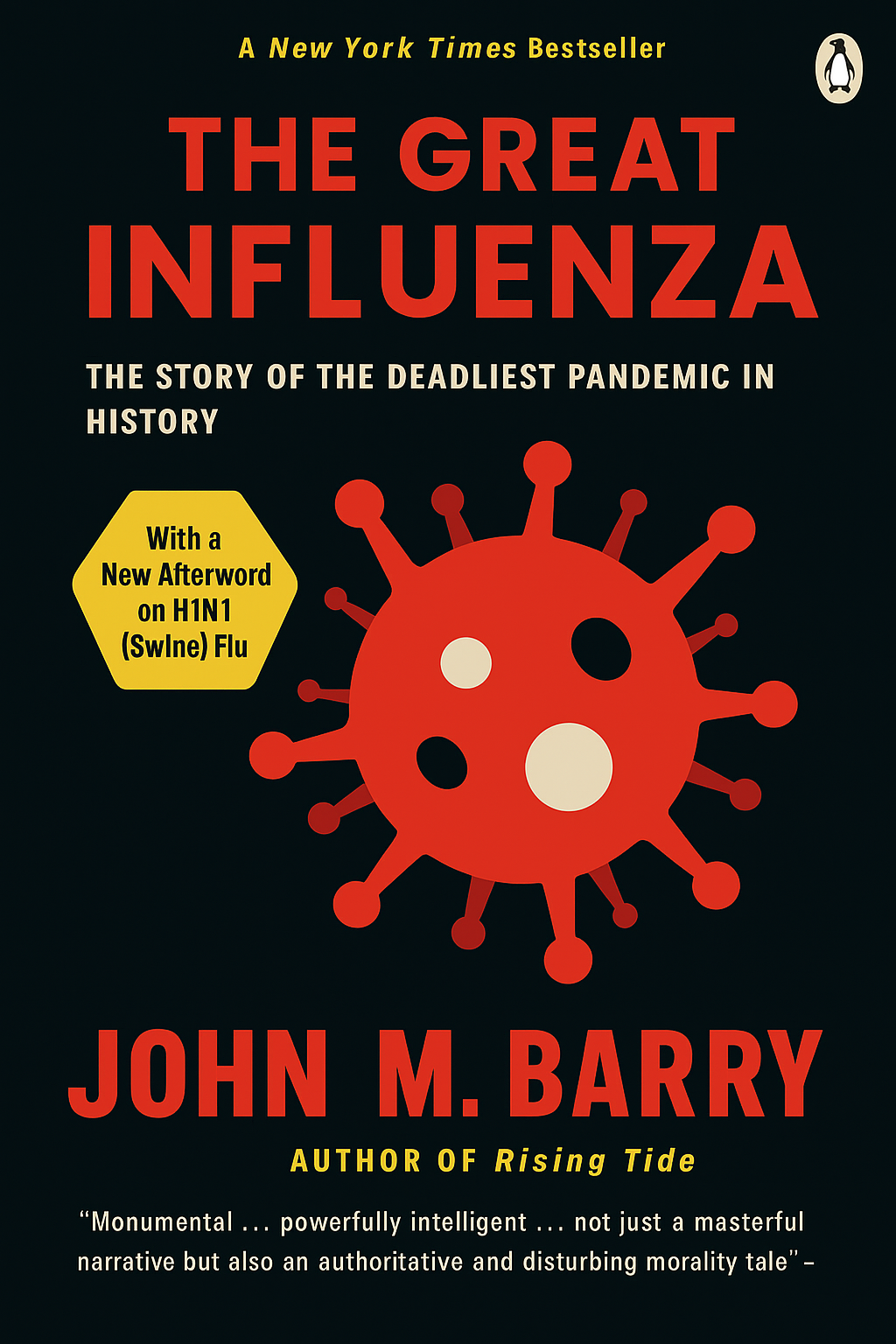
By John M. Barry
