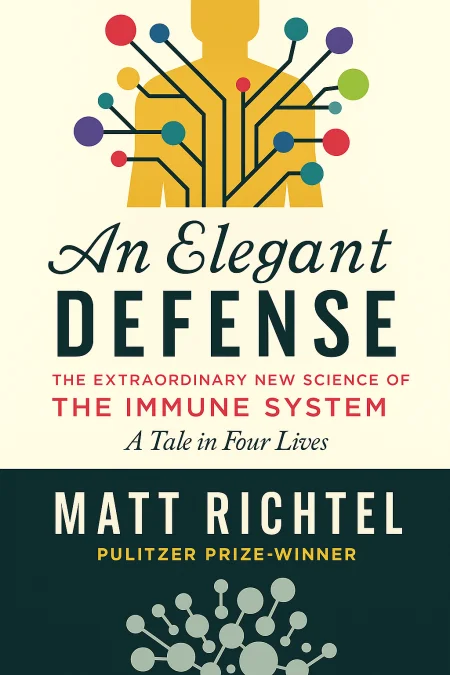
An Elegant Defense
The Extraordinary New Science of the Immune System: A Tale in Four Lives
Book Edition Details
Summary
Amidst the delicate dance of life and death, where microscopic warriors wage unseen battles, lies the heart of Matt Richtel's groundbreaking narrative, *An Elegant Defense*. Here, the immune system's intricate ballet unfolds through the poignant tales of four individuals: a cancer patient reborn, a miraculous defiance of HIV, and two women confronting their own bodies' rebellion. This isn't merely science—it's a human saga, where evolution's masterpiece stands both as a sentinel and a saboteur. Richtel, a Pulitzer Prize–winning journalist, crafts an unforgettable odyssey through history’s plagues and today’s medical marvels, revealing the fragile majesty of our body's most enigmatic guardian. This is a story where every chapter turns on the edge of discovery, inviting readers to rethink the very fabric of survival and resilience.
Introduction
Right now, as you read these words, an extraordinary battle is taking place inside your body. Millions of microscopic warriors are patrolling your bloodstream, standing guard at every entrance, and making split-second decisions that could mean the difference between health and disease. Yet this isn't the simple war between good and evil that we often imagine. Your immune system is far more sophisticated than any army—it's a peacekeeping force that must distinguish friend from foe while maintaining a delicate balance that keeps you alive. Every day, it faces an impossible challenge: protect you from countless threats while avoiding friendly fire against your own tissues. Through the remarkable stories of patients whose immune systems have both failed and triumphed, you'll discover why fever might actually be your ally, how stress literally rewrites your cellular defenses, and why the trillions of bacteria living inside you could be your most important partners in staying healthy. Most surprisingly, you'll learn that having the "strongest" immune system isn't the goal—having the wisest one is.
The Discovery of Our Body's Defense System
For centuries, doctors noticed that people who survived certain diseases rarely caught them again, but no one understood why. The breakthrough came from studying what seemed like the most useless parts of the body. In chicken anatomy, researchers found a small sac called the bursa that appeared to serve no purpose. In humans, the thymus gland seemed equally pointless—it was largest in children and shrank with age, leading many to dismiss it as evolutionary baggage. Everything changed when scientists began removing these "useless" organs from laboratory animals. Mice born without a thymus couldn't fight off infections that normal mice handled easily. They would accept skin grafts from other animals without rejection, as if their bodies couldn't tell the difference between self and foreign tissue. The thymus, it turned out, was actually a training academy for immune cells called T cells—the generals and coordinators of your body's defense system. Meanwhile, other researchers discovered that a different type of immune cell, called B cells, developed in the bone marrow. These cells act like skilled manufacturers, producing antibodies—specialized proteins that lock onto specific threats like keys fitting into locks. The beauty of this system lies in its incredible diversity: your body can create antibodies for threats that have never existed before, essentially giving you a master key set for locks you've never encountered. This discovery revealed that immunity isn't just about building walls against invaders. Instead, your immune system is an adaptive learning network that can recognize billions of different threats, remember them for decades, and coordinate sophisticated responses involving multiple types of cells working in perfect harmony. The system has two main branches: innate immunity provides immediate but general protection, like security guards who can spot obvious troublemakers, while adaptive immunity creates detailed files on specific criminals and hunts them down with precision. Together, they form an elegant defense that has protected complex life forms for over 500 million years, proving its effectiveness through the ultimate test of evolutionary time.
When the Immune System Goes Wrong
Sometimes our most sophisticated protection becomes our greatest enemy. Autoimmune diseases occur when the immune system's remarkable ability to distinguish "self" from "other" breaks down catastrophically. Instead of attacking only foreign invaders, it begins targeting the body's own healthy tissues with the same precision and persistence it normally reserves for dangerous pathogens. This isn't simply a case of an overactive immune system—it's a fundamental error in recognition that can have devastating consequences. Consider rheumatoid arthritis, where immune cells mistake the lining of joints for foreign tissue and launch a sustained assault. The inflammation that would normally help heal an injury becomes a chronic source of destruction, causing the painful swelling and eventual joint damage that characterizes the disease. What makes this particularly tragic is the immune system's excellent memory—once it has identified these "foreign" targets that are actually part of the person's own body, it continues the attack indefinitely, maintaining detailed cellular records of tissues it should be protecting. Women are three times more likely to develop autoimmune diseases than men, a cruel irony given that their generally stronger immune responses help them live longer and better protect their children during pregnancy. This enhanced immune vigilance comes with a dangerous trade-off: the same robust defenses that fight off infections more effectively can become hypervigilant, overreacting to harmless substances or turning against healthy tissue. Stress, infections, hormonal changes, and genetic factors can all trigger this immune rebellion, creating perfect storms where the body's defenses spiral out of control. The revolution in treating autoimmune diseases came with the development of targeted therapies that work like molecular guided missiles. Instead of suppressing the entire immune system with steroids—equivalent to using a sledgehammer when you need a scalpel—newer drugs can block specific inflammatory signals while leaving the rest of the immune system intact. Medications like Enbrel and Humira neutralize tumor necrosis factor, a chemical messenger that tells cells to die, effectively halting autoimmune attacks while preserving the body's ability to fight real infections. However, the complexity of autoimmune diseases means that finding the right treatment often requires careful trial and adjustment, highlighting how much we still have to learn about our elegant but sometimes misdirected defenses.
Modern Threats and Immune System Challenges
Our immune systems evolved in a world teeming with dangerous microbes, but modern life has created an unexpected problem: we may have become too clean for our own good. The hygiene hypothesis suggests that our sanitized environments are leaving immune systems undertrained and prone to overreacting to harmless substances like pollen, pet dander, or even our own tissues. Like soldiers who become trigger-happy without real enemies to fight, our immune cells may be attacking the wrong targets simply because they lack proper training. The evidence for this paradox comes from studying communities with different lifestyles. Amish children, who grow up on traditional farms surrounded by animals and dust, have dramatically lower rates of asthma and allergies compared to their genetically similar neighbors who use modern industrial farming methods. The Amish homes contain seven times more bacterial residue, yet the children have stronger, more balanced immune systems. Similarly, children who grow up with pets, attend daycare early, or have older siblings tend to develop fewer allergies—their immune systems receive diverse microbial education that teaches them to distinguish real threats from harmless environmental particles. The trillions of bacteria living in your gut, collectively called the microbiome, play a crucial role in this immune education. These microscopic partners don't just help digest food—they actively train your immune system, helping develop specialized regulatory cells that prevent overreactions and maintain the delicate balance between protection and restraint. When we overuse antibiotics or antibacterial products, we disrupt this ancient partnership, potentially contributing to the rise in allergies and autoimmune diseases seen in developed countries. Perhaps most importantly, modern research has revealed the profound connections between mental and physical health in immune function. Chronic stress floods your body with hormones that suppress immune responses, making you more vulnerable to infections and possibly cancer. Sleep deprivation reduces the production of infection-fighting cells and weakens your ability to form immunological memories from vaccines. The interconnected nature of our physical and mental well-being means that managing stress, getting adequate sleep, and maintaining a diverse microbiome through sensible rather than excessive hygiene practices may be as important as any medical intervention. Our elegant defense system, refined over millions of years of evolution, requires not just medical support but lifestyle choices that honor its sophisticated design and fundamental need for balance.
Summary
The immune system represents one of biology's most remarkable achievements—a defense network so sophisticated that it can distinguish between countless potential threats while maintaining the delicate balance necessary for life itself. Rather than a simple army fighting foreign invaders, our immune system functions as an elegant peacekeeping force that must constantly choose between protection and restraint, learning to coexist with beneficial microbes while eliminating genuine dangers. The modern world presents unprecedented challenges to this ancient system: diseases that exploit our defenses, environments so sanitized they may weaken our natural resilience, and lifestyles that chronically stress the very mechanisms designed to protect us. Understanding how this system actually works—its need for training, balance, and cooperation with our microbial partners—offers profound insights into maintaining health in our complex modern world. How might we redesign our daily habits and medical approaches to work with, rather than against, this remarkable biological inheritance? What other secrets might this system hold for treating not just infections and cancer, but the growing epidemic of immune-related disorders that challenge our sanitized society?
Related Books
Download PDF & EPUB
To save this Black List summary for later, download the free PDF and EPUB. You can print it out, or read offline at your convenience.

By Matt Richtel
