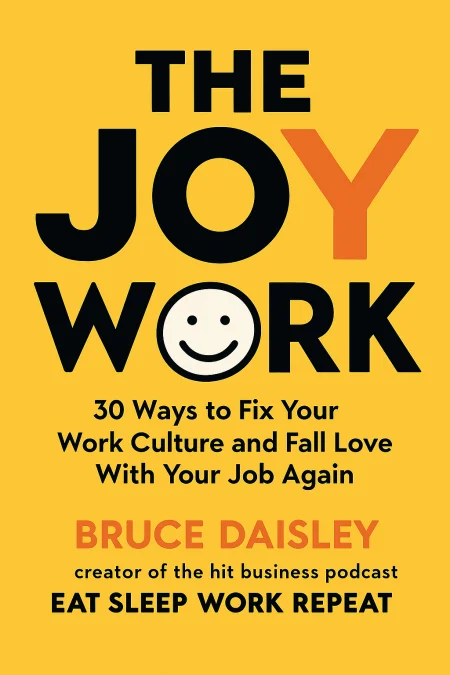
The Joy of Work
30 Ways to Fix Your Work Culture and Fall in Love With Your Job Again
Book Edition Details
Summary
In a world where the office often feels like a battleground, Bruce Daisley's "The Joy of Work" emerges as a beacon of transformative insight, reshaping how we perceive our daily grind. Daisley, renowned for his hit podcast, guides us through the maze of modern work life with wit and wisdom, challenging the age-old quest for "why" with a fresh focus on "how." This book brims with concise, empirically backed strategies to revolutionize your work environment, from optimizing coffee break locales to unlocking the mysterious power of the Monk Mode Morning. If the status quo leaves you yearning for more joy and less chaos, this book promises to elevate your 9-to-5 into a fulfilling pursuit of happiness and productivity.
Introduction
Have you ever noticed how some Monday mornings feel different? There's an energy in certain offices where people seem genuinely glad to be there, where conversations flow naturally, and where challenges are met with curiosity rather than dread. This isn't about ping-pong tables or free snacks. It's about something far more fundamental: the quality of human connection and the conditions that allow people to do their best work. The modern workplace has become a maze of endless meetings, constant notifications, and the relentless pressure to be always on. We've convinced ourselves that being busy equals being productive, that longer hours mean better results, and that work should feel like work. But what if this entire approach is not only wrong but actively harmful to both our wellbeing and our performance? What if the secret to loving where you work isn't about finding the perfect job, but about transforming how we approach the work we already have? The evidence is clear: small changes in how we structure our days, connect with colleagues, and create psychological safety can dramatically transform our experience of work from something we endure to something that energizes us.
Recharge: Restore Your Energy and Focus
The foundation of loving your work begins with recognizing a simple truth: you cannot pour from an empty cup. In our hyperconnected world, we've forgotten the basic rhythms that make human beings thrive. We check emails before our feet hit the floor in the morning and scroll through notifications as our heads hit the pillow at night. This constant connectivity isn't making us more productive; it's slowly draining our creative reserves and leaving us feeling perpetually exhausted. Consider Cal Newport's concept of "Deep Work" and how architect Jony Ive once described Apple's creative process. The breakthrough innovations didn't happen in bustling open offices during marathon brainstorming sessions. They emerged during protected periods of focused concentration, when minds were free to wander and make unexpected connections. Newport advocates for what he calls "Monk Mode Mornings," where the first few hours of the day are completely protected from interruptions, meetings, and the digital noise that fragments our attention. The transformation is remarkable when people reclaim these focused periods. David Wilding, a colleague who commuted two hours to London each day, discovered that switching to a later train allowed him to work in genuine quiet, turning his commute from dead time into his most productive hours of the day. He arrived at the office having already accomplished meaningful work, energized rather than depleted. The key is to identify your personal energy patterns and design your day around them. Most people find their minds are clearest in the morning, making this the ideal time for creative or complex work. Block these hours ruthlessly, communicate your boundaries clearly, and watch how protecting just a few hours of focused time can revolutionize your relationship with work. Start small with two mornings a week, and gradually expand as you experience the profound difference this makes to both your output and your sense of accomplishment.
Sync: Build Trust and Team Connection
Human beings are fundamentally social creatures, and the quality of our relationships at work determines whether we dread Monday mornings or approach them with anticipation. The most successful teams aren't necessarily filled with the most talented individuals; they're the ones where people feel genuinely connected to each other, where trust runs deep, and where everyone feels their voice matters. Sandy Pentland's groundbreaking research at MIT revealed something surprising about workplace productivity. Using sociometric badges to track thousands of interactions, he discovered that the physical location of something as simple as the coffee machine had as much impact on collaboration as the organizational chart. When teams naturally encountered each other around shared spaces, ideas flowed more freely, problems got solved faster, and innovation flourished. This principle transformed the experience of a Bank of America call center in a remarkable way. Instead of allowing employees to take breaks individually, managers synchronized break times so teams could decompress together. The results were extraordinary: stress levels dropped by 19 percent, team cohesion increased by 18 percent, and most remarkably, productivity soared by 23 percent. This wasn't because people worked harder; it was because they supported each other through difficult calls, shared solutions, and created genuine human connections that made the work feel meaningful. The lesson extends far beyond call centers. Create opportunities for your team to connect as human beings, not just as job functions. This might mean instituting regular coffee walks, organizing brief team lunches, or simply ensuring there's space in your schedule for the informal conversations that build trust. Remember that psychological safety, the feeling that you can speak up without fear of humiliation or retribution, is the foundation of high-performing teams. Foster an environment where questions are welcomed, mistakes are learning opportunities, and everyone's contribution is valued.
Buzz: Create Psychological Safety and Positive Impact
The highest level of workplace satisfaction occurs when teams achieve what can only be described as "buzz." This is the magical state where psychological safety meets positive energy, where people feel both safe to be vulnerable and energized by the work they're doing together. Teams in this state don't just perform better; they actively seek out challenges and approach obstacles with genuine excitement. Amy Edmondson's research in hospitals revealed the counterintuitive truth about high-performing teams: the best medical teams reported more errors than their lower-performing counterparts. The difference wasn't in their competence but in their willingness to acknowledge mistakes and learn from them. Teams with psychological safety created environments where problems could be discussed openly, leading to better outcomes for everyone involved. Bjarke Ingels, the renowned architect, discovered a practical way to create this safety in his design meetings. Instead of people defending their ideas personally, he ensures that every discussion centers around physical models or sketches. This way, when someone critiques an idea, they're critiquing the work, not the person. This simple shift transforms potentially threatening conversations into collaborative problem-solving sessions where everyone's goal is to make the project better. The transformation to a "buzz" state requires intentional effort from everyone on the team. Leaders must model vulnerability by admitting their own mistakes and uncertainties. Team members must commit to focusing on issues rather than personalities. Everyone must contribute to creating an atmosphere where laughter and lightness can coexist with serious work and high standards. Most importantly, remember that psychological safety isn't about lowering standards or avoiding difficult conversations. It's about creating conditions where people can bring their full selves to work, where diverse perspectives are valued, and where the collective intelligence of the team is greater than the sum of its parts. When teams achieve this state, work becomes not just bearable but genuinely energizing.
Summary
The path to loving where you work isn't about finding the perfect job or waiting for someone else to fix your workplace culture. It's about taking ownership of your own energy, building genuine connections with the people around you, and creating conditions where everyone can do their best work. As one insight from this research makes clear: "We don't need to love what we do, but we need to feel that what we do matters, that we're making progress, and that we're doing it alongside people who see and value our contributions." The most powerful change you can make starting tomorrow is this: choose one small way to protect your energy, one genuine way to connect with a colleague, and one opportunity to make someone else's work a little easier or more enjoyable. These seemingly minor shifts have the power to transform not just your own experience, but to create ripples of positive change throughout your entire workplace. Your future self will thank you for starting today.
Related Books
Download PDF & EPUB
To save this Black List summary for later, download the free PDF and EPUB. You can print it out, or read offline at your convenience.
By Bruce Daisley
