
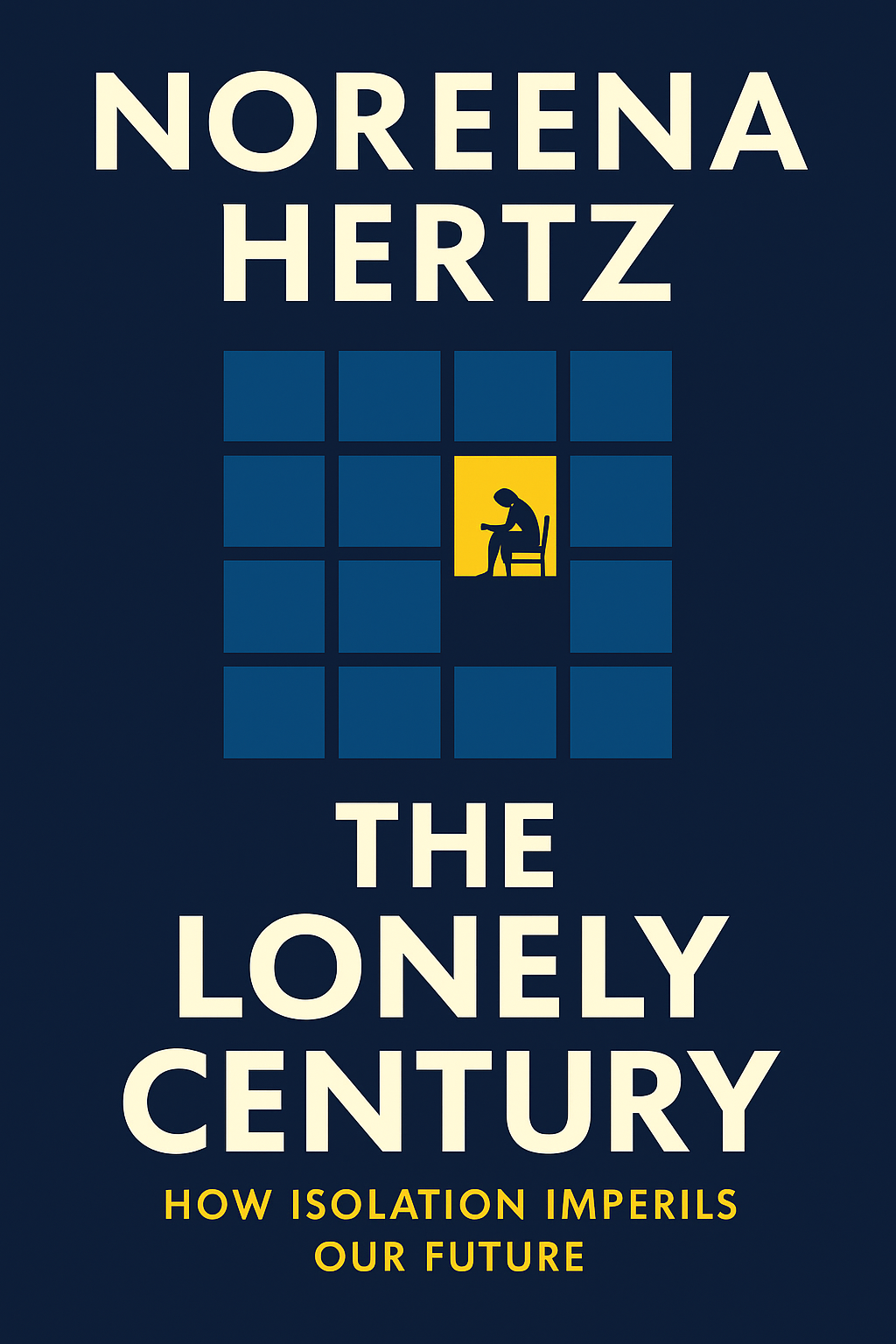
The Lonely Century
How Isolation Imperils Our Future
Book Edition Details
Summary
In an era where the bonds of community are fraying and isolation lurks behind every screen, Noreena Hertz confronts the silent epidemic that shadows modern life: loneliness. Her revelatory work, "The Lonely Century," delves deep into the heart of this pervasive solitude, weaving together a tapestry of insights from a decade of research and vivid storytelling. Hertz leads us through the unsettling terrain of a world where "renting a friend" becomes a norm, and technological whispers replace human touch. Yet, amid the gloom, she unveils bold, imaginative solutions—compassionate AI, reimagined urban landscapes, and revitalized civic life. This isn't just a narrative of despair; it's a clarion call for transformation, offering readers a hopeful blueprint to mend the social fabric and reignite the spark of genuine human connection.
Introduction
Modern society confronts a profound paradox that challenges fundamental assumptions about progress and human connection. Despite unprecedented technological capabilities for communication and interaction, vast populations across developed nations report experiencing deeper isolation than previous generations. This phenomenon extends far beyond individual emotional distress to encompass systematic erosion of the social bonds that sustain democratic institutions, economic cooperation, and collective problem-solving capacity. The crisis reveals how seemingly beneficial developments in technology, urban planning, and economic organization have converged to create conditions fundamentally at odds with human social needs. Digital platforms promise community while delivering performative isolation. Economic systems prioritize efficiency over relationship-building. Urban environments facilitate movement while discouraging meaningful encounter. These trends have produced measurable consequences for public health, political stability, and social cohesion that demand serious analytical attention. Understanding this crisis requires examining the intricate relationships between individual psychology, technological systems, economic structures, and political outcomes. The evidence demonstrates that loneliness operates not merely as personal affliction but as active force shaping collective behavior, democratic participation, and institutional trust. Through systematic analysis of neurological research, economic data, political movements, and technological impacts, patterns emerge that illuminate both the scope of contemporary social disconnection and potential pathways toward rebuilding meaningful community in an atomized world.
Systemic Forces Creating Modern Loneliness Crisis
Contemporary loneliness differs fundamentally from historical experiences of solitude or social isolation, representing instead a systematic breakdown of the social infrastructure that traditionally provided meaning, connection, and mutual support. Economic restructuring has transformed work from collaborative social enterprise into isolated, competitive endeavor where individuals compete for scarce opportunities while lacking meaningful workplace community. The rise of gig economy platforms exemplifies this transformation, forcing millions into precarious employment relationships mediated by algorithmic systems that reduce human complexity to numerical ratings. Neoliberal ideology has systematically dismantled collective institutions in favor of radical individualism, reframing citizens as consumers competing in zero-sum markets rather than community members with shared interests and mutual obligations. This ideological shift extends beyond economic policy to reshape cultural values, replacing social solidarity with personal responsibility and treating community bonds as obstacles to market efficiency rather than essential elements of human flourishing. Urban design principles prioritize economic productivity over social interaction, creating physical environments that discourage spontaneous encounters and community formation. Hostile architecture deliberately excludes vulnerable populations while discouraging lingering or unstructured social activity. The destruction of public spaces eliminates crucial venues where people from different backgrounds might encounter each other and practice democratic citizenship skills. Residential segregation by income ensures that social classes remain isolated from one another, reducing opportunities for cross-cutting social ties that historically fostered empathy and political moderation. Workplace surveillance systems and algorithmic management create unprecedented alienation by reducing workers to data points while providing no meaningful recourse for unfair treatment. Employees find themselves constantly monitored and evaluated by systems that cannot recognize human complexity or respond to individual circumstances. This technological dehumanization extends beyond efficiency concerns to fundamentally alter the nature of work relationships, making genuine collaboration and mutual support increasingly difficult to sustain within formal employment structures.
Digital Technology's Role in Social Fragmentation
Digital communication technologies have fundamentally altered the quality and depth of human interaction, often substituting shallow, performative exchanges for meaningful face-to-face relationships. Social media platforms deliberately employ addictive design features borrowed from gambling psychology, including variable reward schedules and social comparison mechanisms that generate compulsive usage patterns while failing to provide the emotional sustenance of genuine human connection. These platforms profit from user engagement rather than wellbeing, creating business incentives that prioritize emotional arousal over authentic relationship formation. The psychological impact of constant digital engagement extends beyond addiction to fundamental changes in social cognition and empathy development. Heavy social media users demonstrate reduced ability to read facial expressions and nonverbal cues, while children raised with significant screen time show delayed development of emotional regulation and interpersonal skills. This suggests that digital natives may be systematically less equipped for the complex social negotiations required by democratic participation and community building. Algorithmic curation creates echo chambers that reinforce existing beliefs while limiting exposure to diverse perspectives and challenging ideas. This digital segregation reduces opportunities for cross-cutting social ties that historically fostered political compromise and mutual understanding. Users retreat into ideological bubbles where their worldviews go unchallenged, contributing to political polarization and making democratic deliberation increasingly difficult to sustain across partisan divides. The attention economy demands constant engagement, fragmenting focus and making sustained, deep relationships more difficult to maintain. Notifications interrupt conversations, multitasking becomes normalized, and fear of missing out drives compulsive device checking. These patterns erode the patience and presence required for meaningful connection, creating societies of individuals who are physically together but mentally elsewhere, absorbed in digital worlds rather than engaging with people around them. The result is widespread social isolation despite apparent connectivity.
Political and Health Consequences of Mass Isolation
Chronic loneliness produces measurable physiological impacts comparable to major health risk factors, triggering inflammatory responses that compromise immune function and increase cardiovascular disease risk. Research demonstrates that social isolation carries mortality risk equivalent to smoking fifteen cigarettes daily, yet this public health crisis receives far less attention or resources than other recognized threats. The economic burden reaches hundreds of billions annually across developed nations through increased healthcare utilization, prescription drug usage, and long-term care needs. Social isolation creates fertile conditions for authoritarian movements and populist appeals that exploit feelings of abandonment and disconnection. Lonely individuals become more susceptible to conspiracy theories, more likely to view politics through tribal lenses, and more willing to support leaders who promise simple solutions to complex problems. Historical analysis reveals consistent patterns linking social atomization to political extremism, with totalitarian movements finding strongest support among socially isolated populations lacking moderating influence of diverse social networks. The decline of intermediary institutions has eliminated crucial spaces where citizens once learned democratic skills and developed cross-cutting loyalties. Labor unions, religious organizations, civic associations, and local community groups historically served as schools for democracy, teaching compromise, deliberation, and collective action. Their absence leaves individuals more vulnerable to demagogic appeals and less capable of collaborative problem-solving that democracy requires. Digital echo chambers amplify these tendencies by providing illusion of community while actually increasing isolation. Online political engagement often takes the form of performative outrage rather than genuine dialogue, reinforcing tribal identities while degrading capacity for empathy across political divides. The result is political culture characterized by mutual incomprehension, where citizens increasingly view opponents as existential threats rather than fellow citizens with different perspectives worthy of engagement and potential compromise.
Rebuilding Community Through Structural Reform
Addressing systematic loneliness requires coordinated intervention across multiple domains, beginning with recognition that individual therapeutic approaches cannot solve structural problems. Governments must prioritize social infrastructure with urgency typically reserved for physical infrastructure, funding libraries, community centers, and public spaces that facilitate intergenerational interaction and cross-class encounter. Urban planning must prioritize community formation over efficiency metrics, creating mixed-income housing developments and designing neighborhoods that encourage walking, lingering, and spontaneous social interaction. Technology companies bear responsibility for redesigning platforms to promote genuine connection rather than addictive engagement. This requires fundamental restructuring of business models that currently profit from emotional arousal and extended usage time. Regulatory frameworks must evolve to constrain harmful aspects of digital technology, particularly for children and adolescents, including mandatory addiction warnings, restrictions on manipulative design features, and robust content moderation to reduce toxic discourse. Workplace reforms must restore human dignity and agency in employment relationships through strict limitations on employee surveillance, transparent performance evaluation algorithms, meaningful appeals processes, and restoration of collective bargaining rights. The classification of gig workers as independent contractors must end where platforms exercise employer-like control over working conditions and compensation. Organizations must recognize that employee wellbeing ultimately serves business interests by improving productivity, creativity, and collaborative effectiveness. Educational institutions must teach digital literacy alongside traditional subjects, helping young people understand how technology affects relationships and mental health while developing practical skills for managing digital consumption and maintaining face-to-face relationships. Schools themselves must model healthy community by creating environments where students learn collaboration, empathy, and civic engagement through direct experience rather than abstract instruction.
Summary
The loneliness epidemic represents a fundamental crisis of social organization that threatens the collaborative relationships essential for democratic governance and collective problem-solving, requiring systematic solutions that address structural forces undermining human connection rather than treating isolation as individual pathology. The convergence of technological disruption, economic inequality, and social fragmentation has created conditions where meaningful social bonds become increasingly difficult to form and maintain, with measurable consequences for public health, political stability, and economic productivity. Rebuilding community demands conscious choices to prioritize human connection over technological convenience, to design institutions that foster rather than fragment social relationships, and to recognize that true prosperity requires not merely economic growth but preservation and cultivation of social bonds that make democratic life possible and meaningful.
Related Books
Download PDF & EPUB
To save this Black List summary for later, download the free PDF and EPUB. You can print it out, or read offline at your convenience.
By Noreena Hertz
