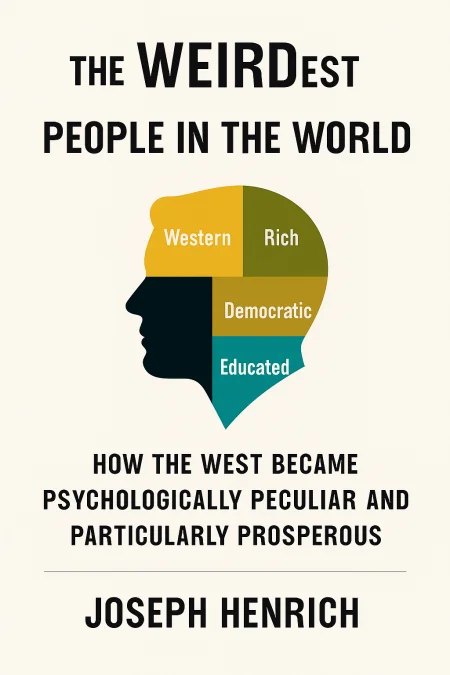
The WEIRDest People in the World
How the West Became Psychologically Peculiar and Particularly Prosperous
Book Edition Details
Summary
What if the very fabric of your thoughts, your values, your sense of self, was woven by cultural forces unseen and ancient? In "W.E.I.R.D. Minds," Joseph Henrich embarks on a groundbreaking exploration of the peculiar psychological landscape of Western societies. This riveting narrative unravels the evolutionary threads that distinguish Western, Educated, Industrialized, Rich, and Democratic minds from the rest of the globe. Henrich's keen insights traverse the epochs, revealing how radical shifts in kinship and marriage, propelled by the Roman Catholic Church, forged a uniquely individualistic psyche. This distinct mindset, in turn, ignited the industrial revolution and sculpted the modern world's socio-economic and political bedrock. A tapestry of anthropology, psychology, and history, Henrich's work captivates with its audacity and depth, challenging readers to rethink how culture, institutions, and mindsets have coalesced to shape human destiny.
Introduction
Picture yourself walking through a bustling European marketplace in 1300 CE, where merchants from distant lands shake hands on deals worth fortunes, young apprentices choose their own masters, and couples marry for love rather than family alliance. This scene would have been utterly impossible just three centuries earlier, when Europe was a patchwork of tribal societies bound by blood ties and ancient customs. What transformed this continent from a collection of kinship-based clans into the birthplace of individualism, democracy, and modern capitalism? The answer lies in one of history's most unexpected revolutions: the medieval Catholic Church's systematic campaign to reshape European family life. Through seemingly mundane marriage regulations and kinship prohibitions, Church authorities inadvertently triggered a psychological transformation that would fundamentally alter how Europeans thought, felt, and related to one another. This transformation created what we now recognize as WEIRD psychology—Western, Educated, Industrialized, Rich, and Democratic ways of thinking that emphasize individual choice, analytical reasoning, and cooperation with strangers. Understanding this remarkable story illuminates some of history's most puzzling questions: Why did the Scientific Revolution emerge in Europe rather than China? How did democratic institutions take root? What made certain societies more innovative and economically dynamic? This book is essential reading for anyone curious about the deep historical roots of modernity, the hidden forces that shape human behavior across cultures, or the surprising ways that religious institutions can accidentally transform entire civilizations over centuries.
Ancient Kinship Networks: Europe's Tribal Foundation (500-800 CE)
In the centuries following the collapse of the Western Roman Empire, European societies resembled a vast archipelago of tribal communities, each bound together by intensive kinship networks that would seem alien to modern eyes. The Franks, Goths, Anglo-Saxons, and countless other Germanic and Celtic tribes organized their entire social world around extended family clans, where blood relationships determined everything from marriage partners to inheritance rights to collective responsibility for crimes. These kinship-intensive societies operated according to psychological principles that differed dramatically from modern Western thinking. Cousin marriage was not just common but often preferred, as it strengthened clan bonds and kept valuable property within the family lineage. When conflicts arose, entire extended families bore collective responsibility for individual actions—if your nephew committed murder, you might find yourself liable for blood money or facing retaliation from the victim's relatives. This system created fierce loyalty within kin groups but profound suspicion toward outsiders who couldn't be trusted without the bonds of blood or marriage. The psychological patterns that emerged from these social structures shaped every aspect of daily life. People thought holistically rather than analytically, viewing individuals as inseparable from their family context and community relationships. Decision-making prioritized group harmony and ancestral wisdom over individual choice or innovation. Trust flowed readily to blood relatives but rarely extended beyond clan boundaries, limiting the scale of cooperation and economic exchange. This kinship-based world produced remarkable solidarity and mutual support within small communities, but it also constrained social development in crucial ways. Villages rarely grew beyond a few hundred people, trade remained largely local and personal, and technological innovation spread slowly through networks of family connections. The psychological toolkit that served tribal societies well—intense group loyalty, conformity to traditional practices, and suspicion of strangers—would prove inadequate for the complex, large-scale institutions that later civilizations would require. Yet this ancient foundation provided the raw material for one of history's most consequential social experiments.
The Church's Marriage Revolution: Dismantling Family Structures (800-1200 CE)
Around 800 CE, the Western Catholic Church embarked on what would become one of history's most systematic campaigns of social engineering. Through an expanding web of marriage prohibitions and family regulations, Church authorities began dismantling the kinship networks that had organized European society for millennia. What started as scattered restrictions on close-relative marriages evolved into a comprehensive assault on the very foundations of tribal social organization. The transformation accelerated under Pope Gregory I and his successors, who understood that intensive kinship networks posed a direct challenge to Church authority. Extended family clans commanded ultimate loyalty from their members, competed with religious institutions for resources and allegiance, and maintained their own systems of justice and social control. By systematically prohibiting marriages between increasingly distant relatives—eventually extending to sixth cousins—the Church made it nearly impossible for families to maintain the tight-knit alliances that had defined European societies for centuries. The Marriage and Family Program, as historians now call it, went far beyond simple incest taboos. Church authorities banned polygamy, prohibited adoption between families, eliminated inheritance rights for children born outside sanctified marriages, and required public ceremonies overseen by clergy. They forbade levirate marriage, where widows married their deceased husband's brothers, and sororate marriage, where widowers married their deceased wife's sisters. Each prohibition severed another thread in the web of kinship obligations that bound communities together. Enforcement proved remarkably effective through a combination of spiritual terror and earthly consequences. Excommunication meant social death in medieval Europe, cutting violators off from all Christian society and condemning their souls to eternal damnation. Those who persisted in forbidden marriages faced anathema—a ritual consignment to Satan that few dared risk. The Church also positioned itself to inherit wealth from the childless couples and broken family lines that resulted from its policies, creating powerful economic incentives to maintain the new system. By 1200 CE, this relentless campaign had fundamentally altered the social landscape of Western Europe. The dense kinship networks that had organized tribal societies for millennia lay in ruins, replaced by nuclear families and individuals who had to forge new relationships beyond blood ties. This transformation created the psychological conditions for entirely new forms of social organization based on voluntary association, shared interests, and impersonal cooperation—the foundations of the modern world.
Medieval Transformation: From Clans to Cities and Individual Identity (1200-1500 CE)
As Europe's ancient kinship networks crumbled under centuries of Church pressure, a remarkable transformation began to unfold across the medieval landscape. Freed from the dense web of clan obligations that had previously defined their identities, Europeans increasingly saw themselves as individuals capable of making personal choices about marriage, occupation, and residence. This psychological shift manifested in an explosion of new social institutions that would have been impossible under the old kinship-based system. The most dramatic manifestation was the rapid growth of cities and voluntary associations that transformed medieval Europe into a laboratory of social innovation. Universities sprouted across the continent, beginning with Bologna and Paris, creating communities of scholars bound by shared intellectual purpose rather than blood ties. Craft guilds organized artisans into professional associations that transcended family connections, while merchant guilds facilitated trade networks spanning vast distances. These voluntary institutions operated according to impersonal rules and merit-based advancement rather than kinship obligations and inherited status. Medieval cities became magnets for the rootless individuals created by the Church's family revolution. Young people could no longer rely on arranged marriages within extended family circles, forcing them to venture beyond their birth communities to find spouses and opportunities. The famous medieval saying "city air makes one free" captured this transformation—urban life literally liberated people from the constraints of traditional kinship obligations while offering new possibilities for association and advancement based on personal attributes rather than family background. The psychological changes accompanying these social transformations ran deep. Europeans began thinking more analytically, breaking complex problems into component parts rather than viewing them holistically within webs of relationship and tradition. They developed stronger senses of individual identity and personal responsibility, taking ownership of their actions rather than deferring to family or clan leaders. Time consciousness emerged as mechanical clocks spread through urban centers, creating new rhythms of work and social coordination that prioritized efficiency over traditional customs. Perhaps most importantly, Europeans began developing what we now recognize as impersonal trust—the ability to cooperate fairly with strangers based on shared norms rather than personal relationships or family connections. This psychological capacity enabled the emergence of complex market systems, legal institutions, and political arrangements that could coordinate the activities of thousands of genetically unrelated individuals. By 1500, Western Europe had developed a unique combination of nuclear families, voluntary associations, and market-based institutions that distinguished it from every other civilization on Earth, setting the stage for the revolutionary changes that would follow.
WEIRD Psychology Emerges: Protestant Innovation to Modern Institutions (1500-1800 CE)
The Protestant Reformation of the early 16th century represented the religious crystallization of psychological changes that had been developing in European populations for centuries. When Martin Luther challenged papal authority and emphasized individual faith over institutional mediation, he tapped into a mindset that had already been shaped by generations of weakened kinship ties and voluntary association. Protestant emphasis on personal Bible reading, individual salvation, and direct relationship with God perfectly matched the individualistic psychology that had emerged from the ruins of Europe's clan-based societies. Protestant communities became incubators of the psychological traits that would define modern Western civilization. The doctrine of sola scriptura required believers to interpret religious truth for themselves rather than accepting traditional authority, fostering the analytical and critical thinking that would prove essential for scientific inquiry. Protestant work ethic, with its emphasis on worldly calling and material success as signs of divine favor, channeled individualistic psychology toward economic innovation and accumulation. The proliferation of Protestant sects, each claiming direct access to divine truth, normalized religious competition and voluntary association in ways that would later extend to political and economic spheres. The economic implications of Europe's psychological transformation became increasingly apparent as Protestant regions pulled ahead of their Catholic neighbors in innovation, trade, and living standards. The combination of individualism, analytical thinking, and impersonal trust that had emerged from centuries of social experimentation proved perfectly adapted to the demands of early capitalism. Entrepreneurs could raise capital from strangers, workers could sell their labor in impersonal markets, and consumers could trust the quality of goods produced by people they would never meet. Political innovation followed psychological change as European societies developed increasingly sophisticated forms of representative government and constitutional law. The same voluntary associations that had emerged in medieval cities evolved into political parties, professional organizations, and civil society institutions that mediated between individuals and state power. Democratic ideals of individual rights, popular sovereignty, and limited government resonated with populations that had already internalized individualistic values and experience with voluntary cooperation. By 1800, the transformation was complete. Europeans had developed what researchers now call WEIRD psychology—ways of thinking and feeling that emphasized individual agency, analytical reasoning, guilt-based morality, and the ability to cooperate with strangers through impersonal institutions. This psychological toolkit would prove crucial as Europe entered the age of industrial revolution, democratic transformation, and global expansion that would reshape the entire world according to Western models and values.
Summary
The central paradox of Western civilization lies in how a religious institution's campaign to control marriage and family life accidentally created the psychological foundations for secular modernity. The medieval Catholic Church's systematic dismantling of Europe's kinship networks didn't just change how people married and inherited property—it fundamentally rewired how Europeans thought, felt, and related to one another. This thousand-year transformation created a new kind of human psychology characterized by individualism, analytical thinking, and the ability to cooperate with strangers based on abstract principles rather than blood ties. This remarkable story reveals that human psychology is far more malleable and culturally variable than we typically assume. What seems like "natural" ways of thinking and behaving—individual choice, analytical reasoning, trust in strangers—are actually the products of specific historical circumstances and institutional changes that unfolded over centuries. The WEIRD psychology that enabled scientific progress, democratic governance, and economic growth also contributed to social isolation, environmental destruction, and the erosion of traditional communities that provided meaning and support for most of human history. For our interconnected world, this history offers crucial insights for navigating contemporary challenges. First, successful institutional transfer requires understanding the psychological foundations that make different systems work—importing formal democracy or capitalism without considering cultural fit often leads to dysfunction and conflict. Second, psychological transformation occurs gradually across generations, suggesting that sustainable development requires patient cultivation of underlying mindsets rather than expecting rapid cultural change. Finally, recognizing the contingent nature of Western values and institutions should inspire both humility about their universality and curiosity about alternative ways of organizing human societies that might address the limitations of WEIRD psychology while preserving its benefits.
Related Books
Download PDF & EPUB
To save this Black List summary for later, download the free PDF and EPUB. You can print it out, or read offline at your convenience.
By Joseph Henrich
