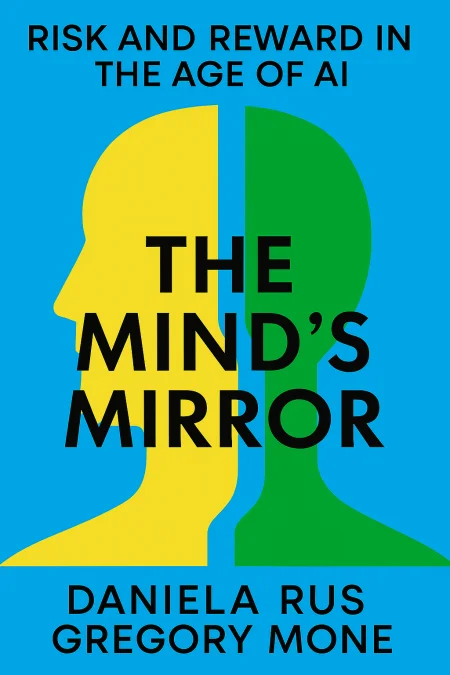
The Mind's Mirror
Risk and Reward in the Age of AI
Book Edition Details
Summary
When the uncharted realms of artificial intelligence beckon, fear and fascination intermingle. "The Mind’s Mirror" by esteemed MIT director Daniela Rus, alongside science writer Gregory Mone, dares to dissect this enigma with refreshing clarity. As AI continues to revolutionize our world, this book offers a gripping exploration into its dual nature—an extraordinary tool for human advancement and a harbinger of potential peril. Rus's unique vantage point, honed through years of pioneering research, unveils the intricacies, possibilities, and pitfalls of AI, urging society to tread wisely. This narrative isn't just an exposé; it's a clarion call to harness AI's promise responsibly, ensuring it uplifts rather than undermines our future. In a vibrant tapestry of insights and foresight, "The Mind’s Mirror" is a captivating primer on navigating the thrilling yet precarious frontier of artificial intelligence.
Introduction
Imagine having a conversation with a machine that seems to understand you better than some humans do, or watching as artificial intelligence discovers new medicines in weeks rather than years. Four billion people now carry AI-powered devices in their pockets, yet most of us barely understand what we're holding. This technological revolution isn't coming—it's already here, transforming everything from how we work and learn to how we create and communicate. But beneath the headlines about chatbots and deepfakes lies a more profound story about intelligence itself, both artificial and human. This book explores how AI systems actually work, what they can and cannot do, and most importantly, how we can harness their extraordinary capabilities while navigating the very real risks they present. You'll discover how these digital minds serve as mirrors reflecting our own cognitive processes, revealing not just the future of technology, but new insights into the nature of human intelligence itself.
AI Superpowers: Speed, Knowledge, Insight, and Creativity
Modern AI systems possess capabilities that can genuinely be described as superpowers, amplifying human abilities in ways that seemed impossible just a few years ago. These aren't mystical powers, but rather computational strengths that emerge from processing vast amounts of data at incredible speeds. Think of AI as a cognitive amplifier that can enhance our natural mental faculties across multiple dimensions simultaneously. The first superpower is speed—not just moving fast, but thinking and processing information at superhuman velocity. An AI system can read through millions of research papers in hours, write sophisticated code in minutes, or generate complex analyses in seconds. This isn't merely about doing things quickly; it's about compressing timescales that normally constrain human progress. Drug discovery, which traditionally takes years, can now happen in weeks when AI systems help identify promising compounds and predict their behavior. AI's knowledge superpower goes beyond simple information storage. These systems can synthesize insights from disparate fields, connecting patterns across domains that individual human experts might never encounter. They serve as both microscopes and telescopes for knowledge—revealing hidden details in complex datasets while also providing broad perspectives across vast information landscapes. Unlike traditional search engines that retrieve information, AI can generate new understanding by finding unexpected connections between seemingly unrelated concepts. Perhaps most remarkably, AI demonstrates genuine creative capabilities, generating novel art, writing, music, and even scientific hypotheses. This creativity isn't just recombination of existing elements, but the emergence of genuinely new forms and ideas. When AI systems collaborate with human creators, they can push the boundaries of what's possible, serving as creative partners that suggest new directions and possibilities that humans alone might never explore.
How AI Works: Predicting, Generating, and Optimizing
Understanding AI's capabilities requires grasping three fundamental approaches that power most modern systems. These aren't just technical details—they're the core mechanisms that enable machines to exhibit intelligent behavior. Each approach tackles different types of problems and reveals different aspects of what we call artificial intelligence. Predictive AI learns from historical patterns to forecast future outcomes or classify new information. Think of it as a sophisticated pattern-matching system that can recognize faces in photos, predict stock market trends, or diagnose medical conditions from symptoms. These systems work by training on massive datasets, gradually adjusting their internal parameters until they can accurately identify relevant patterns. The key insight is that prediction and classification are essentially the same process—both involve recognizing which category or outcome best fits new information based on learned patterns. Generative AI represents a fascinating flip of this process. Instead of going from many inputs to one output, generative systems start with simple prompts and create complex, detailed outputs. When you ask ChatGPT to write a story or request an image from DALL-E, you're witnessing generative AI in action. These systems learn the underlying structure of human language, visual art, or other creative domains, then use that understanding to produce new content that feels authentic and original. The third approach, optimization through reinforcement learning, enables AI systems to learn through trial and error, much like humans do. These systems explore different strategies in pursuit of specific goals, gradually improving their performance based on feedback about what works and what doesn't. This is how AI mastered complex games like Go and chess, and how it's learning to navigate real-world challenges like autonomous driving or resource allocation.
Challenges and Risks: Technical, Societal, and Economic
The same capabilities that make AI so powerful also create unprecedented challenges across multiple dimensions of human society. These aren't distant, theoretical problems—they're immediate concerns that affect jobs, privacy, security, and the fundamental fabric of how we organize our communities and economies. Technical challenges begin with the massive computational requirements that currently limit AI development to well-funded corporations and institutions. Training advanced AI models requires enormous amounts of energy and water, creating environmental concerns even as these systems help solve other sustainability problems. The complexity of modern AI also creates "black box" problems—we often can't understand exactly how these systems reach their conclusions, making it difficult to ensure they're reliable or fair. Societal risks encompass everything from privacy erosion to the spread of misinformation. AI systems can be used for mass surveillance, generating convincing deepfakes, or amplifying existing biases in ways that discriminate against vulnerable groups. The same tools that democratize access to sophisticated capabilities can also be weaponized by bad actors for fraud, manipulation, or social disruption. Perhaps most concerning is the potential for these systems to undermine trust in information itself, as the line between authentic and artificial content becomes increasingly blurred. Economic disruption may be the most immediate and widespread impact. While AI won't simply replace human workers wholesale, it will fundamentally transform how work gets done across virtually every industry. Some jobs will disappear, others will be enhanced by AI assistance, and entirely new categories of work will emerge. The transition period poses significant challenges for workers, communities, and policymakers trying to ensure that AI's benefits are shared broadly rather than concentrated among a few powerful entities.
AI Stewardship: Shaping Our Technological Future
The future of AI isn't predetermined—it's something we can actively shape through thoughtful stewardship and deliberate choices about how these technologies are developed and deployed. This responsibility extends far beyond technologists and policymakers to include every person and organization that will be affected by AI's continued evolution. Effective stewardship begins with understanding rather than fear. We need more people to develop practical literacy about how AI works, what it can and cannot do, and how to evaluate AI systems critically. This doesn't mean everyone needs to become a computer scientist, but rather that citizens, workers, and leaders need enough knowledge to make informed decisions about AI adoption and regulation. Technical solutions can address many current limitations and risks. Researchers are developing smaller, more efficient AI models that require less energy and can run on everyday devices rather than massive data centers. New approaches to training can reduce bias and improve reliability, while security measures can protect against misuse. However, technical fixes alone aren't sufficient—we also need social and institutional frameworks to guide AI development. The most important insight may be that AI serves as a mirror for human intelligence, reflecting both our capabilities and our limitations. As we build machines that can think, create, and solve problems, we're learning more about what makes human cognition special. Rather than replacing human intelligence, the goal should be creating collaborative partnerships between human and artificial minds that amplify our collective problem-solving abilities.
Summary
The age of AI is not arriving in some distant future—it's unfolding right now, offering unprecedented opportunities to augment human capabilities while presenting equally unprecedented challenges to navigate carefully. The key insight is that artificial intelligence systems, despite their remarkable abilities, function best as partners rather than replacements for human intelligence, creating a collaborative dynamic that can solve problems neither humans nor machines could tackle alone. As we shape this technology's future, two crucial questions emerge: How can we ensure that AI's benefits are distributed broadly across society rather than concentrated among a few powerful entities? And how can we maintain human agency and values as these systems become increasingly sophisticated and pervasive? For readers interested in understanding the forces that will shape the next phase of human civilization, grappling with these questions isn't just intellectually fascinating—it's essential for participating meaningfully in the decisions that will determine whether AI becomes a tool for human flourishing or a source of unprecedented disruption.
Related Books
Download PDF & EPUB
To save this Black List summary for later, download the free PDF and EPUB. You can print it out, or read offline at your convenience.
By Daniela Rus
