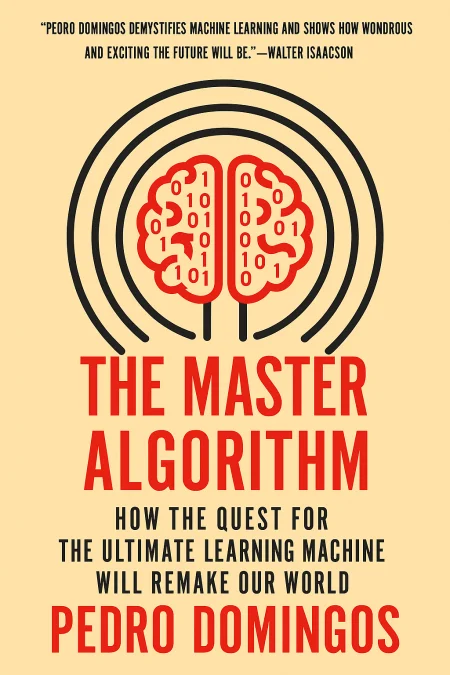
The Master Algorithm
How The Quest For The Ultimate Learning Machine Will Remake Our World
Book Edition Details
Summary
Hidden within the labyrinth of today's technological frontier lies a quest as profound as any mythic odyssey: the creation of a Master Algorithm, a learning entity so adaptable, it mirrors human cognition. In "The Master Algorithm," Pedro Domingos unveils the secretive, exhilarating race to craft a universal learner—one capable of deciphering the vast tapestry of data before us. This narrative isn't just a journey through code; it's a glimpse into the soul of modern science, where lines of algorithms sculpt the future of business, reshape societal norms, and redefine the very essence of knowledge. Domingos doesn't just outline the evolution of machine learning; he positions it as the new gospel of the digital age, a transformative force already entwined with every facet of our lives. This is not merely a book but a gateway to understanding the invisible engines propelling our world into tomorrow.
Introduction
Imagine a world where computers don't just follow pre-written instructions, but actually learn and improve on their own, much like a child discovering patterns in the world around them. This isn't science fiction—it's happening right now, and it's called machine learning. Every time you search Google, shop on Amazon, or ask Siri a question, you're interacting with algorithms that have taught themselves to understand what you want. But here's the fascinating part: despite the incredible diversity of these applications, they all spring from just a handful of fundamental approaches to learning. This book takes us on a journey through the five major "tribes" of machine learning, each with their own philosophy about how intelligence works and how machines should learn. We'll discover how symbolists believe all intelligence can be reduced to manipulating symbols like a mathematician solving equations, while connectionists try to reverse-engineer the brain itself. Along the way, we'll explore whether there might be one ultimate learning algorithm—a "Master Algorithm"—that could learn anything and everything, potentially revolutionizing science, medicine, and our understanding of intelligence itself.
Five Tribes of Machine Learning: Different Paths to Intelligence
The world of machine learning isn't a unified field but rather a collection of competing schools of thought, each with their own beliefs about how learning should work. Think of it like different philosophical schools in ancient Greece, each convinced they've found the true path to knowledge. These five tribes—symbolists, connectionists, evolutionaries, Bayesians, and analogizers—approach the problem of machine learning from fundamentally different angles, yet each has contributed crucial insights to our understanding of artificial intelligence. The symbolists believe that all intelligence can be reduced to manipulating symbols, much like how a mathematician solves complex equations by replacing one expression with another according to logical rules. They see learning as the inverse of deduction—if we can deduce conclusions from premises, then we should be able to work backwards from conclusions to discover the missing premises or rules. Their master algorithm is inverse deduction, which figures out what knowledge is missing to make a logical argument work, then generalizes it as broadly as possible. Connectionists take inspiration from the brain itself, viewing learning as what happens when networks of simple processing units adjust their connections based on experience. Just as neurons that fire together wire together, artificial neural networks strengthen connections that lead to correct outputs and weaken those that don't. Their master algorithm is backpropagation, which systematically adjusts connection weights throughout a network to minimize errors, much like how a coach might adjust each player's role to improve the team's overall performance. The remaining three tribes—evolutionaries who simulate natural selection, Bayesians who treat learning as probabilistic inference, and analogizers who learn by recognizing similarities—each bring their own powerful perspectives to the challenge of creating machines that can learn and adapt in our complex world.
From Data to Knowledge: How Algorithms Learn Patterns
At its heart, machine learning is about finding patterns in data and using those patterns to make predictions about new situations. But the devil is in the details—how exactly does a machine extract meaningful patterns from raw information without getting lost in noise or irrelevant details? The answer lies in understanding how different algorithms approach this fundamental challenge, each with their own strengths and blind spots. Consider the perceptron, one of the earliest learning algorithms, which works like a simplified artificial neuron. It takes multiple inputs, weights them according to their importance, adds them up, and fires if the total exceeds a threshold. Learning happens by adjusting these weights based on mistakes—if the perceptron should have fired but didn't, it increases the weights of active inputs; if it fired when it shouldn't have, it decreases them. This simple process can learn to recognize patterns, but it has a crucial limitation: it can only learn concepts that can be separated by a straight line, like distinguishing between large and small objects based on size and weight. The breakthrough came with multilayer networks and backpropagation, which can learn much more complex patterns by stacking multiple layers of artificial neurons. Think of it like an assembly line where each worker performs a simple task, but together they can create something sophisticated. The first layer might detect simple features like edges in an image, the second layer combines these into more complex shapes, and so on until the final layer can recognize entire objects. The magic happens during training, when errors at the output propagate backwards through the network, telling each neuron how to adjust its connections to reduce mistakes. But learning isn't just about finding patterns—it's about finding the right patterns while avoiding the trap of overfitting, where an algorithm becomes so focused on the specific examples it has seen that it fails to generalize to new situations. This is like a student who memorizes practice problems so thoroughly that they can't solve similar problems with different numbers. The key is finding the sweet spot between underfitting, where the model is too simple to capture important patterns, and overfitting, where it's so complex that it mistakes noise for signal.
The Quest for Universal Learning: Building the Master Algorithm
The holy grail of machine learning is finding a single algorithm that could learn anything—what researchers call the Master Algorithm. This isn't just an academic curiosity; it represents our best hope for solving some of humanity's greatest challenges, from curing cancer to understanding consciousness itself. But is such an algorithm even possible, or are we chasing a chimera that will forever remain just out of reach? Several lines of evidence suggest that a Master Algorithm might indeed exist. From neuroscience, we know that the brain appears to use the same basic learning mechanism throughout the cortex—the same neural architecture that processes vision can learn to process sound if the inputs are rewired during development. From evolution, we see that a single process of variation and selection has produced the incredible diversity of life on Earth, suggesting that one algorithm might be capable of learning anything that can be learned. The challenge lies in combining the strengths of each tribe while overcoming their individual limitations. Symbolists excel at reasoning with explicit knowledge and can incorporate human expertise, but they struggle with noisy, incomplete data. Connectionists can learn complex nonlinear patterns and handle uncertainty well, but their models are often opaque and require massive amounts of data. Evolutionaries can discover novel structures and solutions, but they're slow and don't always converge to optimal answers. The key insight is that these approaches aren't mutually exclusive—they're complementary pieces of a larger puzzle. A true Master Algorithm would need to combine symbolic reasoning for handling explicit knowledge, neural networks for learning from data, evolutionary methods for discovering structure, Bayesian inference for dealing with uncertainty, and analogical reasoning for learning from limited examples. This isn't just about creating a more powerful learning algorithm; it's about understanding the fundamental principles that govern how any intelligent system—biological or artificial—can extract knowledge from experience and use it to navigate an uncertain world.
Machine Learning's Impact on Society and Future
The master algorithm, when it arrives, will not merely be another technological advancement but a transformative force that reshapes the very fabric of human society. In medicine, it promises to revolutionize healthcare by creating personalized treatment plans based on individual genetic profiles, medical histories, and real-time physiological data. Imagine a future where cancer treatment becomes as precise as GPS navigation, with algorithms continuously adapting therapy based on how tumors respond and evolve. The same principles could transform education, creating adaptive learning systems that adjust to each student's pace and style, or revolutionize scientific research by automatically generating and testing hypotheses across vast datasets. Yet this transformation brings profound challenges alongside its promises. As machines become capable of performing increasingly sophisticated cognitive tasks, entire categories of human employment may become obsolete. The transition will likely be tumultuous, requiring society to grapple with questions of income distribution, human purpose, and the value of work itself. Privacy and autonomy face new threats as algorithms gain unprecedented insight into human behavior and decision-making. The concentration of algorithmic power in the hands of a few technology companies raises concerns about democratic governance and individual freedom. Perhaps most fundamentally, the master algorithm will force us to confront deep questions about the nature of intelligence, consciousness, and human uniqueness. As machines demonstrate increasingly human-like capabilities in reasoning, creativity, and even empathy, we may need to revise our understanding of what makes us special as a species. The future may belong not to humans or machines alone, but to a new form of hybrid intelligence that combines biological intuition with computational power. Success in this transition will require not just technological innovation but wisdom in how we choose to integrate these powerful new capabilities into human society. The master algorithm represents both humanity's greatest opportunity and its greatest responsibility, demanding that we think carefully about the kind of future we want to create.
Summary
The search for a universal learning algorithm reveals that intelligence itself may be less mysterious than we once believed, emerging from the interplay of representation, evaluation, and optimization across different domains of knowledge. While no single approach has yet achieved the dream of artificial general intelligence, the convergence of symbolic reasoning, neural networks, evolutionary computation, probabilistic inference, and similarity-based learning points toward a future where machines can truly understand and adapt to the world around them. This technological revolution will challenge us to reconsider fundamental questions about work, privacy, creativity, and what it means to be human in an age of artificial intelligence. How will we ensure that these powerful tools serve humanity's best interests rather than concentrating power in the hands of a few? And as machines become increasingly capable of tasks we once thought uniquely human, what new forms of collaboration between biological and artificial intelligence might emerge to tackle the greatest challenges facing our species?
Related Books
Download PDF & EPUB
To save this Black List summary for later, download the free PDF and EPUB. You can print it out, or read offline at your convenience.
By Pedro Domingos
