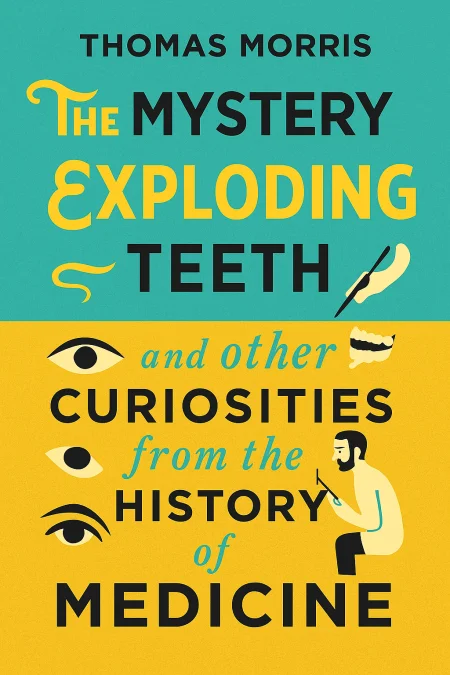
The Mystery of the Exploding Teeth
And Other Curiosities from the History of Medicine
Book Edition Details
Summary
Within the shadowy corridors of medical history lies an anthology of the bizarre and the mind-boggling. "The Mystery of the Exploding Teeth" peels back the layers on a collection of historical oddities that have both baffled and amused the medical profession. Journey from the operating rooms of seventeenth-century Europe to the whaling ships of the Pacific, where tales of sailors swallowing penknives and students experimenting with reactive chemicals unfold. These stories, laced with human folly and surgical brilliance, chronicle a time when remedies were as peculiar as crow's vomit and port-wine enemas. Dive into this vivid tapestry of medical marvels and missteps, where the line between genius and madness blurs. Witness the audacity and ingenuity that shaped the evolution of medicine, offering a glimpse into a past that is as curious as it is captivating.
Introduction
Picture this: a surgeon in 1829 London faces a patient whose intestines have been squeezed into his scrotum by a cart wheel, swelling it to the size of a child's head. With nothing but hot water bottles, leeches, and sheer determination, the doctor must somehow coax the man's guts back where they belong. Remarkably, the patient not only survives but walks out of the hospital three weeks later, requiring only a special truss to keep everything in place. This extraordinary case represents just one thread in the rich tapestry of medical history's most bewildering moments. These stories reveal the raw courage of physicians who faced the unknown armed with little more than curiosity and compassion. They illuminate the profound transformation of medicine from medieval superstition to scientific understanding, showing us how each bizarre case contributed to our modern knowledge. Through accounts of swallowed knives, exploding teeth, and miraculous recoveries, we witness the eternal human struggle against suffering and death. These tales speak to anyone fascinated by the resilience of the human spirit, the evolution of scientific thinking, or simply the strange and wonderful capacity of people to survive the most improbable circumstances. They remind us that behind every medical breakthrough lies a story of human drama, often tinged with both tragedy and triumph.
Ancient Remedies and Medieval Mishaps (17th-18th Century)
The medical landscape of the 17th and 18th centuries was a world balanced precariously between ancient wisdom and emerging enlightenment. Physicians still clung to theories inherited from Greek masters like Galen, believing that health depended on balancing four bodily humors through bleeding, purging, and other drastic measures. Yet this era also witnessed the first stirrings of scientific inquiry, as doctors began to question age-old assumptions and document their observations with unprecedented detail. Consider the extraordinary case of Andrew Grünbeide, the Prussian peasant who accidentally swallowed a six-and-a-half-inch knife while attempting to induce vomiting after a night of heavy drinking. When surgeons at the University of Leiden opened his abdomen in 1635, they performed what was essentially prehistoric gastric surgery, carefully extracting the blade from his stomach while he remained fully conscious. The operation took place before a crowd of distinguished physicians who had gathered to witness what they knew might be medical history in the making. Such cases reveal the peculiar mixture of sophistication and brutality that characterized early modern medicine. These practitioners possessed an impressive understanding of anatomy and surgical technique, yet they worked without anesthesia, antiseptics, or any real comprehension of infection. Their treatments often seemed as dangerous as the conditions they sought to cure. The Countess Cornelia di Bandi's mysterious death by apparent spontaneous combustion in 1731 led physicians to theorize about "fiery evaporations" caused by excessive consumption of brandy, revealing how supernatural explanations still competed with natural philosophy. The period established crucial precedents for medical ethics and scientific documentation that would shape centuries to come. When faced with seemingly impossible cases, these doctors chose to record rather than dismiss them, creating a foundation of empirical observation that would eventually triumph over dogmatic tradition.
The Age of Heroic Surgery (Early 19th Century)
The early 1800s ushered in an era of unprecedented surgical audacity, where physicians attempted procedures that would challenge even modern practitioners. This was the age of "heroic surgery," when doctors like Sir Astley Cooper and Baron Guillaume Dupuytren pushed the boundaries of human endurance and medical possibility. Without anesthesia, surgeons relied on speed, skill, and their patients' extraordinary tolerance for pain to perform operations that seemed to defy the limits of human survival. The tragic case of Hoo Loo, the Chinese peasant who traveled thousands of miles to Guy's Hospital for treatment of a massive scrotal tumor, exemplifies both the ambition and the limitations of this period. When surgeons finally operated in 1831 before an audience of 680 spectators, they discovered that removing the 56-pound growth required sacrificing the patient's genitals to save his life. Despite their technical skill and genuine desire to help, the operation's duration nearly two hours proved fatal, and Hoo Loo died from shock and blood loss. These cases illuminate a fundamental shift in medical thinking, where physicians began to see surgery not merely as a last resort but as a legitimate means of investigation and treatment. The French surgeon Baron Richerand's removal of two ribs and a portion of diseased pleura created a literal window into a patient's chest, allowing observers to watch his beating heart through the transparent pericardium. Such procedures represented a new willingness to intervene dramatically in the body's natural processes. The period's emphasis on documentation and public demonstration laid crucial groundwork for surgical education and the systematic sharing of medical knowledge. Though many patients paid the ultimate price for these pioneering efforts, their sacrifices contributed to the gradual development of safer, more effective surgical techniques that would eventually save countless lives.
Victorian Medicine's Strange Discoveries (Mid-Late 19th Century)
The Victorian era witnessed medicine's awkward adolescence, as practitioners struggled to reconcile traditional methods with emerging scientific understanding. This period produced some of history's most peculiar medical theories, from the belief that cast-iron stoves caused typhoid fever to warnings that cycling would inevitably lead to heart disease. Yet beneath these seemingly absurd concerns lay genuine attempts to understand the relationship between environment, lifestyle, and human health. The case of Rachel Hertz, the young Danish woman who produced nearly 400 needles from various parts of her body over an 18-month period, illustrates both the era's diagnostic challenges and its growing sophistication in psychological understanding. While her doctors initially accepted her story of accidentally ingesting the needles during a night spent in a graveyard, modern analysis suggests she was suffering from what we might now recognize as a form of factitious disorder, deliberately inserting the needles herself to gain medical attention and sympathy. Victorian physicians displayed remarkable ingenuity when confronting the unknown, even as they sometimes drew wildly incorrect conclusions. Dr. George Herschell's warnings about the cardiovascular dangers of cycling seem laughable today, yet they reflected genuine concerns about the effects of rapid social and technological change on human health. His detailed observations of "baked" cyclists struggling up hills contained valid insights about exercise physiology, even if his recommendations were overly cautious. This era's greatest contribution may have been its systematic approach to medical documentation and peer review. The proliferation of medical journals created unprecedented opportunities for physicians to share unusual cases and challenge each other's theories. Though many Victorian medical beliefs would later prove incorrect, the period's commitment to observation, documentation, and professional discourse established the foundation for evidence-based medicine that continues to guide medical practice today.
Modern Understanding of Historical Mysteries
The lens of contemporary medical knowledge allows us to revisit these historical mysteries with fresh understanding, transforming seemingly supernatural phenomena into comprehensible biological processes. Many cases that baffled physicians for centuries can now be explained through advances in genetics, immunology, and our understanding of rare diseases. The "serpent" found in John Pennant's heart was almost certainly a massive blood clot, while the woman who appeared to urinate through her nose likely suffered from a combination of kidney failure and a rare anatomical abnormality. This retrospective analysis reveals the remarkable consistency of human physiology across time and culture. The French shepherd who performed repeated self-surgery with a wooden file to break up his bladder stones was essentially conducting a primitive form of lithotripsy, anticipating by decades the surgical techniques that would later become standard treatment. His success, achieved through desperation rather than medical knowledge, demonstrates the body's extraordinary capacity for adaptation and healing. Modern diagnostic tools would have quickly resolved many historical puzzles that consumed entire medical careers. The boy who vomited what appeared to be his own twin brother probably suffered from a teratoma or other developmental abnormality, while the reports of people surviving weeks underwater were almost certainly exaggerated accounts of near-drowning experiences. These revelations don't diminish the historical importance of these cases but rather highlight how medical progress builds upon the accumulated observations of countless practitioners. Perhaps most importantly, contemporary analysis reveals the enduring human elements that transcend medical advancement: the courage of patients facing uncertain outcomes, the dedication of physicians working at the limits of their knowledge, and the gradual triumph of empirical observation over superstition and dogma.
Summary
These extraordinary medical cases reveal a fundamental truth about human progress: that knowledge advances through the courageous confrontation of the unknown, often at great personal cost. Across centuries, patients and physicians alike faced bizarre and seemingly impossible situations with remarkable determination, creating a legacy of observation and documentation that continues to inform medical practice today. From medieval surgeons operating by candlelight to Victorian doctors puzzling over unexplained phenomena, each generation built upon the accumulated wisdom of their predecessors while adding their own hard-won insights to the collective understanding. The real lesson of these historical medical mysteries lies not in their strangeness but in their humanity. They remind us that medical progress depends on the willingness of individuals to take risks, ask difficult questions, and persist in the face of uncertainty. For modern readers, these stories offer three crucial insights: first, that skeptical inquiry combined with compassionate care remains the cornerstone of good medicine; second, that apparent failures often contain the seeds of future breakthroughs; and third, that the courage to document and share unusual experiences, however embarrassing or inexplicable, serves the greater good of human knowledge. As we face our own medical challenges in an age of rapid technological advancement, these historical cases remind us that the essential elements of healing remain unchanged: careful observation, honest reporting, and the willingness to learn from both successes and failures. The physicians of the past may have lacked our sophisticated tools, but they possessed qualities that remain just as valuable today: curiosity, persistence, and an unwavering commitment to relieving human suffering.
Related Books
Download PDF & EPUB
To save this Black List summary for later, download the free PDF and EPUB. You can print it out, or read offline at your convenience.

By Thomas Morris
