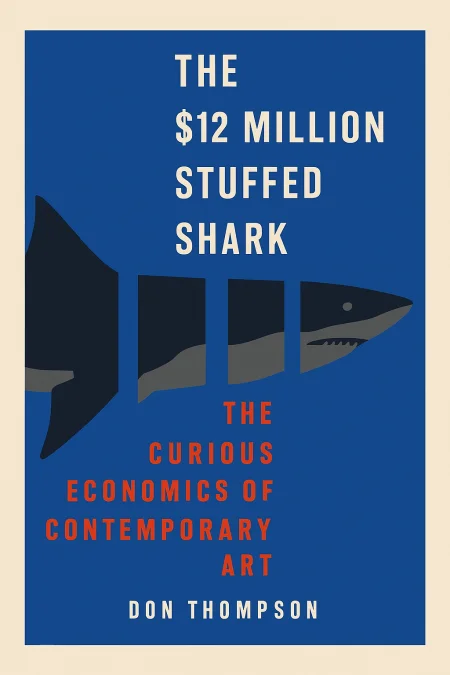
The $12 Million Stuffed Shark
The Curious Economics of Contemporary Art
Book Edition Details
Summary
In a world where art auctions become high-stakes arenas, one question looms: what makes a piece of art worth millions, or even hundreds of millions? Dive into the curious case of a taxidermied shark fetching $12 million, and a Pollock painting selling for $140 million, as Don Thompson unravels the enigma of the modern art market in "The $12 Million Stuffed Shark." This compelling narrative blends the intrigue of economic theory with the psychology of desire, spotlighting how art becomes a symbol of status and power. Through candid interviews with auction house insiders, artists, and collectors, Thompson paints a vivid portrait of a world where branding, ego, and ambition dictate value. Prepare for a fascinating exploration of the forces that elevate art from mere objects to coveted treasures, revealing secrets even seasoned art aficionados might miss.
Introduction
The contemporary art market operates as a fascinating laboratory where aesthetic judgment collides with sophisticated financial engineering, revealing profound truths about value creation in modern capitalism. At its core lies a compelling paradox: how do objects of questionable artistic merit command prices that exceed the GDP of small nations, while technically masterful works languish in obscurity? This economic puzzle illuminates the systematic transformation of cultural production into branded commodities through carefully orchestrated psychological manipulation and institutional gatekeeping. The mechanisms driving contemporary art valuation extend far beyond traditional supply and demand dynamics, operating instead through complex networks of dealers, auction houses, collectors, and cultural institutions who collectively manufacture desire and legitimacy. These stakeholders have perfected techniques borrowed from luxury marketing and behavioral psychology to create artificial scarcity and social pressure that transforms art acquisition into status competition among the wealthy. The resulting market bears little resemblance to historical art patronage, functioning instead as a sophisticated wealth concentration system disguised as cultural appreciation. Understanding these dynamics provides crucial insights into broader questions about value creation in post-industrial economies, where intangible assets like prestige and cultural capital generate extraordinary returns through manipulation of human psychology and social hierarchies. The contemporary art world serves as a microcosm of modern luxury markets, demonstrating how elite networks shape public taste while systematically excluding broader participation through financial and cultural barriers that maintain their privileged positions.
Branding as Primary Value Driver in Art Markets
Contemporary art markets demonstrate how branding mechanisms supersede aesthetic considerations in determining value, transforming cultural objects into luxury commodities through systematic application of marketing principles. The insecurity of art buyers creates fertile ground for brand-based purchasing decisions, as collectors lacking expertise in evaluating contemporary works rely heavily on external validation systems provided by prestigious galleries, established artists' names, and institutional endorsements. The branding process operates at multiple levels simultaneously, encompassing individual artists, galleries, auction houses, previous owners, and exhibition histories. Each layer of branded association adds incremental value to artworks regardless of their intrinsic qualities. An unknown artist's work gains legitimacy when displayed in a prestigious gallery, further enhanced when purchased by a notable collector, and ultimately validated when offered at a major auction house. This cumulative branding effect can multiply valuations by factors of ten or more through pure association. Successful contemporary artists understand branding as integral to their practice, cultivating distinctive visual signatures, provocative public personas, and strategic relationships with key market players. They transform themselves from mere creators into brand managers overseeing complex commercial enterprises where artistic output serves as one component of larger marketing strategies. This approach prioritizes market positioning over aesthetic innovation, encouraging artists to develop recognizable styles that function effectively as luxury brand identifiers. The most powerful galleries and dealers have evolved beyond traditional representation models to become comprehensive cultural institutions that shape taste through strategic exhibition programming, critical writing, and media manipulation. They operate international networks capable of simultaneously launching artists in multiple markets while controlling supply and maintaining price levels through careful market management and coordinated relationships with auction houses and major collectors.
Auction Psychology and Institutional Market Manipulation
Christie's and Sotheby's have established a duopoly that exploits sophisticated psychological manipulation techniques to transform commercial art sales into theatrical performances where ego and social status override rational economic calculation. The auction format itself serves as a powerful psychological weapon that creates artificial urgency through time pressure, competitive dynamics, and public performance anxiety that systematically drives bidders beyond their predetermined limits. The public nature of auction bidding transforms private purchasing decisions into competitive spectacles where participants experience endowment effects, developing psychological ownership of leading bids that creates powerful reluctance to withdraw. Auctioneers employ specific verbal techniques, timing strategies, and theatrical elements designed to maintain momentum and prevent reflective consideration of purchase decisions. The carefully orchestrated atmosphere of cultural significance justifies extraordinary expenditures by allowing participants to purchase not merely artworks but membership in an exclusive cultural elite. Auction houses manufacture legitimacy through elaborate catalogues presenting scholarly justifications for extraordinary valuations, while preview exhibitions create museum-like environments suggesting institutional endorsement. The complex financial instruments of estimates, reserves, and guarantees create artificial market signals that protect auction houses while encouraging aggressive bidding. These mechanisms allow auction houses to manipulate price discovery while maintaining the illusion of transparent market transactions. The presence of telephone bidders and anonymous participants amplifies competitive pressure by creating impressions of widespread international demand from mysterious collectors with unlimited resources. Bidders compete not only against visible opponents but against unknown entities whose financial capabilities remain deliberately obscured. This orchestrated uncertainty intensifies psychological pressure to bid aggressively, transforming art sales into psychological warfare where rational valuation becomes impossible and emotional decision-making dominates.
Power Networks and Elite Control of Cultural Value
The contemporary art market operates through a concentrated power structure where a small network of superstar dealers, mega-collectors, and prestigious museums controls access to valuable works and emerging talents. This hierarchical system creates artificial scarcity while enabling systematic price manipulation that benefits insiders through exclusive relationships and information asymmetries unavailable to broader market participants. Superstar dealers wield enormous influence through their ability to make or break artistic careers, controlling access to sought-after works while maintaining waiting lists that manufacture scarcity. They function as cultural kingmakers who determine which artists receive international recognition and museum representation, using their relationships with major collectors and institutions to orchestrate market manipulation that extends far beyond mere sales transactions to encompass fundamental directions of contemporary art development. Mega-collectors possess financial resources sufficient to single-handedly create markets for entire artistic movements through their purchasing decisions. When these collectors acquire works by unknown artists, their choices signal quality and investment potential to other market participants, creating feedback loops where collector interest generates media attention, museum recognition, and dealer representation that collectively transform obscure artists into international stars through coordinated promotional campaigns. Museums occupy unique positions as supposedly neutral arbiters of artistic quality who actually participate in market manipulation through acquisition and exhibition decisions that provide cultural legitimacy translating directly into increased market values. This relationship creates systematic conflicts of interest where museum officials may benefit personally from institutional decisions, while donors and trustees use their positions to enhance their private collection values. The supposed separation between cultural and commercial interests dissolves under examination of these interconnected financial relationships and mutual dependencies.
Investment Reality Versus Market Mythology
Despite widespread promotion of art as an alternative investment class, financial analysis reveals sobering realities for most contemporary art purchases. The vast majority of artworks never appreciate in value, while transaction costs including dealer markups, auction house commissions, insurance, and storage expenses consume substantial portions of any potential gains. Widely cited examples of spectacular returns represent statistical outliers that systematically mask the poor performance of typical art investments. Professional investment analysis demonstrates that only works by established artists with strong auction records offer reasonable appreciation prospects, while pieces by emerging or mid-career artists carry enormous risks of total loss. The art market lacks liquidity, transparency, and regulatory oversight characterizing mature financial markets, making it fundamentally unsuitable for investors seeking predictable returns or genuine portfolio diversification benefits. The psychological appeal of art investment stems from cognitive biases causing people to overestimate their ability to identify undervalued works and predict future trends. The complexity and subjectivity of artistic evaluation create opportunities for systematic self-deception where buyers convince themselves they possess special insight or taste generating superior returns. This overconfidence bias is deliberately exploited by dealers and advisors who encourage speculation while concealing statistical realities of art market performance. Genuinely successful art investment strategies require substantial capital, extensive market knowledge, and insider access that effectively limit participation to existing art world elites. These approaches typically involve purchasing works by artists with established track records at below-market prices through private sales or estate liquidations, then holding for extended periods while actively promoting artist reputations through strategic museum loans and carefully timed resales. The resources and connections required make art investment a system where success depends more on social capital and market manipulation capabilities than aesthetic judgment or financial analysis.
Summary
The contemporary art market reveals itself as a sophisticated value creation system operating independently of traditional aesthetic or cultural criteria, where a concentrated network of dealers, collectors, and institutions manufactures extraordinary valuations through systematic manipulation of scarcity, social pressure, and institutional legitimacy. This process demonstrates how cultural capital and elite social networks generate enormous financial returns by exploiting human psychology and status anxiety while systematically excluding broader participation through financial and cultural barriers. The market's emphasis on branding over artistic merit reflects broader trends in post-industrial capitalism where intangible assets and social positioning create value more effectively than traditional production or utility, providing crucial insights into how elite networks maintain power and wealth concentration through sophisticated cultural manipulation that transforms aesthetic appreciation into luxury consumption and social hierarchy maintenance.
Related Books
Download PDF & EPUB
To save this Black List summary for later, download the free PDF and EPUB. You can print it out, or read offline at your convenience.
By Don Thompson
