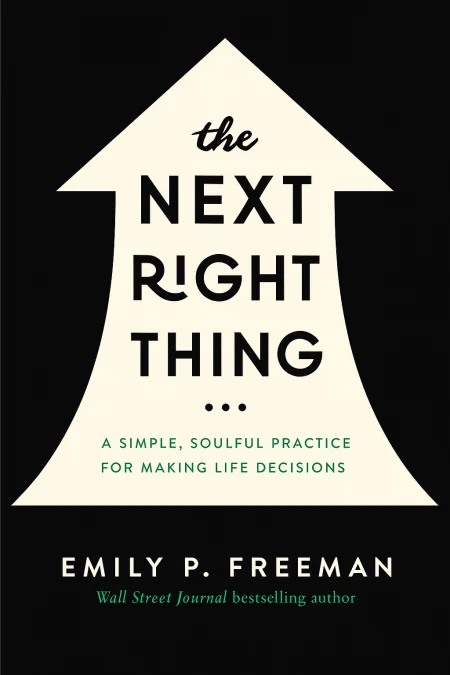
The Next Right Thing
A Simple, Soulful Practice for Making Life Decisions
Book Edition Details
Summary
In the tangled web of life's countless decisions, clarity often feels elusive. Emily P. Freeman offers a beacon of hope with "The Next Right Thing," a guide crafted for those weary from decision fatigue or paralyzed by hesitation. Through heartfelt storytelling and timeless wisdom, Freeman gently encourages readers to embrace a simple yet transformative mantra: focus on the next right thing. This book is a sanctuary for the soul, promising peace and courage to face life’s crossroads. Whether navigating a significant transition or grappling with everyday uncertainties, Freeman's insights invite readers to breathe deeply, find balance, and step forward with grace and confidence.
Introduction
Standing in the admissions building of her college alma mater, Emily found herself frozen by a familiar paralysis. The decision to return to graduate school had kept her awake for weeks, wrestling with questions that seemed to spiral endlessly. Why would she want to do this? What was the actual point? The mights and maybes of life had turned her into a hyperfocused version of herself, searching for deeper meanings in sermon messages and even Dove chocolate wrappers. This moment of indecision reveals something universal about our human experience. We live in a world that demands over 35,000 decisions daily, yet we often find ourselves completely overwhelmed by the big ones that really matter. Whether facing career transitions, relationship choices, or major life changes, we can become paralyzed by the weight of getting it right. The problem isn't that we lack wisdom or guidance, but that we've lost touch with a simpler, more soulful approach to decision-making. This exploration offers something refreshingly different from the typical decision-making advice. Instead of complex frameworks or lengthy pros-and-cons lists, it presents a practice rooted in ancient wisdom: simply doing the next right thing. This isn't about having all the answers or seeing the complete path ahead. It's about creating space for your soul to breathe, learning to name the unnamed things within you, and discovering how to take one faithful step forward in love.
Creating Space: From Soul Minimalism to Naming Our Stories
The woman in the documentary had been diagnosed with MS, and her instinct was to work even harder to prove she was okay. She overworked, overexercised, and basically overextended herself until she felt terrible. When someone advised her to listen to her body, she responded honestly: "I can't even listen to my family; I don't know how I'm going to hear my body." This confession sparked a journey of simplifying her schedule and home that eventually reduced her stress and created space for her to tune into what really mattered. This story illuminates our modern predicament perfectly. If we struggle to listen to our family and the body we live in every day, how much more do we struggle to hear the whispers of our soul? Like that cluttered gym with eight televisions blaring simultaneously, our inner world receives constant input with very little output. We need regular soul decluttering just as much as we need to organize our physical spaces. The practice begins with becoming what could be called a "soul minimalist." This means turning off notifications that interrupt our concentration, finding cracks of silence in our days, and refusing to let everyone else's agenda live rent-free in our minds. It's about creating space not just in our schedules, but in our hearts. When we can finally hear the quiet voice within, we can begin the equally important work of naming our narratives. Too often we live with unnamed stories running beneath the surface, stories about our failures, our fears, or our false beliefs about God. Until we bring these shadows into the light and call them what they are, they continue to influence our choices in ways we don't even realize.
Finding Direction: Following Arrows, Embracing Beginnings, and Asking Hard Questions
When John's father passed away, the grief broke him open in ways that initially looked like panic and sleepless nights. During his three-month sabbatical from youth ministry, instead of receiving the clear vocational direction they hoped for, John and Emily kept getting arrows that seemed to lead everywhere except where they wanted to go. There were arrows through grief, arrows toward desire, and ultimately arrows that kept pointing them back to each other. For months, all God seemed to offer was the simple instruction to move toward one another as a couple. This experience taught them something profound about how God often works. Rather than providing a detailed five-year plan, He frequently gives us faint arrows instead of black-and-white answers. Sometimes clarity comes not as a lightning bolt revelation but as a gentle nudge in the right direction, an invitation to pay attention to our deepest desires rather than our surface fears. The journey often requires embracing our role as beginners, even when we'd rather rush to expertise. There's a particular shame that comes with not knowing, with being called a "novice" when we want to be recognized as brilliant. But what if being a beginner is actually a gift rather than a liability? What if our willingness to start where we are, with what we have, is exactly the kind of humility that opens doors to growth? Before making any hard decision, we must learn to ask ourselves one crucial question: "Am I being led by love or pushed by fear?" This simple filter can cut through weeks of circular thinking and help us recognize when we're making choices based on imaginary storms rather than actual circumstances.
Building Community: Gathering Listeners, Finding Mentors, and Walking into Rooms
In the midst of their vocational uncertainty, John and Emily made a deliberate choice to gather a small group of trusted friends in their living room. They weren't asking for advice exactly, though they were open to it. They simply didn't want to feel so alone in their decision-making process. The group listened as John shared about his grief, his desires, and his hopes for the future. They asked thoughtful questions, prayed together, and agreed to meet again in a few months. What surprised the couple was how much clarity emerged not from the answers they received, but from the simple act of speaking their truth in the presence of people who cared. This practice of gathering "co-listeners" reveals something important about decision-making: we weren't meant to figure everything out in isolation. The most helpful voices in our lives aren't necessarily the loudest ones or the most impressive credentials, but rather those who know us well enough to ask good questions and care enough to really listen to our answers. Sometimes we need what could be called a "No Mentor" – someone who isn't dazzled by opportunities that sound impressive but helps us filter requests through the lens of what we actually want to build in our lives. The key is learning to be selective about whose voices we allow into our decision-making process. Not every critic deserves words, and not every guru deserves our attention. When we walk into rooms, whether literal or metaphorical, we have a choice: we can enter focused on ourselves and how we're being perceived, or we can enter focused on others and how we might connect and serve. The difference in these approaches changes everything about how we make choices and how we experience life.
Moving Forward: Choosing Presence, Expecting Surprises, and Waiting with Hope
Years after hearing Sarah Masen sing in a small youth group, Emily found herself in Chicago, riding in a car with new friends to a chicken restaurant. As they pulled up to park, there through the window sat Sarah Masen with her family, enjoying a casual Sunday lunch. What had begun as a simple invitation to join some acquaintances for a meal became an unexpected reunion that reminded Emily how often the best moments in life are the ones we never see coming. This serendipitous encounter illustrates something profound about how life actually works. We spend enormous energy trying to control outcomes and predict results, but the most meaningful experiences often arrive as complete surprises. Instead of demanding certainty before we act, perhaps we need to learn the art of staying present to today while remaining open to the unexpected gifts that tomorrow might bring. The practice ultimately calls us to a different way of being in the world. Rather than rushing toward clarity or forcing quick decisions, we can learn to wait with hope. This doesn't mean passive inaction, but rather active trust – taking the next small step in front of us while holding our plans lightly. Sometimes our next right thing is to pick what we like and see how it grows. Sometimes it's to wear better pants that don't constrict our breathing. Sometimes it's simply to show up as ourselves in rooms where we feel uncertain about our place.
Summary
The path to making better decisions isn't found in more complex analysis or sophisticated strategies, but in returning to the simple, soulful practice of staying present to God's voice within the ordinary moments of our lives. This approach acknowledges that most of our decision-making paralysis comes not from lack of information, but from the noise and clutter that prevents us from hearing our own hearts in conversation with our Creator. The practice invites us to trust that we don't need to see the entire staircase to take the first step. By creating space for our souls to breathe, naming the stories we tell ourselves, and surrounding ourselves with people who know how to listen, we can learn to recognize the difference between being led by love and pushed by fear. We discover that God rarely provides detailed blueprints, but He always offers His presence and the grace to discern our next small step. Perhaps most importantly, this approach reminds us that the decision is rarely the point – transformation is. Whether we choose the job or don't choose it, move to the new city or stay where we are, what matters most is that we're becoming more fully ourselves in relationship with God and others. When we embrace this truth, our choices become less about getting everything right and more about staying connected to the source of all wisdom and love. In that connection, we find the courage to simply do the next right thing.
Related Books
Download PDF & EPUB
To save this Black List summary for later, download the free PDF and EPUB. You can print it out, or read offline at your convenience.
By Emily P. Freeman
