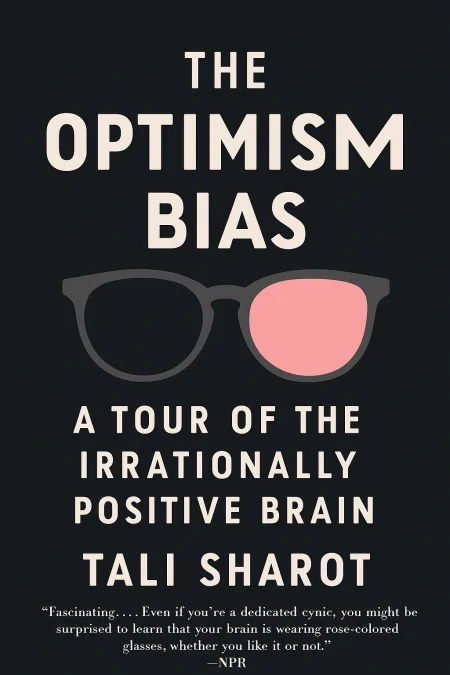
The Optimism Bias
A Tour of the Irrationally Positive Brain
Book Edition Details
Summary
Neuroscience meets the art of optimism in Tali Sharot’s riveting exploration of the mind’s sunniest tendencies. In a world where our brains are hardwired to favor silver linings, Sharot uncovers the profound impact of optimism on our daily decisions and long-term happiness. Through a lens of groundbreaking research, she unravels the mysteries behind why we often view life through rose-colored glasses and how this innate bias shapes our financial, emotional, and professional landscapes. With wit and wisdom, "The Optimism Bias" not only delves into the neural mechanics of hope but also reveals why this psychological quirk is essential to our survival. Prepare for a cerebral adventure that challenges your perceptions and inspires a reevaluation of how you engage with the world.
Introduction
Picture yourself five years from now. What comes to mind? Most likely, you see yourself thriving professionally, enjoying fulfilling relationships, and living in good health. Rarely do we imagine ourselves unemployed, divorced, or seriously ill. This isn't just positive thinking—it's a fundamental feature of how our brains work. Scientists have discovered that roughly 80% of the population displays what's called the "optimism bias," a systematic tendency to overestimate the likelihood of positive events and underestimate negative ones in our personal futures. This bias isn't simply about being cheerful or naive. It's a sophisticated neural mechanism that influences everything from our career decisions to our health behaviors, from our financial choices to our relationships. Through cutting-edge neuroscience research, we're learning that optimism isn't just a personality trait—it's hardwired into our brain's architecture. You'll discover how this bias operates at the cellular level, shaping our memories, perceptions, and actions in ways we never consciously realize. Perhaps most surprisingly, you'll learn why this "irrational" tendency to see the future through rose-colored glasses may actually be one of our species' greatest survival advantages, even as it occasionally leads us astray.
The Science of Unrealistic Optimism
Unrealistic optimism is the systematic tendency for people to believe that they are more likely than others to experience positive events and less likely to experience negative ones. When researchers ask people to estimate their chances of getting divorced, most predict odds well below the actual 50% divorce rate. When asked about their likelihood of developing cancer, people typically underestimate their risk by significant margins. This isn't ignorance—most people are well aware of general statistics. Instead, they believe these unfortunate events happen to other people, not to them. This phenomenon extends far beyond major life events. Studies reveal that people consistently overestimate their chances of small daily pleasures while underestimating minor setbacks. Students predict they'll enjoy more parties and have fewer arguments with roommates than actually occurs. The bias appears across cultures, ages, and socioeconomic levels, suggesting it's a fundamental feature of human cognition rather than a cultural artifact. What makes this particularly fascinating is how persistent the bias remains even when people are confronted with contradictory evidence. When researchers provided participants with accurate statistics about negative events, people readily learned and remembered this information. However, they only updated their personal risk estimates when the news was better than expected. If told that divorce rates were lower than they'd thought, they revised their personal estimates downward. But if told divorce rates were higher, they largely ignored this inconvenient truth. Brain imaging studies reveal the neural basis of this selective updating. When people receive unexpectedly good news about future risks, regions in the frontal cortex that track prediction errors become highly active, facilitating learning. But when the news is unexpectedly bad, these same regions show diminished activity, essentially allowing the brain to dismiss unwelcome information while readily incorporating encouraging data.
Neural Mechanisms Behind Positive Expectations
The brain regions responsible for optimism form an intricate network spanning from ancient subcortical structures to the most recently evolved areas of the human cortex. At the heart of this system lies the rostral anterior cingulate cortex, a region that acts like a neural traffic controller, enhancing signals that convey positive emotions while dampening negative ones. When optimistic people imagine future events, this area shows heightened activity, effectively amplifying pleasant associations while suppressing unpleasant ones. Deep within the brain, the amygdala and striatum play crucial supporting roles. The amygdala, traditionally known for processing fear and negative emotions, actually contributes to optimism by helping to generate vivid, emotionally rich images of positive future scenarios. The striatum, part of the brain's reward system, becomes active when we anticipate good things, creating a neurochemical basis for hopeful expectations. These regions work in concert with memory centers like the hippocampus to construct detailed, compelling visions of our bright futures. Neurotransmitters provide the chemical foundation for optimistic thinking. Dopamine, often called the "feel-good" neurotransmitter, surges when we expect rewards and helps update our valuations of future possibilities. Serotonin, the target of many antidepressant medications, regulates emotional processing and helps maintain positive biases in attention and memory. People with genetic variations that enhance serotonin function tend to be more optimistic and show stronger biases toward attending to positive rather than negative information. Perhaps most remarkably, the same neural pathways that break down in depression are hyperactive in optimistic individuals. While depressed patients show impaired communication between frontal control regions and emotional processing areas, optimistic people display enhanced connectivity in these same circuits. This suggests that optimism and depression represent opposite ends of a neural spectrum, with optimism serving as a natural buffer against mental illness through its effects on brain function.
When Optimism Becomes Self-Fulfilling Prophecy
The most remarkable feature of optimistic expectations is their power to create the very outcomes they predict. This occurs through a psychological mechanism known as the self-fulfilling prophecy, where beliefs about the future influence behavior in ways that make those beliefs come true. When basketball coach Pat Riley guaranteed his team would repeat as NBA champions, his optimistic prediction didn't just boost morale—it fundamentally changed how his players trained, practiced, and competed throughout the season. The brain facilitates this transformation through its hierarchical organization. Higher cortical regions generate expectations that filter down to influence perception, attention, and memory. When we expect positive outcomes, we literally see more opportunities and remember more encouraging feedback. Students who believe they're academically gifted notice teachers' supportive comments while overlooking criticism. Job candidates who expect success project confidence that interviewers find compelling. This isn't conscious manipulation—it's automatic neural processing shaped by our expectations. Expectations also drive goal-directed behavior. Optimistic beliefs motivate persistence in the face of obstacles, encourage risk-taking when opportunities arise, and promote the kind of proactive behavior that turns hopes into reality. People who expect to recover from illness take better care of themselves, follow medical advice more carefully, and engage in healthier behaviors. Those who anticipate career success work longer hours, seek additional training, and network more effectively. The brain's reward system reinforces these positive behaviors by releasing dopamine when optimistic expectations are confirmed. However, this process requires genuine belief rather than mere wishful thinking. The prophecy works only when people truly expect positive outcomes and act accordingly. Surface-level positive thinking without underlying neural commitment fails to produce the behavioral changes necessary for self-fulfilling effects. This is why authentic optimism, rooted in the brain's expectation systems, proves so much more powerful than forced positivity or motivational slogans.
The Dark Side of Excessive Hope
While moderate optimism provides significant benefits, extreme optimistic biases can lead to dangerous miscalculations and costly mistakes. The 2008 financial crisis offers a sobering example of collective optimism gone wrong. Individual investors, mortgage brokers, bank executives, and government regulators all held slightly inflated expectations about housing prices, loan repayment rates, and market stability. When combined across millions of decisions, these individual biases created a massive bubble that eventually burst with devastating consequences. Personal decision-making also suffers when optimism becomes excessive. People who dramatically overestimate their longevity may save too little for retirement. Those who severely underestimate health risks may skip important medical screenings or engage in dangerous behaviors. Students who are wildly optimistic about their academic abilities may choose inappropriate career paths or fail to develop necessary backup plans. The key distinction lies between moderate optimism, which motivates positive action while maintaining reasonable caution, and extreme optimism, which ignores genuine risks and constraints. Construction projects provide classic examples of optimism bias in planning. The Sydney Opera House, originally budgeted at seven million dollars and scheduled for completion in six years, ultimately cost over one hundred million dollars and took sixteen years to finish. Each team member—architects, engineers, contractors—slightly underestimated their portion of the work. Since tasks occurred sequentially rather than simultaneously, these individual biases compounded into massive delays and cost overruns. Research reveals that moderate optimists make the best decisions across multiple life domains. They work longer hours and save more money than pessimists, but they also smoke less and take fewer unnecessary risks than extreme optimists. Like red wine, optimism appears beneficial in moderation but potentially harmful in excess. The brain's natural optimism bias seems calibrated to provide motivation and resilience while avoiding the most dangerous pitfalls of unrealistic thinking, though individuals vary significantly in where they fall along this spectrum.
Summary
The human brain comes equipped with a built-in tendency to expect the future to be better than the past or present, and this optimistic bias represents one of our species' most powerful survival mechanisms. Rather than being a flaw in human reasoning, unrealistic optimism serves crucial functions: it motivates goal-directed behavior, enhances psychological resilience, and creates self-fulfilling prophecies that often make positive expectations come true. The neural networks underlying this bias involve sophisticated interactions between emotional processing centers, memory systems, and executive control regions, all working together to filter information and guide behavior in ways that promote wellbeing and success. Yet this same mechanism can lead us astray when taken to extremes, contributing to financial bubbles, project failures, and poor personal decisions. The challenge for individuals and society lies in harnessing the benefits of optimistic thinking while maintaining enough realism to navigate genuine risks and constraints. By understanding how our brains construct hopeful visions of the future, we can better appreciate both the power and the limitations of human optimism. How might we cultivate the kind of grounded optimism that motivates positive action without blinding us to important dangers? What role should awareness of our optimistic biases play in major personal and professional decisions?
Related Books
Download PDF & EPUB
To save this Black List summary for later, download the free PDF and EPUB. You can print it out, or read offline at your convenience.
By Tali Sharot
