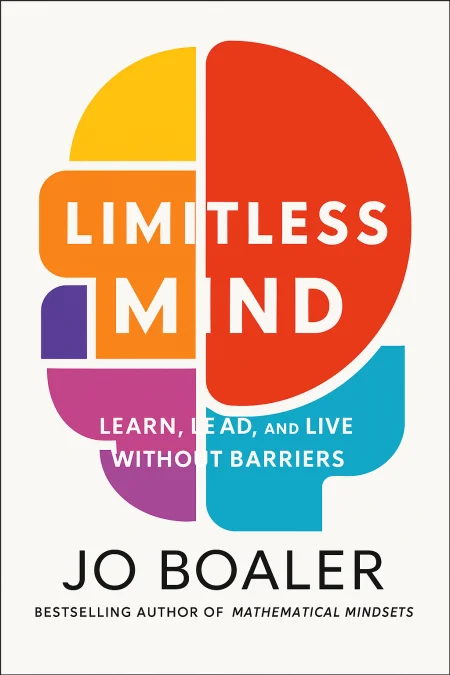
Limitless Mind
Learn, Lead, and Live Without Barriers
Book Edition Details
Summary
In the realm of learning, where myths of fixed intelligence reign supreme, Jo Boaler emerges as a transformative voice, shattering these age-old beliefs. "Limitless Mind" is not just a book; it's a manifesto for the boundless potential nestled within every brain. Boaler, a luminary in education, weaves her profound classroom insights with groundbreaking brain science to reveal six transformative keys that unlock the full spectrum of human capability. She dismantles the fallacy that our abilities are pre-determined by genetics and instead presents a riveting argument for the brain's infinite capacity to adapt and grow. Whether your aspirations lie in mastering mathematics, mastering a new language, or uncovering latent creativity, Boaler's work is a clarion call to redefine what's possible. This is not merely about learning; it's about embracing change and realizing the extraordinary tapestry of potential that each of us carries.
Introduction
What if everything we believed about intelligence, learning, and human potential was fundamentally wrong? For decades, society has operated under the premise that our cognitive abilities are fixed, that some people are simply born "smart" while others are not, and that our brains reach their peak capacity in early adulthood before inevitably declining. This deterministic view has created artificial barriers in classrooms, workplaces, and our personal lives, limiting countless individuals who internalize messages about their supposed intellectual limitations. Recent breakthroughs in neuroscience have shattered these constraining beliefs, revealing that our brains possess remarkable plasticity throughout our entire lives. The emerging science demonstrates that neural pathways can be strengthened, new connections can be formed, and cognitive abilities can be dramatically enhanced regardless of age or background. This revolutionary understanding challenges traditional educational practices, workplace hierarchies, and personal limiting beliefs that have held back human potential for generations. The theoretical framework presented here rests on six fundamental keys that unlock our natural capacity for growth and learning. These principles reveal how our minds can transcend perceived limitations through understanding brain plasticity, embracing productive struggle, adopting growth-oriented beliefs, engaging in multidimensional thinking, developing flexible cognitive approaches, and fostering collaborative connections. Together, these elements form a comprehensive system for unleashing human potential that has profound implications for how we learn, work, and live.
The Science of Brain Plasticity and Growth Mindset
The foundation of human potential lies in neuroplasticity, the brain's extraordinary ability to reorganize, form new neural connections, and adapt throughout our entire lives. This scientific discovery fundamentally challenges the fixed mindset that has dominated educational and professional environments for centuries. Unlike previous beliefs that positioned the brain as a static organ with predetermined capabilities, neuroplasticity reveals our minds as dynamic, ever-changing systems capable of remarkable transformation. Brain plasticity operates through three primary mechanisms: forming new neural pathways when we encounter novel information, strengthening existing connections through repeated engagement, and creating bridges between previously unconnected regions of the brain. Each time we learn something new or practice a skill, our brain physically changes its structure, developing more robust networks that enhance our cognitive capacity. This process continues throughout our lives, meaning that a sixty-year-old can develop new neural pathways just as effectively as a twenty-year-old, albeit through different approaches. The implications of neuroplasticity extend far beyond academic learning into every aspect of human experience. When London taxi drivers spent years memorizing the city's complex street layout, brain scans revealed significant growth in their hippocampus, the region responsible for spatial navigation. Similarly, professional musicians show enhanced connectivity between brain regions that control fine motor skills and auditory processing. These examples demonstrate that our brains physically adapt to meet the demands we place upon them, reshaping their very architecture in response to our experiences and efforts. Understanding neuroplasticity transforms how we approach challenges and setbacks. Rather than viewing difficulties as evidence of our limitations, we can recognize them as opportunities for brain growth and development. This shift from a fixed to a growth mindset creates a fundamental change in how we navigate learning, relationships, and professional development, opening pathways that seemed permanently closed and revealing potential we never knew existed.
Mistakes, Struggle, and Multidimensional Learning
Perhaps the most counterintuitive discovery in learning science is that mistakes and struggle are not signs of inadequacy but rather the optimal conditions for brain growth. When we encounter difficulties and make errors, our brains enter a heightened state of activity, forming stronger neural connections than when we easily complete tasks correctly. This neurological response explains why individuals who embrace challenges and persist through setbacks often achieve greater long-term success than those who avoid difficult situations. The physiology of productive struggle involves multiple brain regions working in coordination. When we grapple with challenging problems, areas responsible for attention, memory, reasoning, and problem-solving simultaneously activate, creating rich networks of interconnected knowledge. This multidimensional engagement strengthens not only our understanding of the specific topic at hand but also our overall cognitive flexibility and resilience. The temporary discomfort of not knowing becomes the catalyst for profound learning and development. Multidimensional learning amplifies this effect by engaging different sensory and cognitive pathways simultaneously. Instead of approaching problems through a single method, we can explore concepts through visual representations, physical manipulation, verbal explanation, and numerical analysis. This varied engagement creates multiple entry points for understanding and builds robust mental models that can be accessed and applied in diverse contexts. Research shows that students who learn mathematics through visual and kinesthetic approaches alongside traditional methods develop deeper conceptual understanding and greater problem-solving flexibility. The practical applications of this principle extend throughout professional and personal life. When facing complex challenges at work, individuals who embrace the discomfort of not knowing and explore multiple approaches consistently develop more innovative solutions. In relationships, those who view conflicts as opportunities for deeper understanding rather than threats to be avoided build stronger, more resilient connections. This reframing of struggle from obstacle to opportunity represents a fundamental shift that enables continuous growth and adaptation throughout life.
Speed Myths and Flexible Thinking Strategies
Modern society's obsession with speed has created one of the most damaging myths about intelligence and learning. The belief that quick thinking equals superior intelligence has led to educational practices and workplace cultures that prioritize rapid responses over deep understanding, ultimately limiting human potential and creating unnecessary anxiety. Neuroscience reveals that the brain's most sophisticated processes, including creative problem-solving and conceptual understanding, actually require time and cannot be rushed without sacrificing quality. Flexible thinking represents the antithesis of speed-focused approaches, emphasizing adaptability, creativity, and the ability to approach problems from multiple angles. This cognitive flexibility involves the capacity to shift between different concepts, consider various perspectives simultaneously, and generate novel solutions by combining ideas in unexpected ways. Unlike rigid thinking patterns that rely on memorized procedures and quick recall, flexible thinking draws upon deep understanding and the ability to apply knowledge across diverse contexts. The development of flexible thinking strategies transforms how we approach both familiar and novel challenges. Instead of seeking the single "correct" method, flexible thinkers explore multiple pathways, test different approaches, and adapt their strategies based on emerging insights. This might involve visualizing mathematical concepts through diagrams, approaching business problems through historical analogies, or solving interpersonal conflicts by considering various cultural perspectives. Each approach provides unique insights that contribute to a more complete understanding. Real-world applications of flexible thinking appear across every domain of human activity. Successful entrepreneurs often succeed not because they implement their original plans perfectly, but because they adapt flexibly to changing circumstances and unexpected opportunities. Master musicians create compelling performances by varying their interpretations based on venue acoustics, audience energy, and collaborative dynamics. In education, students who learn to approach subjects through multiple modalities develop deeper understanding and greater retention than those who rely solely on traditional methods. This flexibility becomes increasingly valuable in our rapidly changing world, where the ability to adapt and learn continuously determines long-term success.
Collaborative Learning and Limitless Living
The final dimension of limitless learning recognizes that human potential reaches its highest expression through collaborative engagement and connection with others. Individual intelligence, while important, represents only a fraction of what becomes possible when we learn to think, create, and solve problems together. Collaborative learning leverages diverse perspectives, distributes cognitive load, and creates synergistic effects that exceed the sum of individual contributions. Effective collaboration requires three essential elements: open minds that value diverse perspectives, open content that can be approached from multiple angles, and comfortable embrace of uncertainty that allows for genuine exploration and discovery. When these conditions exist, groups can tackle challenges that would overwhelm any individual member, generate creative solutions that none would discover alone, and build collective knowledge that benefits everyone involved. This collaborative capacity extends far beyond formal educational settings into professional teams, community organizations, and personal relationships. The neuroscience of collaboration reveals that our brains are fundamentally social organs, with specialized networks dedicated to understanding others' thoughts, emotions, and intentions. When we engage in meaningful collaboration, these social brain networks activate alongside our analytical and creative regions, creating rich, multifaceted thinking experiences. This neural integration explains why collaborative problem-solving often generates more innovative and robust solutions than individual efforts, even when participants possess identical knowledge and skills. Limitless living emerges when we combine brain plasticity awareness, productive struggle embracement, flexible thinking strategies, and collaborative engagement into a coherent life philosophy. This approach recognizes that our potential remains perpetually expandable, that challenges represent growth opportunities rather than threats, and that our greatest achievements arise through connection and mutual support. Whether applied to personal development, professional advancement, or community building, these principles create conditions for continuous learning and unlimited growth throughout our lives.
Summary
The path to limitless living begins with a revolutionary understanding: our brains are not fixed entities with predetermined capabilities, but dynamic, adaptable systems capable of continuous growth and transformation throughout our entire lives. By embracing the science of neuroplasticity, welcoming productive struggle, developing flexible thinking strategies, and engaging in meaningful collaboration, we can transcend the artificial limitations that society has placed upon human potential. These principles offer nothing less than a fundamental reimagining of what it means to learn, grow, and contribute to the world around us.
Related Books
Download PDF & EPUB
To save this Black List summary for later, download the free PDF and EPUB. You can print it out, or read offline at your convenience.
By Jo Boaler
