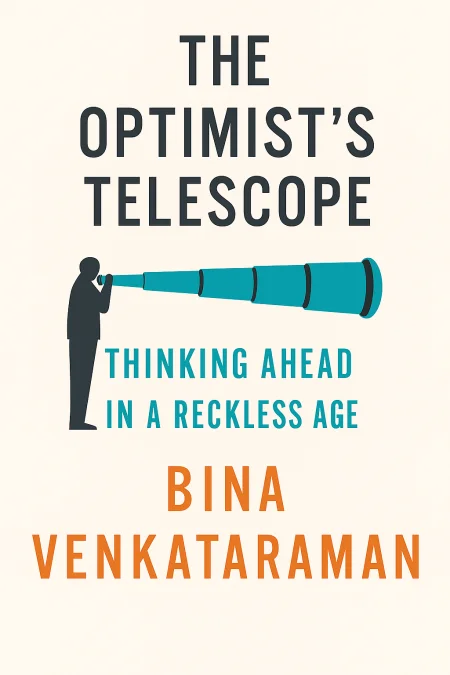
The Optimist's Telescope
Thinking Ahead in a Reckless Age
Book Edition Details
Summary
What if the secret to a brighter tomorrow lies in how we think today? In "The Optimist's Telescope," Bina Venkataraman unveils the art of foresight in a world obsessed with the now. Blending science with storytelling, she challenges us to rethink our choices—personal, financial, and societal. From the misuse of antibiotics to the pitfalls of short-term corporate gains, Venkataraman draws on her rich experience, including her tenure in the Obama administration, to reveal the human capacity for smarter decision-making. This book isn't just a guide; it's a call to action to harness our latent potential for the benefit of generations to come.
Introduction
Contemporary civilization confronts a profound temporal paradox that threatens its very sustainability. Despite possessing unprecedented technological capabilities for forecasting and planning, human societies consistently prioritize immediate gains over long-term consequences across virtually every domain of decision-making. This systematic bias toward short-term thinking manifests in individual choices about health and finances, corporate strategies that sacrifice sustainable growth for quarterly profits, and governmental policies that defer critical challenges to future administrations. The phenomenon extends beyond mere impatience or poor judgment to represent a fundamental misalignment between human cognitive evolution and the complex, interconnected world we have created. The analysis reveals that this temporal myopia emerges from the intricate interplay of psychological biases, institutional incentives, cultural norms, and political structures that collectively trap us in cycles of shortsighted decision-making. Understanding these mechanisms requires examining how evolved cognitive architecture designed for immediate survival struggles to process abstract future consequences, while simultaneously exploring how modern institutions systematically reward present-focused behavior. The investigation employs a multidisciplinary framework drawing from behavioral economics, organizational psychology, and systems thinking to demonstrate that apparent individual irrationality often reflects rational responses to poorly designed choice environments and institutional structures.
Why Modern Society Systematically Prioritizes Present Over Future
Modern society has constructed what amounts to a perfect storm for shortsighted decision-making through the convergence of technological acceleration, cultural shifts toward instant gratification, and institutional structures that reward immediate results. The digital revolution has created environments designed to compress time and eliminate waiting, training people to expect immediate rewards while experiencing delay as intolerable. Social media platforms and consumer technologies employ the same psychological mechanisms as casino slot machines, creating compulsion loops that prioritize momentary satisfaction over sustained well-being. This cultural transformation toward immediacy occurs precisely when the stakes for long-term thinking have reached unprecedented levels. A global population approaching eight billion, armed with technologies capable of reshaping planetary systems and editing human genetic code, faces consequences that will reverberate across centuries. Yet the very tools that grant such power also fragment attention spans and create artificial urgency, making it increasingly difficult to contemplate outcomes beyond immediate horizons. The problem extends far beyond individual psychology to encompass fundamental features of how modern institutions operate. Workplaces reward quarterly performance metrics over sustainable value creation, educational systems measure success through standardized test scores rather than genuine learning, and political processes favor election cycles over generational planning. These structural incentives create environments where even well-intentioned individuals find themselves making decisions that betray their own long-term interests and stated values. However, recognizing the systematic nature of this challenge also reveals the possibility of systematic solutions. The same human capacity for institutional innovation that created these myopic systems can be redirected toward fostering environments that support foresight and patient decision-making across multiple levels of social organization.
How Psychological Biases and Institutional Design Create Temporal Myopia
Human cognitive architecture evolved to prioritize immediate survival threats and opportunities, creating neurological systems fundamentally oriented toward present-moment decision-making. Brain imaging research demonstrates that contemplating immediate rewards activates limbic regions associated with emotion and automatic responses, while considering future benefits requires engagement of prefrontal cortex areas responsible for abstract reasoning and self-control. This creates an inherent neurological imbalance where immediate temptations feel visceral and compelling, while future consequences remain cognitively distant and emotionally flat. The psychological phenomenon of temporal discounting means that people systematically undervalue future rewards relative to immediate ones, often treating their future selves as strangers deserving little consideration. Research reveals that individuals show similar patterns of neural activation when thinking about themselves in ten years as when considering completely different people. This psychological distance makes it extraordinarily difficult to feel genuine concern for future outcomes, even when those outcomes will directly affect the decision-maker. Modern institutional environments amplify these natural cognitive biases through systematic design features that exploit temporal discounting. Corporate governance structures requiring quarterly earnings reports create relentless pressure for immediate results, leading executives to cut research investments and delay infrastructure spending to meet short-term targets. Financial markets dominated by algorithmic trading with holding periods measured in microseconds further disconnect economic activity from long-term value creation. Political institutions face parallel challenges through electoral cycles that reward politicians for delivering visible results before the next vote while penalizing investments in infrastructure, education, or research that may not yield benefits until after they leave office. Democratic systems struggle with temporal representation gaps where future generations cannot vote or lobby for their interests, systematically biasing political processes toward present-day concerns regardless of long-term consequences.
Strategic Frameworks for Cultivating Foresight in Decision-Making
Effective long-term thinking requires systematic approaches that counteract both psychological biases and institutional pressures toward temporal myopia. One crucial framework involves developing temporal landmarks that transform abstract future goals into concrete, actionable scenarios. This technique leverages the psychological principle that humans process specific situations more effectively than vague possibilities, creating detailed mental models that can guide present decision-making with greater clarity and motivation. Implementation intention strategies provide powerful tools for extending planning horizons through "if-then" approaches that prepare specific responses to anticipated future scenarios. Research demonstrates that individuals and organizations engaging in detailed scenario planning show significantly higher rates of follow-through on long-term commitments because they have mentally rehearsed necessary actions and identified potential obstacles in advance. These techniques reduce the cognitive burden of long-term thinking by converting abstract planning into predetermined behavioral scripts. Measurement systems play critical roles in supporting extended temporal perspectives by focusing on leading indicators rather than lagging results. Organizations that optimize exclusively for immediate outcomes like monthly sales figures or quarterly profits inevitably sacrifice long-term sustainability for short-term gains. More sophisticated approaches identify early signals of long-term success such as employee development metrics, customer satisfaction trends, or research pipeline strength that provide regular feedback on strategic trajectory while maintaining focus on ultimate objectives. The most effective frameworks also incorporate systematic processes for challenging assumptions and preparing for uncertainty through techniques like pre-mortems, where teams imagine future failure scenarios and work backward to identify potential causes. These approaches recognize that long-term success requires not just patient execution of current strategies, but adaptive capacity to respond to changing circumstances while maintaining strategic direction across extended time horizons.
Building Systems That Align Present Incentives with Future Welfare
Creating sustainable alignment between present incentives and future welfare requires institutional mechanisms that embed long-term thinking into organizational structures and social systems. One promising approach involves establishing temporal trustees or institutional roles specifically designed to represent future stakeholder interests in present decision-making processes. Some organizations have experimented with board positions designated to advocate for long-term consequences, while certain governments have created ombudsman offices charged with evaluating policy impacts on future generations. Legal and regulatory frameworks provide additional avenues for institutionalizing intergenerational responsibility through concepts like public trust doctrine, which treats shared resources as held in trust for future generations rather than as assets to be consumed by present stakeholders. Extending these principles beyond environmental law to domains such as infrastructure investment, education systems, or research funding could create legal obligations to consider long-term impacts in major policy decisions. Financial mechanisms offer tools for making future consequences visible in present economic calculations through approaches like sovereign wealth funds that convert temporary resource windfalls into permanent endowments benefiting multiple generations. Carbon pricing systems attempt to internalize long-term environmental costs in immediate market prices, while patient capital investment structures reward sustained value creation over rapid returns. The most robust systems combine multiple reinforcing mechanisms rather than relying on single interventions. Successful examples integrate measurement systems tracking long-term indicators, governance structures representing future interests, financial incentives rewarding patient capital, and cultural practices celebrating extended temporal perspectives. This comprehensive approach recognizes that sustainable change requires transforming entire ecosystems of incentives and constraints rather than appealing to individual virtue or wisdom alone.
Summary
The fundamental insight emerging from this comprehensive analysis reveals that temporal myopia operates not as an inevitable feature of human nature but as a systematic product of institutional design choices that can be reformed through coordinated intervention across multiple levels of social organization. The most powerful realization is that effective solutions must work with rather than against basic psychological tendencies, using environmental design and institutional mechanisms to channel natural cognitive patterns toward longer-term thinking. Rather than expecting individuals to overcome evolutionary biases through willpower alone, successful approaches create systems where patient decision-making becomes the path of least resistance through aligned incentives, supportive measurement frameworks, and governance structures that represent future interests in present choices. This perspective transforms the challenge from one of overcoming fixed human limitations to one of making better collective decisions about how to structure our social, economic, and political systems to serve both present needs and future flourishing across generations.
Related Books
Download PDF & EPUB
To save this Black List summary for later, download the free PDF and EPUB. You can print it out, or read offline at your convenience.
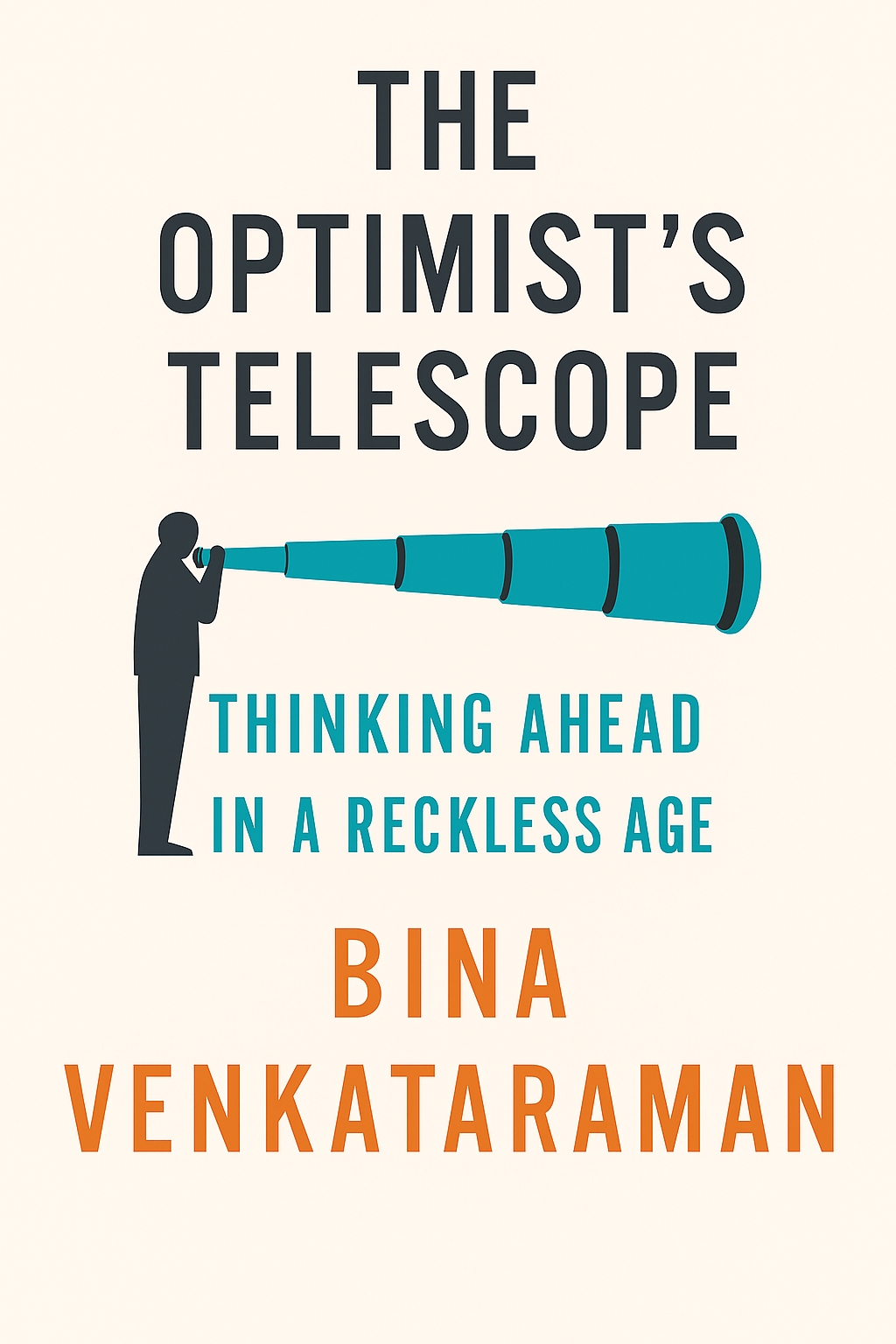
By Bina Venkataraman
