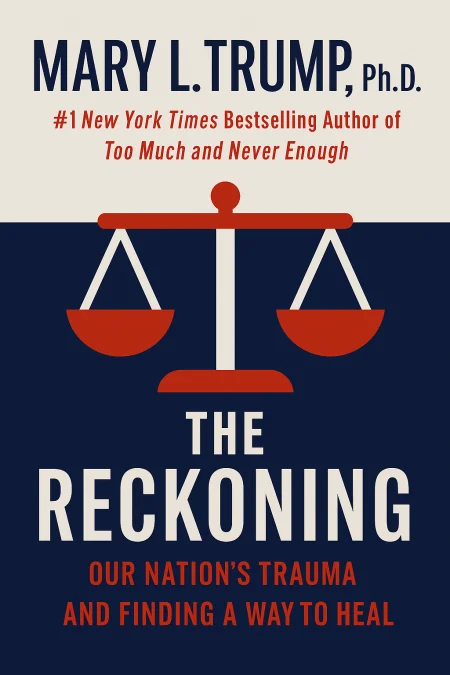
The Reckoning
Our Nation's Trauma and Finding a Way to Heal
Book Edition Details
Summary
A tempest of turmoil has engulfed America, leaving behind the jagged shards of national trust and unity. In "The Reckoning," Mary L. Trump, armed with a Ph.D. in clinical psychology and her own brush with post-traumatic stress, peels back the layers of collective trauma that have scarred the nation under the influence of her infamous uncle. Her piercing analysis connects the dots between historical injustices and the contemporary quagmire of division and despair. This gripping narrative challenges us to confront the deeper malaise within our societal foundations, urging a reckoning not just with recent political turbulence but with a legacy of inequality. It's an urgent call to action, a blueprint for healing a fractured nation, and a profound reflection on the resilience required to rebuild from chaos.
Introduction
On January 6, 2021, Confederate flags flew through the halls of the United States Capitol for the first time in history. This shocking image crystallized a truth many Americans had been reluctant to face: the unresolved traumas of our past had finally caught up with us. The insurrection wasn't an aberration but the logical culmination of centuries of unhealed wounds, unaddressed grievances, and a democracy that had never fully reckoned with its original sins. This book traces the through-line from slavery and Reconstruction's failures to Jim Crow, from mass incarceration to the Trump presidency, revealing how America's foundational traumas continue to shape our present reality. Like individuals who never process their deepest wounds, nations that refuse to confront their history remain trapped by it, doomed to repeat destructive patterns across generations. The work is essential reading for anyone seeking to understand how we arrived at our current crisis of democracy, why traditional political solutions keep falling short, and what genuine healing might actually require. It's for those brave enough to look unflinchingly at our past in order to build a more honest future.
Foundation of Failure: Reconstruction's Betrayal (1865-1920)
The period following the Civil War represented America's greatest missed opportunity for true democratic transformation. Between 1865 and 1877, the nation possessed both the moral authority and political power to create a genuinely multiracial democracy. Instead, it chose the path of accommodation with its former enemies, setting patterns of betrayal that would echo through subsequent centuries. President Andrew Johnson, a former enslaver himself, began issuing pardons to Confederate leaders within months of taking office. By 1866, he had reversed General Sherman's orders redistributing land to freed slaves, effectively evicting Black families from property explicitly granted to them. Meanwhile, the Freedmen's Bureau, tasked with helping four million newly freed people transition to citizenship, was systematically underfunded and undermined. As one Republican congressman observed, without land reform, speculators would reduce freedmen to a situation "more galling than slavery itself." The constitutional amendments passed during this era contained fatal loopholes that white supremacists would exploit for generations. The Thirteenth Amendment's exception for punishment of crime became the foundation for convict leasing systems that re-enslaved thousands of Black Americans under conditions often worse than plantation slavery. The promise of forty acres and a mule gave way to sharecropping systems designed to trap families in perpetual debt and dependency. Perhaps most tragically, when Black Americans achieved remarkable success despite these obstacles, establishing schools, businesses, and political organizations, white violence systematically destroyed their gains. The 1921 Tulsa massacre exemplified this pattern: a thriving Black community dubbed "Negro Wall Street" was burned to the ground by white mobs, with survivors placed in internment camps while the perpetrators faced no consequences. This cycle of Black achievement followed by white backlash would define American race relations for the next century, establishing the template for every subsequent period of progress and retrenchment.
Modern Cruelty: Jim Crow to Trump Era (1920-2021)
The collapse of Reconstruction ushered in an era of legalized apartheid that would last nearly a century. Jim Crow wasn't merely about separate water fountains and lunch counters; it was a comprehensive system designed to extract Black labor while denying Black humanity. Between 1877 and 1950, over 4,000 documented lynchings terrorized Black communities, often accompanied by torture rituals that rivaled medieval barbarism. These weren't spontaneous acts of mob violence but calculated campaigns of domestic terrorism designed to maintain white supremacy. The supposed end of Jim Crow in the 1960s simply drove these systems underground. Nixon's "War on Drugs" marked the beginning of mass incarceration as the new method of racial control. By 1990, federal sentences for crack cocaine averaged 49 percent higher for Black Americans than whites, despite identical chemical compositions between crack and powder cocaine. The result was a prison population that exploded from 300,000 in 1980 to over 2 million by 2000, with Black men comprising the vast majority of new inmates. This carceral system extended into schools through "zero tolerance" policies that criminalized childhood behavior, creating what scholars term the "school-to-prison pipeline." Black preschool children became 48 percent of students suspended multiple times, despite comprising only 19 percent of preschool enrollment. The message was clear: Black bodies remained sites of extraction and control, whether through unpaid prison labor or the private prison industry that emerged to profit from human cages. The Trump presidency represented the full flowering of these historical patterns. The administration's child separation policies, the deployment of unmarked federal agents against protesters, and the January 6 insurrection all drew from America's long tradition of state-sanctioned violence against those deemed outside the bounds of full citizenship. When Confederate flags finally entered the Capitol, they were simply coming home to the democracy that had never fully rejected what they represented.
White Supremacy's Grip: Systemic Racism Endures
The myth of white supremacy requires constant maintenance through institutions, policies, and cultural narratives that make racial hierarchy seem natural and inevitable. This work begins in childhood, through textbooks that describe slavery as a "peculiar institution" rather than a crime against humanity, and continues through hiring practices, housing policies, and criminal justice systems that perpetuate racial disadvantage across generations. Modern residential segregation wasn't the result of private choices but deliberate government policy. Federal agencies like the FHA and VA systematically denied mortgages to Black families while subsidizing white suburban development through the GI Bill and other programs. This wasn't merely unfair; it was theft on a massive scale, preventing Black families from accumulating the generational wealth that forms the backbone of American middle-class stability. The result is a median white family wealth that remains ten times higher than median Black family wealth today. The health consequences of systemic racism literally kill. Environmental racism places Black communities disproportionately near toxic waste sites and highway systems that poison the air. Medical racism leads to Black mothers dying in childbirth at rates three times higher than white mothers, while Black Americans receive substandard healthcare due to persistent myths about biological differences. Research shows that 200 Black Americans die prematurely every day due to these accumulated health disparities. Perhaps most insidiously, the criminal legal system continues to function as a mechanism for racial control disguised as colorblind law enforcement. Black Americans are arrested, prosecuted, convicted, and sentenced more harshly at every stage of the process, despite similar rates of drug use and criminal behavior across racial groups. Once labeled as felons, they face legal discrimination in employment, housing, education, and voting that can last a lifetime. As civil rights lawyer Michelle Alexander observes, "Once you're labeled a felon, the old forms of discrimination suddenly become legal." The system has evolved but never abandoned its core function of maintaining white supremacy through law.
Facing Truth: Reparations and Democratic Renewal
The path toward genuine healing requires more than good intentions and colorblind policies. It demands a national reckoning with the full scope of historical and ongoing harm, followed by concrete measures to repair the damage. Reparations represent not only moral necessity but democratic survival, offering the only realistic path toward creating the multiracial democracy America has never actually achieved. This isn't about guilt or blame but about cause and effect. When the government subsidized white homeownership while denying Black families access to mortgages, it created wealth gaps that compound across generations. When convict leasing systems extracted billions in free labor from Black bodies, that value didn't disappear but was invested in building the infrastructure and institutions that still benefit white communities today. The question isn't whether these harms occurred but whether America has the courage to face their ongoing consequences. Reparations would involve direct cash payments to African American descendants of enslaved people, but also broader systemic changes: massive investment in Black communities, educational initiatives that teach accurate history, criminal justice reforms that end mass incarceration, and healthcare programs that address centuries of medical neglect and abuse. The goal isn't to punish white Americans but to create conditions where all Americans can thrive without the artificial advantages and disadvantages created by racial hierarchy. The alternative to reparative justice is continued crisis. Demographics alone will make white supremacy increasingly untenable, but demographic change without structural transformation typically leads to backlash and violence. The January 6 insurrection offered a preview of how white Americans might respond to becoming a numerical minority while retaining structural power. True democracy requires not just majority rule but protection of minority rights and genuine equality before the law. America can choose the path of justice and healing, or it can continue down the road of division and domination that leads ultimately to the destruction of democratic institutions themselves.
Summary
America's current crisis of democracy stems not from recent political failures but from unresolved traumas that date to the nation's founding. The central contradiction between the ideals of freedom and equality and the realities of slavery and genocide created fault lines that continue to destabilize American society. Each moment of potential healing has been followed by backlash and retrenchment, creating cycles of progress and regression that prevent genuine democratic consolidation. The through-line from Reconstruction's betrayal to Jim Crow to mass incarceration to the Trump presidency reveals how white supremacy adapts and evolves while maintaining its essential function. What changes is the method, not the goal: whether through lynching, legal segregation, or colorblind policies that produce racially disparate outcomes, the system consistently operates to maintain white advantage and Black disadvantage. Individual prejudice matters less than structural arrangements that make racial inequality appear natural and inevitable. The path forward requires three interconnected commitments: truth-telling about the full scope of historical and ongoing harm, material repair through reparations and systemic change, and the courage to imagine genuinely multiracial democracy for the first time in American history. This work benefits everyone by creating conditions where human potential can flourish without artificial constraints. The choice facing America is ultimately simple: evolve into the democracy it has always claimed to be, or continue the patterns of domination that will ultimately destroy democratic institutions altogether. Time is running out to choose transformation over collapse.
Related Books
Download PDF & EPUB
To save this Black List summary for later, download the free PDF and EPUB. You can print it out, or read offline at your convenience.
By Mary L. Trump
