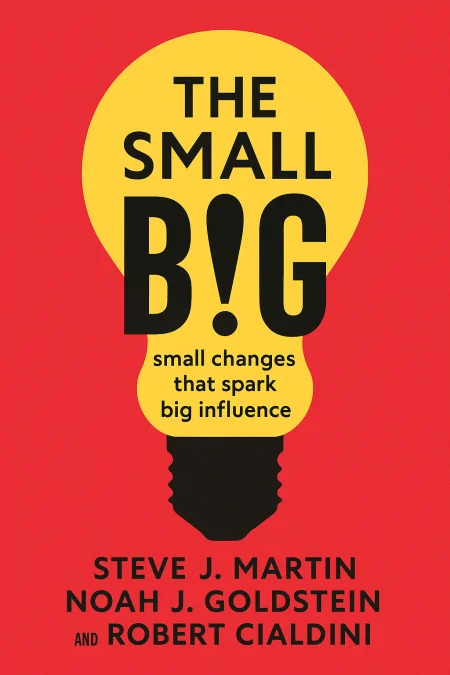
The Small BIG
Small Changes that Spark Big Influence
byRobert B. Cialdini, Steve J. Martin, Noah J. Goldstein
Book Edition Details
Summary
Persuasion isn't about grand gestures; it's about the subtle art of influence in everyday encounters. Whether you're coaxing a friend to try a new restaurant or negotiating a crucial business deal, "The Small BIG" by persuasion maestros Steve Martin, Noah Goldstein, and Robert Cialdini unveils the power of tiny tweaks in behavior that yield monumental shifts in outcomes. In a world drowning in information, they offer 52 insightful strategies that transform the mundane into the monumental, enhancing your ability to sway minds and shape decisions. Dive into these micro-changes and watch as your confidence and success in negotiation soar, proving that in the realm of influence, less truly is more.
Introduction
In our complex world of endless information and competing demands, we often assume that creating meaningful change requires grand gestures, substantial resources, or dramatic interventions. Yet behavioral science reveals a counterintuitive truth: the most profound transformations frequently emerge from the smallest modifications to how we communicate, present choices, or structure our appeals. This principle challenges conventional wisdom about influence and persuasion, suggesting that minor adjustments in context, timing, or framing can yield disproportionately powerful results. The authors present a comprehensive framework built on decades of psychological research, demonstrating how tiny behavioral modifications can redirect human decision-making with remarkable precision. Rather than relying on intuition or traditional marketing approaches, this system grounds itself in empirical evidence about how people actually process information and make choices. The work addresses fundamental questions about human psychology: Why do people respond more strongly to social proof than logical arguments? How does the sequence of information affect decision-making? What role does context play in shaping our judgments? These insights form the foundation for understanding how small changes can create outsized impact across diverse domains, from healthcare compliance to environmental conservation, from business negotiations to personal relationships.
The Science of Social Proof and Persuasion
Social proof operates as one of the most fundamental drivers of human behavior, functioning as a psychological shortcut that helps individuals navigate complex decisions by observing what others do. This principle recognizes that people rarely make choices in isolation; instead, they constantly scan their environment for cues about appropriate behavior, particularly when facing uncertainty or unfamiliar situations. The mechanism works because following the crowd typically leads to accurate decisions while simultaneously fulfilling our deep-seated need to belong and gain social acceptance. The effectiveness of social proof stems from three interconnected motivations that shape human psychology. First, people seek to make accurate decisions efficiently, using others' behavior as a reliable indicator of the best course of action. Second, individuals desire to affiliate with and gain approval from their peers, making conformity a pathway to social connection. Third, people want to maintain a positive self-image, and aligning with majority behavior helps preserve this sense of moral identity. These motivations work synergistically, creating powerful pressure toward conformity that operates largely below conscious awareness. Real-world applications demonstrate the remarkable power of social proof across diverse contexts. When British tax authorities modified collection letters to emphasize that most citizens pay their taxes on time, compliance rates increased dramatically, generating hundreds of millions in additional revenue. Similarly, hotels that informed guests about other visitors' towel reuse behavior saw significant increases in environmental compliance. These examples illustrate how highlighting existing positive behaviors can be more effective than traditional approaches focused on consequences or incentives. The key insight is that people are naturally inclined to follow social norms when made aware of them, making social proof a cost-effective and ethical tool for behavior change.
Commitment and Consistency in Influence
The human drive for consistency represents a fundamental aspect of psychological functioning, reflecting our deep need to maintain coherence between our stated beliefs, past actions, and future behavior. This principle operates on the understanding that people experience genuine discomfort when their actions contradict their previous commitments, creating internal pressure to behave in ways that align with their established positions. The mechanism becomes particularly powerful when commitments are made actively, publicly, and with personal effort, as these conditions strengthen the psychological ownership of the decision. Effective commitment strategies involve two critical components that amplify their influence potential. The first element focuses on securing active participation, where individuals personally engage in the commitment process rather than passively receiving instructions or agreements. This might involve writing down appointment times, stating goals aloud, or physically signing agreements. The second component emphasizes making commitments specific and actionable, with clear implementation intentions that detail when, where, and how the committed behavior will occur. These elements work together because active participation increases psychological ownership while specificity reduces the cognitive burden of translating intentions into actions. The practical applications of commitment and consistency principles extend far beyond simple promise-making, encompassing sophisticated approaches to behavior change and compliance. Healthcare providers have reduced appointment no-shows by having patients write down their own appointment times rather than receiving pre-written cards, while organizations have increased follow-through on initiatives by securing specific implementation plans from participants. The underlying insight is that people are more likely to honor commitments they have actively created themselves, particularly when these commitments are embedded within clear action frameworks. This approach transforms abstract intentions into concrete behavioral contracts, significantly increasing the likelihood of successful outcomes.
Strategic Communication and Message Framing
The way information is presented often matters more than the information itself, as human decision-making relies heavily on contextual cues and framing effects that operate below conscious awareness. Strategic communication recognizes that identical content can produce dramatically different responses depending on how it is structured, sequenced, or positioned relative to other information. This principle challenges the assumption that rational arguments alone drive behavior change, instead emphasizing the crucial role of presentation context in shaping how messages are received and processed. The architecture of effective message framing involves several interconnected elements that work together to optimize persuasive impact. Sequencing effects determine the order in which information is presented, with research showing that certain arrangements can enhance or diminish overall message effectiveness. Contrast effects influence how people evaluate options by manipulating what they compare against, while precision effects demonstrate that specific numbers often carry more weight than round figures. Social proof elements embed messages within broader behavioral contexts, showing recipients how their peers have responded to similar appeals. These components must be carefully coordinated because combining too many techniques can create resistance or skepticism. Successful applications of strategic communication principles appear across numerous domains, from marketing and sales to public policy and healthcare. Restaurants that present expensive items first on menus increase overall spending, while negotiators who make precise initial offers achieve better outcomes than those using round numbers. Environmental campaigns that emphasize what most people are already doing prove more effective than those focusing on problems or consequences. These examples demonstrate that small modifications to message structure can create substantial behavioral shifts without requiring additional resources or changing fundamental content. The key insight is that presentation context serves as a powerful but often overlooked lever for influence, offering practical opportunities for improving communication effectiveness across virtually any domain.
Summary
The most profound insight from behavioral science may be that transformative influence requires not grand gestures or substantial resources, but rather precise adjustments to the psychological context in which decisions occur. This understanding fundamentally shifts how we approach persuasion, moving from content-focused strategies to context-aware interventions that align with natural human psychology. The implications extend far beyond marketing or business applications, offering a scientifically grounded framework for addressing complex social challenges, from public health compliance to environmental conservation, from educational engagement to organizational change. By recognizing that small changes in presentation, timing, or social context can redirect human behavior with remarkable precision, we gain access to practical tools for creating positive impact while respecting individual autonomy and choice.
Related Books
Download PDF & EPUB
To save this Black List summary for later, download the free PDF and EPUB. You can print it out, or read offline at your convenience.
By Robert B. Cialdini
