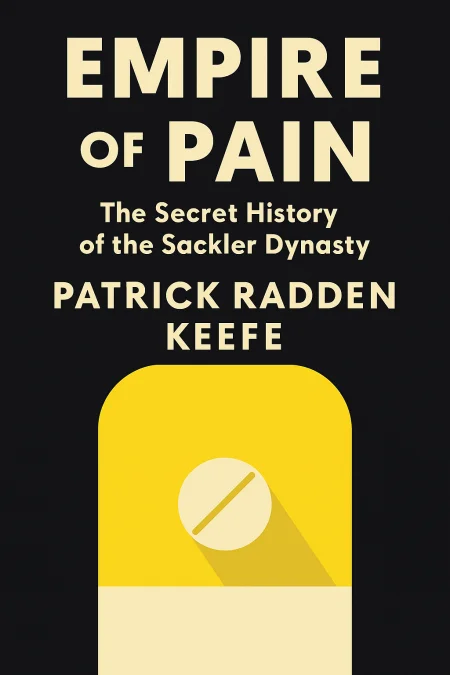
Empire of Pain
The Secret History of the Sackler Dynasty
Book Edition Details
Summary
Glimpse the opulent world of the Sacklers—a dynasty whose philanthropic facade conceals a darker legacy. Renowned for their contributions to elite institutions like Harvard and the Louvre, the Sacklers amassed unimaginable wealth, their fortune rooted in the controversial drug OxyContin. "Empire of Pain" unravels the intricate tapestry of this family's rise and the ensuing chaos of the opioid crisis that shattered countless lives. With a narrative as relentless as the crisis itself, this book exposes the ironclad grip of influence and wealth that shielded the Sacklers from accountability. A gripping exploration of power, greed, and the human cost of unchecked ambition, it demands a reckoning with the true price of their empire.
Introduction
In December 1972, a widowed mother of ten children vanished from her Belfast apartment, dragged away by masked figures who promised she would return in a few hours. She never did. This disappearance occurred during one of the bloodiest years of Northern Ireland's conflict, when nearly five hundred people lost their lives in a war that would consume a generation. The story of Jean McConville's abduction opens a window into one of the twentieth century's most complex and enduring conflicts, where the line between victim and perpetrator often blurred beyond recognition. This narrative reveals how ordinary people became swept up in extraordinary violence, transforming neighbors into enemies and idealistic young students into bombers and gunmen. Through intimate portraits of individuals on all sides, we witness how a civil rights movement devolved into decades of sectarian warfare, how the British government's counterinsurgency tactics often backfired spectacularly, and how the culture of silence that surrounded paramilitary activity created wounds that persist to this day. The book illuminates not just the mechanics of political violence, but its profound human cost, making it essential reading for anyone seeking to understand how societies fracture and, eventually, how they might heal.
Seeds of Conflict: From Civil Rights to Armed Struggle (1968-1972)
The troubles that would consume Northern Ireland for three decades began not with bombs or bullets, but with a simple demand for equal rights. In the late 1960s, Catholic citizens faced systematic discrimination in housing, employment, and voting rights within the Protestant-dominated state. What started as peaceful civil rights marches, inspired by the American movement led by Martin Luther King Jr., quickly escalated when met with violent resistance from loyalist counter-protesters and heavy-handed police responses. The transformation from peaceful protest to armed rebellion crystallized around figures like Dolours Price, a young Catholic woman who witnessed the brutal attack on civil rights marchers at Burntollet Bridge in January 1969. The sight of peaceful protesters being beaten with clubs and stones by masked loyalists, while police stood by or participated, shattered any faith in constitutional change. For Price and thousands like her, the lesson was clear: violence was the only language their oppressors understood. The arrival of British troops in 1969, initially welcomed by Catholics as protection from loyalist attacks, soon became another source of grievance as soldiers conducted aggressive searches and imposed curfews on nationalist areas. The introduction of internment without trial in 1971, targeting only Catholics, further radicalized the community. Young people who had once carried placards now carried guns, joining a revitalized Irish Republican Army that promised to drive the British from Irish soil. This period established the fundamental dynamic that would define the conflict for decades: each act of state repression created new recruits for the IRA, while each IRA attack justified further repression. The cycle of violence had begun, fed by genuine grievances but sustained by the logic of revenge and the intoxicating belief that ultimate victory was just one more operation away.
The Dirty War: Disappearances, Bombings, and Prison Protests (1972-1981)
By 1972, Northern Ireland had descended into what could only be described as a dirty war, where the normal rules of conflict no longer applied. The IRA's campaign expanded from defensive actions to offensive operations, including a devastating bombing campaign that brought the conflict to London's doorstep. Meanwhile, British forces deployed counterinsurgency tactics honed in colonial conflicts, including the use of torture, assassination squads, and a vast network of informants that penetrated every level of republican organizations. The human cost of this escalation was measured not just in the hundreds who died each year, but in those who simply vanished. Jean McConville was among seventeen people who were "disappeared" by the IRA, their bodies hidden in unmarked graves across the Irish countryside. These disappearances served multiple purposes: eliminating suspected informants, terrorizing communities into silence, and denying families the closure that comes with burial. The psychological warfare was as important as the physical violence. Prison became another battlefield, where republican inmates fought for recognition as political prisoners rather than common criminals. The hunger strikes of 1980-81, culminating in the death of Bobby Sands and nine others, transformed the conflict once again. What had been primarily a military struggle became a political one, as Sinn Féin emerged from the shadows to contest elections while the IRA continued its armed campaign. The strategy was summarized in the phrase "ballot paper in one hand, Armalite in the other." The period also revealed the extent to which the British state was willing to bend its own rules in pursuit of victory. Through agents like "Stakeknife," who operated at the highest levels of the IRA while reporting to British intelligence, the line between counterterrorism and state terrorism became increasingly blurred. Both sides claimed to be defending civilization while employing methods that seemed to abandon it entirely.
Peace Process and Moral Reckoning: Truth, Silence, and Legacy (1998-2013)
The Good Friday Agreement of 1998 brought an end to the armed conflict, but not to the moral questions it had raised. Former enemies found themselves sharing power in a devolved government, while ex-prisoners walked free under an amnesty that prioritized peace over justice. The transition from war to peace required a collective agreement to look forward rather than backward, to focus on building a shared future rather than settling old scores. Yet the past refused to stay buried, literally and figuratively. Families of the disappeared continued their search for answers, while historians and journalists began the delicate work of documenting what had really happened during the darkest years. The Boston College oral history project, which promised to preserve the testimonies of former combatants for future generations, became a flashpoint when police sought access to the interviews for ongoing criminal investigations. The peace process revealed the complex relationship between truth and reconciliation. While some argued that full disclosure was necessary for genuine healing, others contended that too much truth-telling could destabilize the fragile peace. Former IRA members like Dolours Price found themselves caught between loyalty to old comrades and a desire to set the historical record straight, struggling with what psychologists call "moral injury" – the wound that comes from participating in or witnessing acts that violate one's deepest beliefs about right and wrong. The search for Jean McConville's remains became a metaphor for this broader struggle with memory and accountability. When her body was finally found in 2003, it provided closure for her children but raised new questions about who was responsible and whether anyone would ever be held accountable. The case illustrated how the past continues to shape the present, how silence can be both protective and corrosive, and how the price of peace sometimes includes the sacrifice of justice.
Summary
The Northern Ireland conflict reveals how quickly civil rights movements can escalate into armed struggles when met with intransigence and violence, and how difficult it becomes to step back from the brink once that line is crossed. The core contradiction that drove three decades of violence was the collision between two legitimate but incompatible aspirations: the desire of Catholics for equality and recognition within the existing state, and the determination of Protestants to maintain their political and cultural dominance. The story offers sobering lessons for contemporary conflicts around the world. It demonstrates how state repression can radicalize moderate movements, turning peaceful protesters into armed revolutionaries. It shows how the logic of counterinsurgency can corrupt democratic institutions, leading governments to employ torture, assassination, and other tactics that undermine the very values they claim to defend. Most importantly, it illustrates how cycles of violence become self-perpetuating, as each generation inherits the grievances and traumas of the last. Yet the eventual peace process also provides hope, showing that even the most intractable conflicts can be resolved through patient negotiation and mutual compromise. The key insight is that peace requires not just the absence of violence, but the presence of justice – or at least the promise that justice might eventually be achieved through political means. For societies emerging from conflict, the challenge is learning to live with ambiguity, to accept that some questions may never be fully answered, and that the price of moving forward sometimes includes leaving the past imperfectly resolved.
Related Books
Download PDF & EPUB
To save this Black List summary for later, download the free PDF and EPUB. You can print it out, or read offline at your convenience.
By Patrick Radden Keefe
