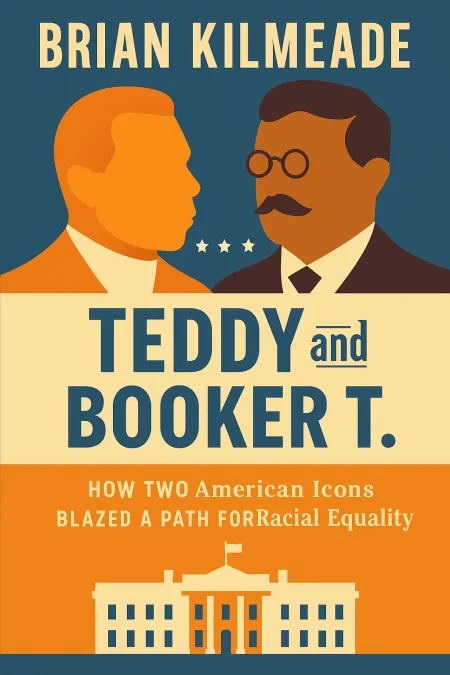
Teddy and Booker T.
How Two American Icons Blazed a Path for Racial Equality
Book Edition Details
Summary
In the crucible of early 20th-century America, where racism surged with brutal force, two improbable allies dared to dream of equality. "Teddy and Booker T." by Brian Kilmeade reveals the riveting alliance between President Theodore Roosevelt, the embodiment of privilege and power, and Booker T. Washington, a visionary born into the shackles of slavery. As Jim Crow laws spread their poison and violence threatened to unravel social progress, these two icons—so different in origin yet united in purpose—ignited a spark of hope. Roosevelt, the audacious Rough Rider, and Washington, the trailblazing educator, confronted an era's deep-seated prejudices with unwavering resolve. This gripping narrative celebrates their shared belief in the transformative power of courage and collaboration, painting an unforgettable portrait of resilience and visionary leadership.
Introduction
On a crisp October evening in 1901, a simple dinner invitation would shatter the racial conventions of an entire nation. When President Theodore Roosevelt welcomed Booker T. Washington to dine at the White House, the reaction was swift and explosive—Southern newspapers erupted in fury, politicians threatened violence, and the country confronted the uncomfortable reality of how far it still had to travel toward true equality. Yet this controversial moment marked the beginning of one of the most remarkable partnerships in American political history. Theodore Roosevelt, the youngest president ever to occupy the White House, embodied the boundless energy and reformist spirit of the Progressive Era. Born into New York privilege but forged by personal tragedy and frontier adventure, he brought to the presidency an unshakeable belief in justice and merit over prejudice. Booker T. Washington, born into the depths of slavery but rising to become America's most influential Black leader, had built an educational empire while navigating the treacherous waters of post-Reconstruction America with extraordinary skill and patience. Their unlikely alliance offers profound insights into the complexities of leadership during times of deep social division. Through their collaboration, we witness the delicate balance between idealism and pragmatism, the courage required to challenge entrenched systems of oppression, and the patient persistence necessary to create lasting change. Their story reveals how two men from vastly different worlds found common ground in their shared vision of an America that could fulfill its promise of equality for all citizens, regardless of the color of their skin.
From Different Worlds: The Making of Two American Leaders
Theodore Roosevelt's transformation from sickly child to national hero began in the most unlikely circumstances. Born into Manhattan's elite society in 1858, young "Teedie" was plagued by severe asthma that left him gasping for breath and largely confined to his family's brownstone mansion. His father's prescription was both simple and transformative: "You have the mind, but you have not the body, and without the help of the body the mind cannot go as far as it should. You must make your body." Through sheer determination and relentless physical training, Roosevelt forged himself into a robust outdoorsman, embodying a principle that would guide his entire life—that character is built through struggle and perseverance. The death of his beloved wife Alice in 1884, on the same day his daughter was born, shattered Roosevelt's carefully constructed world. Seeking solace and renewal, he fled to the Dakota Badlands, where the harsh beauty of the frontier offered both escape and education. Living among cowboys, ranchers, and settlers, he learned invaluable lessons about leadership, resilience, and the fundamental dignity of honest work. These experiences with common men from all walks of life gave him an appreciation for merit over pedigree and planted the seeds of his later commitment to the "square deal" for all Americans. Booker T. Washington's journey was even more extraordinary, beginning from the absolute bottom of American society. Born around 1856 on a Virginia plantation, he spent his earliest years as human property, sleeping on rags in a one-room cabin and watching with desperate longing as white children attended the schoolhouse that remained forever closed to him. The moment of emancipation came when he was about nine years old, as Union soldiers read the proclamation that freed him and millions of others. Yet freedom brought new challenges—his family moved to West Virginia, where young Booker worked in salt mines and coal pits while desperately seeking the education that had been denied him. Washington's hunger for learning was insatiable and would define his entire approach to advancement. When he heard about Hampton Institute, a school for freed slaves in Virginia, he walked nearly 500 miles to get there with little more than determination and a few coins in his pocket. Arriving dirty and exhausted, he impressed the school's administrators by perfectly cleaning a classroom, earning his admission through this simple demonstration of thoroughness and pride in work. At Hampton, under the guidance of General Samuel Chapman Armstrong, Washington developed his philosophy that practical education, moral character, and economic self-sufficiency were the keys to racial progress in a hostile world.
The Historic White House Dinner That Changed America
The evening of October 16, 1901, began as what seemed like a routine working dinner between two public servants committed to good government. President Roosevelt, barely a month into his presidency following McKinley's assassination, had been collaborating quietly with Booker T. Washington on federal appointments throughout the South. Roosevelt recognized Washington's invaluable network of contacts and his ability to identify qualified candidates regardless of race—a revolutionary approach in an era when competence often took a backseat to racial prejudice in government hiring. The dinner itself was a modest family affair, with Roosevelt's wife Edith and several of their children joining the two men for conversation about Southern politics and federal appointments. Washington, now America's most prominent Black leader following the success of his autobiography and his leadership of Tuskegee Institute, found himself dining at the most exclusive table in America, discussing matters of national importance as an equal partner in governance. Neither man anticipated the explosive reaction that would follow when news of their meal became public. When word of the dinner leaked to the press the following day, it unleashed a torrent of racist fury that shocked even seasoned political observers. Southern newspapers competed to express the most extreme outrage, with the Memphis News-Scimitar calling it "the greatest outrage which has ever been perpetrated by any citizen of the United States." Senator Benjamin "Pitchfork Ben" Tillman of South Carolina declared ominously that the dinner would "necessitate our killing a thousand negroes in the South before they will learn their place again." The hysteria revealed the depth of white supremacist sentiment that still dominated much of the nation four decades after the Civil War. Roosevelt was genuinely bewildered by the vicious reaction to what he considered simple courtesy and sound politics. To him, inviting a distinguished educator and trusted advisor to dinner was merely good manners—he had not fully grasped the symbolic weight his actions would carry in a society still rigidly divided by racial barriers. The president initially stood firm, telling friends he would "have him to dine as often as I please," but the political damage was severe and lasting. His hopes of building Republican strength in the South were shattered overnight, and he would never again invite a Black American to dine at the White House, learning a harsh lesson about the limits of presidential power when confronting deeply entrenched prejudice.
Building Bridges: Their Collaboration for Civil Rights Progress
Despite the dinner controversy's political fallout, Roosevelt and Washington continued their behind-the-scenes partnership, working strategically to advance racial progress through the careful placement of qualified individuals in federal positions. Their collaboration represented a pragmatic approach to civil rights—using the power of presidential patronage to gradually build a more racially inclusive government while avoiding the kind of dramatic confrontations that could provoke violent backlash. Roosevelt relied heavily on Washington's extensive network throughout the South to identify candidates who possessed both professional competence and the political skill necessary to survive in hostile environments. The appointment of Dr. William D. Crum as collector of customs in Charleston, South Carolina, became a crucial test case for their strategy. Crum was impeccably qualified—a successful physician, businessman, and longtime Republican Party leader who enjoyed respect from members of both races in his community. Yet his nomination sparked fierce resistance from white supremacists, led by Senator Tillman, who openly declared that "if he were a white man he would be alright" but opposed him solely because of his race. Roosevelt refused to back down, making multiple recess appointments when the Senate blocked confirmation, demonstrating his willingness to expend significant political capital in defense of the principle that merit, not race, should determine fitness for public service. When white supremacists in Indianola, Mississippi, forced Black postmistress Minnie Cox to resign under threat of violence, Roosevelt took even more decisive action. Rather than quietly accept this injustice, he closed the entire post office, declaring he would not "tolerate wrong and outrage of such flagrant character." Cox continued to receive her federal salary while the town's mail was rerouted to a neighboring community, creating significant inconvenience for the very people who had driven her from office. This bold response sent a clear message that the federal government would not simply abandon its Black employees to mob rule. The Roosevelt-Washington partnership extended beyond individual appointments to broader questions of policy and principle. Washington provided crucial advice on the president's speeches and public statements regarding race, helping him navigate treacherous political waters while maintaining his commitment to justice. Their collaboration represented a unique moment in American history when a sitting president actively sought counsel from a Black leader and was willing to risk his own political standing to advance racial equality, even when facing overwhelming opposition from within his own party's Southern wing.
Legacy of Courage: Lessons in Leadership and Social Change
The partnership between Roosevelt and Washington ultimately revealed both the remarkable possibilities and the sobering limitations of elite-level cooperation in advancing racial justice during the Jim Crow era. Their collaboration achieved meaningful, if modest, progress in placing qualified African Americans in federal positions and establishing the crucial principle that government service should be based on merit rather than racial prejudice. Roosevelt appointed more Black Americans to significant federal positions than any president since Reconstruction, while Washington used his influence to ensure these appointments went to individuals who could effectively serve their communities and advance the broader cause of racial progress. However, their relationship also exposed the harsh constraints that even the most powerful allies faced when confronting deeply entrenched systems of racial oppression. The Brownsville Affair of 1906, in which Roosevelt summarily dismissed an entire battalion of Black soldiers without trial based on questionable evidence, demonstrated how political pressure could override personal conviction and friendship. Washington's inability to dissuade the president from this unjust action marked a painful turning point in their relationship and highlighted the limits of behind-the-scenes influence when confronted with white supremacist demands for swift, visible punishment. The friendship between these two extraordinary men transcended their specific policy achievements to become a powerful symbol of what was possible when Americans of different backgrounds united around shared principles of justice and human dignity. Roosevelt's willingness to risk his political standing by publicly honoring Washington challenged prevailing racial orthodoxies and provided a model for future leaders willing to stand on principle. Washington's skillful navigation of the treacherous political landscape demonstrated the power of strategic thinking, moral courage, and patient persistence in advancing civil rights under the most difficult circumstances imaginable. Their collaboration laid crucial groundwork for the civil rights advances that would follow in later decades. By establishing precedents for Black participation in federal government and challenging the assumption that racial segregation was natural or inevitable, Roosevelt and Washington helped create the intellectual and political foundation upon which future generations would build. Their partnership proved that meaningful progress was possible when leaders of goodwill worked together across racial lines, even in the face of overwhelming opposition, violent threats, and enormous personal risk to their careers and safety.
Summary
The remarkable partnership between Theodore Roosevelt and Booker T. Washington stands as a testament to the transformative power of principled leadership and cross-racial cooperation in the face of seemingly insurmountable prejudice and hatred. Their unlikely friendship demonstrated that meaningful progress toward racial justice was possible even during the darkest days of the Jim Crow era, when such collaboration required extraordinary courage from both participants and often came at enormous personal and political cost. Though their efforts achieved only modest immediate gains in the broader struggle for civil rights, they established crucial precedents, challenged fundamental assumptions about race and merit, and inspired future generations of leaders who would build upon their foundation of principled resistance to injustice. From their example, modern leaders can learn that lasting social change often requires patient, strategic work behind the scenes, building relationships across divides and creating opportunities for qualified individuals to prove their worth through dedicated service. Their story reminds us that progress rarely comes through grand gestures alone, but through the accumulation of countless individual acts of moral courage, principled compromise, and persistent advocacy for justice even when the odds seem overwhelming. For anyone seeking to understand how transformational change occurs in American society, or how to build bridges across seemingly unbridgeable divides of race, class, or ideology, the Roosevelt-Washington partnership offers invaluable lessons in the art of principled leadership and the enduring power of friendship in service to the highest ideals of human equality and dignity.
Related Books
Download PDF & EPUB
To save this Black List summary for later, download the free PDF and EPUB. You can print it out, or read offline at your convenience.
By Brian Kilmeade
