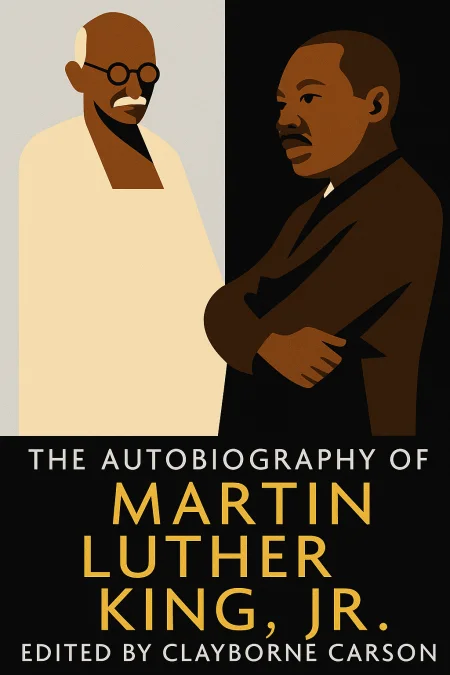
The Autobiography Of Martin Luther King, Jr.
King's journey to becoming the leading figure in the American civil rights movement
byMartin Luther King Jr., Clayborne Carson
Book Edition Details
Summary
In a world where words ignite revolutions, "The Essential Box Set" unveils the powerful oratory of Martin Luther King, Jr. Here, his voice resounds through history, capturing the relentless pursuit of justice and equality. From the stirring hope of "I Have a Dream" to the unyielding demand in "Give Us the Ballot," these speeches are more than echoes of the past; they are blueprints for change. Accompanied by "The Autobiography of Martin Luther King, Jr.," a vivid tapestry woven from personal writings and poignant reflections, this collection offers an intimate glimpse into the life of a man who transformed a nation. Essential for anyone who values the enduring power of words, this set is a testament to the strength of conviction and the enduring spirit of a leader who dared to dream.
Introduction
In the sweltering heat of a Montgomery summer in 1955, a young Baptist preacher found himself thrust into the spotlight of history when a seamstress named Rosa Parks refused to give up her bus seat. Martin Luther King Jr., barely twenty-six years old, would emerge from this moment not merely as a civil rights leader, but as one of the most transformative moral voices of the twentieth century. His journey from the comfortable middle-class world of Atlanta to the steps of the Lincoln Memorial, where he would deliver his immortal "I Have a Dream" speech, represents far more than a personal odyssey—it embodies America's ongoing struggle to fulfill its founding promise that all men are created equal. King's life unfolded during a pivotal era when the old order of segregation began to crumble under the weight of moral conscience and organized resistance. Through his own words, we witness the evolution of a man who would revolutionize the American approach to social change by wedding the Christian gospel of love to Gandhi's philosophy of nonviolent resistance. From this remarkable figure, readers will discover the profound spiritual and intellectual foundations that sustained a movement, the strategic brilliance that transformed local protests into a national awakening, and the personal courage required to maintain hope and humanity in the face of hatred and violence.
Formation of a Leader: Early Years and Intellectual Development
Martin Luther King Jr. was born into a world of contradictions in 1929 Atlanta, where the promise of American democracy collided daily with the harsh realities of Jim Crow segregation. Raised in the nurturing environment of Auburn Avenue's middle-class African American community, young Martin experienced both privilege and prejudice in equal measure. His father, Martin Luther King Sr., was a formidable figure—a sharecropper's son who had fought his way to prominence as pastor of Ebenezer Baptist Church and a fearless advocate for civil rights. His mother, Alberta Williams King, provided the gentle counterbalance with her quiet strength and unwavering moral guidance. The King household was one where love predominated, yet the harsh realities of segregation intruded early into Martin's consciousness. At age six, he lost his white playmate when the boy's father forbade their friendship upon their entering separate, segregated schools. This painful awakening to racial prejudice initially filled young Martin with anger and resentment toward all white people, emotions his parents gently redirected toward understanding the system rather than hating individuals. These early experiences of both familial love and societal rejection would profoundly shape his later philosophy of loving one's enemies while resisting unjust systems. Intellectually precocious and spiritually questioning, Martin excelled academically while wrestling with religious doubts that would ultimately deepen his faith. At Morehouse College, he encountered professors like Benjamin Mays who demonstrated that intellectual rigor and deep religious conviction could coexist. It was here that Martin first encountered Henry David Thoreau's essay on civil disobedience, planting seeds that would later blossom into his philosophy of nonviolent resistance. His decision to enter the ministry came not through dramatic revelation but through a growing sense that the gospel could be a powerful instrument for social transformation. The young seminarian's intellectual journey continued at Crozer Seminary in Pennsylvania, where he immersed himself in the works of great philosophers and theologians. His encounter with Gandhi's philosophy proved revolutionary, as he discovered in the Mahatma's approach the practical method for applying Christian love to social problems. This synthesis of Christian theology with Gandhian nonviolence would become the cornerstone of his life's work, transforming him from a promising young preacher into a prophet for social justice.
Montgomery to Birmingham: The Birth of a Movement
When Rosa Parks was arrested on December 1, 1955, for refusing to surrender her bus seat to a white passenger, the twenty-six-year-old pastor of Dexter Avenue Baptist Church found himself catapulted into a leadership role he had never sought. The Montgomery Improvement Association, formed to coordinate the bus boycott, unanimously elected King as its president, partly because his relative newcomer status made him less threatening to established interests. What began as a one-day protest evolved into a 381-day demonstration of collective resolve that would transform both King and the civil rights movement. The boycott revealed King's remarkable ability to articulate the moral dimensions of the struggle while maintaining discipline among fifty thousand participants. His philosophy of nonviolent resistance, drawing from both Christian teachings and Gandhi's example, provided a framework that elevated the protest beyond mere economic pressure to a spiritual crusade for human dignity. Night after night at mass meetings, King's oratory inspired ordinary people to extraordinary acts of courage, walking miles to work rather than riding segregated buses, transforming their sacrifice into a powerful witness for justice. The personal cost of leadership became apparent as King faced constant death threats, police harassment, and the bombing of his home. In a moment of profound crisis, alone in his kitchen at midnight, King experienced what he would later describe as a direct encounter with the divine, receiving assurance that sustained him through the darkest hours of the struggle. This spiritual experience became the foundation of his unshakeable conviction that God was present in the movement for justice. The successful conclusion of the boycott with the Supreme Court's ruling against bus segregation established King as a national figure and demonstrated the power of organized, nonviolent resistance. More importantly, it proved that ordinary people, when united by a common cause and committed to nonviolent principles, could challenge and overcome seemingly insurmountable systems of oppression. The Montgomery movement became a template for future campaigns and announced the emergence of a new phase in the struggle for civil rights.
National Leadership and Global Recognition: From Selma to Nobel Prize
The March on Washington for Jobs and Freedom on August 28, 1963, marked the apex of King's influence and the civil rights movement's moral authority. Standing before 250,000 Americans of all races, King delivered his "I Have a Dream" speech, transforming what had been planned as a political demonstration into a moment of national spiritual awakening. The speech, largely improvised from his prepared text, captured the movement's vision of an America where character would matter more than color, where the promise of equality would finally be fulfilled for all citizens. The march's success demonstrated King's unique ability to build coalitions across racial, religious, and class lines. Labor unions, religious organizations, and civil rights groups united behind a common vision of justice, creating what King called a "coalition of conscience." The event's peaceful nature and dignified tone countered stereotypes about black protesters and showed white Americans that the civil rights movement represented the best of American values, not a threat to them. The march created the political momentum necessary for the passage of the Civil Rights Act of 1964. King's receipt of the Nobel Peace Prize in 1964, at age thirty-five, represented international recognition of both his personal leadership and the broader civil rights movement's significance. The Norwegian Nobel Committee's decision to honor an American civil rights leader sent a powerful message about the global importance of the struggle for racial equality. For King, the prize was both a tremendous honor and a weighty responsibility, expanding his platform to address not just American racism but worldwide issues of poverty, war, and human rights. The Selma voting rights campaign of 1965 showcased King's mature understanding of how to create the political conditions necessary for federal intervention. Choosing to confront the brutal Sheriff Jim Clark in Alabama's Black Belt, King orchestrated a series of demonstrations designed to expose the violent reality of voter suppression. The march from Selma to Montgomery, protected by federal troops, became a powerful symbol of the federal government's commitment to protecting constitutional rights. The campaign's success led directly to the Voting Rights Act of 1965, removing the legal barriers that had prevented millions of African Americans from exercising their fundamental democratic rights.
Final Struggles: Vietnam, Poverty, and Unfulfilled Dreams
King's opposition to the Vietnam War marked a turning point in his leadership, transforming him from a figure of broad consensus to a more controversial prophet challenging American foreign policy. His decision to speak out against the war in 1967, despite warnings from allies that it would damage the civil rights movement, reflected his deepening understanding of the connections between racism, poverty, and militarism. King argued that a nation spending billions on destruction in Southeast Asia while neglecting poverty at home had lost its moral compass. His "Beyond Vietnam" speech at Riverside Church articulated a vision of America that prioritized human needs over military might, but it cost him support from moderate allies and the Johnson administration. The shift toward economic justice represented King's recognition that legal victories, while essential, were insufficient to address the deeper structures of inequality. The Chicago campaign of 1966 exposed the limitations of Southern strategies when applied to Northern urban problems. King's experience living in a Chicago slum opened his eyes to the daily violence of poverty—rats biting children, families paying premium prices for substandard goods, the psychological damage of hopelessness. The campaign achieved modest gains in housing agreements, but it also revealed the complexity of addressing systemic economic inequality through protest alone. King's final campaign, the Poor People's Campaign of 1968, represented his most ambitious attempt to address economic injustice through massive nonviolent disruption. The plan to bring thousands of poor people to Washington and remain until Congress addressed poverty reflected King's growing radicalism and his sense of urgency about America's moral crisis. He spoke increasingly of the need for fundamental economic restructuring, challenging not just racial discrimination but the assumptions of American capitalism itself. The campaign faced skepticism from allies who worried about its feasibility and from critics who saw it as too radical. King's assassination in Memphis on April 4, 1968, came as he was supporting striking sanitation workers, embodying his belief that all labor deserved dignity and fair wages. His final speech, "I've Been to the Mountaintop," revealed a man who sensed his time was short but remained committed to the struggle for justice. He spoke of having seen the promised land of racial equality and economic justice, even if he might not live to enter it himself. His death at thirty-nine left a movement without its most eloquent voice and America without its most compelling moral leader, but his vision of a beloved community where all people could live together in dignity and mutual respect continued to inspire generations of activists and ordinary citizens seeking to fulfill the promise of American democracy.
Summary
Martin Luther King Jr.'s life stands as a testament to the transformative power of moral courage wedded to strategic brilliance, proving that individuals committed to justice can indeed bend the arc of history toward righteousness. His synthesis of Christian love with Gandhian nonviolence created a methodology for social change that not only dismantled legal segregation but also elevated the consciousness of a nation, forcing America to confront the gap between its ideals and its practices. From his own journey, we learn that authentic leadership requires the willingness to sacrifice personal comfort for collective progress, and that sustainable social change must address not only external structures but also the hearts and minds of both oppressor and oppressed. King's legacy offers two enduring lessons for contemporary struggles for justice: first, that nonviolent resistance, properly understood and courageously applied, remains the most powerful weapon available to those seeking to overcome injustice; and second, that the beloved community he envisioned requires not the defeat of enemies but their transformation into friends. His life reminds us that the work of justice is never finished, that each generation must recommit itself to the ongoing struggle for human dignity and equality. For anyone seeking to understand how ordinary people can create extraordinary change, King's autobiography provides both inspiration and practical wisdom for the continuing journey toward a more just and compassionate world.
Related Books
Download PDF & EPUB
To save this Black List summary for later, download the free PDF and EPUB. You can print it out, or read offline at your convenience.
By Martin Luther King Jr.
