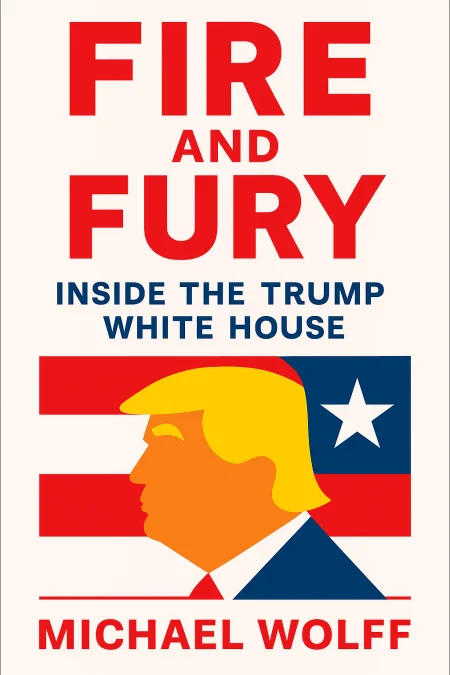
Fire and Fury
Inside the Trump White House
Book Edition Details
Summary
Witness the spectacle of power, intrigue, and chaos as Michael Wolff pulls back the curtain on the first tumultuous months of Donald Trump's presidency in "Fire and Fury: Inside the Trump White House." With unparalleled access to the inner sanctum of the West Wing, Wolff captures the whirlwind of controversy and unpredictability that has left both America and the world on edge. Through a blend of insider interviews and vivid reportage, this book lays bare the explosive dynamics at play: the candid opinions of Trump's closest aides, the mysterious motives behind James Comey's dismissal, and the combustible rivalry between Steve Bannon and Jared Kushner. A gripping narrative of a nation divided, "Fire and Fury" offers an electrifying glimpse into the heart of a presidency unlike any other.
Introduction
On the night of November 8, 2016, as election results defied every prediction and poll, a peculiar scene unfolded in Trump Tower. The man who had just won the presidency appeared more stunned than celebratory, while his inner circle scrambled to comprehend what they had accidentally achieved. This moment captures the essence of one of the most extraordinary political upheavals in American history—a campaign that began as a publicity stunt and ended with the most unconventional president ever to occupy the Oval Office. What happens when an outsider with no political experience suddenly finds himself at the helm of the world's most powerful democracy? How do the institutions of government respond when traditional norms are shattered overnight? These are the questions that defined one of the most turbulent periods in modern American politics. Through unprecedented access to the West Wing's inner workings, we witness the collision between instinctive, media-driven leadership and the complex machinery of federal government. This account illuminates how personal loyalty became the primary currency of power in a system designed around institutional checks and balances, and how the personalities and private ambitions of those closest to power shaped the direction of history itself. For students of political science, observers of democratic institutions, and citizens seeking to understand how American politics reached this inflection point, this inside view offers essential insights into the forces that continue to reshape our democratic landscape.
The Unlikely Victory: From Campaign Chaos to Presidential Transition (2016-2017)
The Trump campaign began as what many insiders considered an elaborate marketing exercise—a way to enhance the Trump brand and perhaps secure a lucrative television deal. Even Trump himself seemed surprised by his early primary victories, often appearing unprepared for the responsibilities that success would bring. The campaign operated more like a family business than a political organization, with his children playing key roles while professional operatives struggled to impose traditional campaign discipline. The turning point came in August 2016 when Steve Bannon, the provocative former Goldman Sachs banker turned media entrepreneur, took control of a campaign trailing badly in the polls. Bannon brought with him a revolutionary theory: that a coalition of forgotten Americans—working-class voters abandoned by globalization—could overwhelm the traditional Republican establishment. This wasn't just political strategy; it was ideological warfare against what Bannon saw as a corrupt bipartisan elite. The final months revealed Trump's peculiar political genius: his ability to dominate media coverage through sheer unpredictability. While Hillary Clinton ran a conventional campaign with carefully scripted messages, Trump generated constant headlines with his Twitter feed and rally performances. His supporters didn't just forgive his controversies—they celebrated them as evidence that he was fighting the system on their behalf. Victory on election night caught nearly everyone off guard, including Trump's own team. The transition period that followed exposed the campaign's fundamental unpreparedness for governing. With no detailed policy agenda and few relationships in Washington, the incoming administration became a magnet for competing factions, each believing they could shape Trump's presidency according to their own vision. This chaotic beginning would establish patterns of improvisation and internal warfare that would define the entire first year in office.
Early Struggles: Immigration Orders, Russia Investigations, and Internal Warfare (January-May 2017)
The opening weeks of the Trump presidency were marked by a series of self-inflicted crises that revealed both the administration's inexperience with governmental processes and its willingness to prioritize dramatic gestures over careful policy implementation. The first major initiative, a sweeping immigration executive order drafted hastily and implemented without proper legal review, created immediate turmoil at airports nationwide and fierce resistance from the courts. Three distinct power centers emerged within the West Wing, each representing different visions for the Trump presidency. Steve Bannon pushed for a populist revolution that would dismantle what he called the "administrative state." Jared Kushner and Ivanka Trump advocated for a more moderate approach that would appeal to suburban voters and business leaders. Meanwhile, Chief of Staff Reince Priebus tried unsuccessfully to impose traditional Republican orthodoxy and organizational discipline. The forced resignation of National Security Advisor Michael Flynn after just twenty-four days in office demonstrated how quickly the administration's Russia connections could become politically toxic. Flynn's departure marked the first major casualty in what would become a defining struggle between Trump's desire for loyalty and the institutional pressures of legal accountability. Behind the scenes, a vicious power struggle was emerging among Trump's senior advisers, with each faction seeking to control access to Trump, knowing that the last person to speak with him often had the most influence over his decisions. Perhaps most significantly, these early months established Trump's relationship with the media as a central organizing principle of his presidency. Rather than treating press coverage as a byproduct of governing, Trump made media dominance his primary objective. Policy decisions were often evaluated not on their merits but on their potential to generate favorable headlines or distract from negative stories, creating a cycle of controversy and response that would consume enormous amounts of time and energy that might otherwise have been devoted to governing.
The Battle for Influence: Bannon vs. Kushner and Policy Divisions (May-August 2017)
The firing of FBI Director James Comey in May 2017 marked a crucial turning point that transformed simmering tensions into open warfare within the administration. Trump's decision, made impulsively and against the advice of most senior staff, demonstrated his fundamental misunderstanding of how Washington's institutional machinery operated. Rather than ending the Russia investigation as he hoped, the firing led directly to the appointment of Special Counsel Robert Mueller and intensified scrutiny of the administration. As the administration found its footing, the ideological battle between Steve Bannon and Jared Kushner intensified into what observers described as a war for Trump's soul. Bannon represented the populist, nationalist wing that had powered Trump's electoral victory, advocating for aggressive trade policies, immigration restrictions, and a fundamental restructuring of America's role in the world. Kushner, supported by his wife Ivanka and allies like Gary Cohn from Goldman Sachs, pushed for a more conventional approach that would make Trump palatable to business leaders and international allies. The battle played out through competing policy initiatives, strategic leaks to favored journalists, and constant maneuvering for face time with the president. Both sides understood that Trump's decision-making process was highly personal and often impulsive, making proximity and timing crucial factors in determining policy outcomes. Internal leaking reached epidemic proportions as different factions sought to protect themselves and damage their rivals, with the Russia investigation becoming a weapon in these battles. This internal warfare had profound consequences for governance, as competing factions often worked at cross-purposes, undermining each other's initiatives and creating policy confusion that extended far beyond the White House. Foreign leaders, congressional Republicans, and federal agencies all struggled to determine which faction spoke for the president on any given issue. The dysfunction became so severe that some staff members began to view their primary job as protecting the country from their own administration's impulses rather than implementing a coherent agenda.
Syria Crisis and Media Wars: Testing Presidential Decision-Making (August 2017 onwards)
The violent white supremacist rally in Charlottesville in August 2017 crystallized the fundamental tensions that had been building within the Trump administration. Trump's response—insisting there were "very fine people on both sides"—horrified many of his advisers and marked the beginning of the end for Steve Bannon's influence. The episode demonstrated how Trump's instinctive reactions often undermined the careful political positioning his staff attempted to construct. The chemical weapons attack in Syria provided the first major test of how Trump would respond to an international crisis, revealing both the possibilities and limitations of his unconventional approach to foreign policy. The horrific images of children killed by Assad's forces created a moment of moral clarity that cut through the usual political calculations, leading to Trump's decision to launch missile strikes against Syrian government targets. Influenced particularly by his daughter Ivanka, who had assembled a presentation of devastating images from the attack, Trump moved quickly to authorize military action. Bannon's departure represented more than just another staff shake-up; it symbolized the victory of the "globalist" wing of the administration over the "nationalist" faction. With Bannon gone, figures like Gary Cohn and Dina Powell gained influence, pushing for more conventional Republican policies on trade and foreign affairs. The appointment of General John Kelly as Chief of Staff represented an attempt to impose military-style discipline on the chaotic White House operation, though he could not fundamentally change Trump's governing style. The aftermath of these decisions revealed how Trump's presidency was reshaping not just American policy but the very nature of presidential communication and media relations. Trump's constant battles with the press, his use of Twitter to announce major policy decisions, and his tendency to contradict his own staff created a new paradigm of presidential communication that bypassed traditional gatekeepers while creating new forms of chaos and confusion. By the end of the first year, a clear pattern had emerged: Trump's presidency would be defined by the constant tension between his personal instincts and the institutional constraints of the office.
Summary
The central paradox of this presidency lies in the collision between one man's deeply personal approach to power and the impersonal machinery of democratic government. Trump's business background taught him to value loyalty above expertise and to treat every interaction as a zero-sum negotiation. When applied to the presidency, these instincts created a government that operated more like a reality television show than a functioning democracy, with constant drama obscuring the serious work of governing. The internal battles within the administration reflected larger tensions in American society about globalization, immigration, and the role of traditional institutions. While Trump's supporters saw his disruptive approach as necessary to challenge a corrupt establishment, his critics viewed it as a fundamental threat to democratic norms. The result was a presidency that satisfied neither vision completely—too chaotic to implement a coherent populist agenda, yet too radical to achieve the kind of bipartisan governance that major challenges require. The lessons from this period extend far beyond partisan politics. They reveal how personal character and institutional design interact in ways that the founders could never have anticipated. Future leaders must recognize that effective governance requires both vision and competence, both disruption and continuity. Citizens must understand that democratic institutions, while resilient, require constant vigilance and renewal to function properly. Most importantly, this account demonstrates that in a democracy, the quality of leadership ultimately depends not just on the person at the top, but on the willingness of those around them to put public interest above personal loyalty and to maintain the delicate balance between change and stability that healthy democracies require.
Related Books
Download PDF & EPUB
To save this Black List summary for later, download the free PDF and EPUB. You can print it out, or read offline at your convenience.
By Michael Wolff
