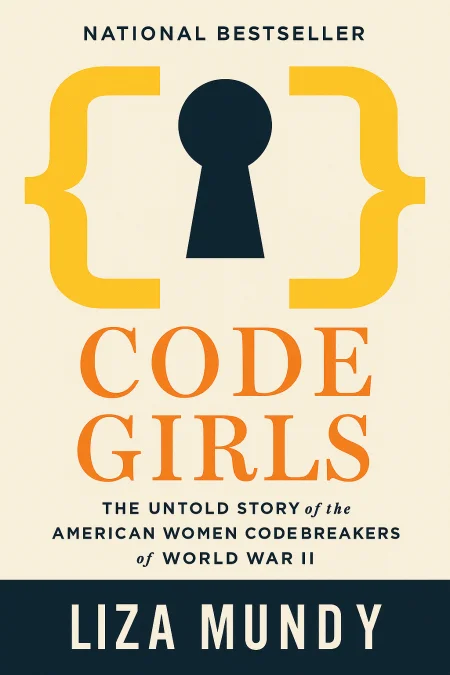
Code Girls
The Untold Story of the American Women Code Breakers of World War II
Book Edition Details
Summary
History's shadows often hide tales of heroism, and Code Girls brings one such tale into the light. During World War II, while the world was engulfed in turmoil, a formidable force emerged—not on the battlefields, but in the cryptic world of code-breaking. Over ten thousand intrepid American women, summoned from small-town America and prestigious universities alike, found themselves in Washington, DC, at the heart of a clandestine war effort. Their nimble minds unraveled the Axis powers' encrypted secrets, hastening the Allied victory and altering the landscape of intelligence work forever. Liza Mundy's meticulous research, enriched by interviews with these unsung heroines, resurrects a narrative of intellect, bravery, and the relentless pursuit of a place in a male-dominated world. Code Girls is a compelling tribute to the women whose silent contributions shaped the course of history, now told with vivid clarity and emotional depth.
Introduction
In the shadowy corridors of wartime Washington, thousands of young women carried secrets that could alter the course of human history. They arrived by train from small towns across America, clutching college degrees and mysterious recruitment letters that promised only vague "communications work" for the government. What awaited them was far more extraordinary than they could have imagined: they would become the backbone of the most successful intelligence operation in modern warfare, wielding mathematical precision and linguistic brilliance to penetrate the enemy's most guarded secrets. This remarkable transformation reveals how educated women became America's secret weapon against the Axis powers, breaking codes that saved countless lives and shortened the war by years. At a time when women were systematically excluded from positions of real influence, these cryptographers found themselves making decisions that would determine the fate of naval battles, the success of invasions, and the survival of entire convoys crossing dangerous waters. Their work demonstrates how necessity can shatter social barriers and reveal hidden reservoirs of talent that peacetime prejudice had kept locked away. For anyone fascinated by untold stories of World War II, the hidden contributions of women to victory, or the origins of modern intelligence warfare, this account illuminates a crucial chapter that remained classified for decades. It shows how ordinary individuals can shape extraordinary events when their unique skills align with their nation's greatest need, and how the most decisive battles are often fought not with weapons, but with minds capable of seeing patterns where others see only chaos.
Breaking Barriers: Women Enter the Secret War (1940-1942)
The transformation began with cryptic letters arriving at elite women's colleges across America in late 1941. Mathematics professors summoned bewildered students to private meetings, asking seemingly unrelated questions about crossword puzzles and marital status. Those who demonstrated analytical minds and personal freedom found themselves recruited into what would become the war's most classified program, though they had no idea they were about to revolutionize both cryptography and women's roles in national security. America's entry into World War II exposed a critical vulnerability that would reshape military thinking forever. The devastating surprise at Pearl Harbor revealed not just tactical failures, but a fundamental weakness in intelligence gathering that threatened the nation's ability to fight a global war. Traditional military structures had relied on small teams of male cryptographers working on diplomatic communications, but the scale and complexity of wartime intelligence demanded an entirely new approach. The military faced an unprecedented challenge: breaking sophisticated enemy codes while simultaneously building the organizational capacity to process thousands of intercepted messages daily. The recruitment of college-educated women represented a radical departure from military tradition and social expectations. These were not the typical clerical workers who had always supported government operations, but mathematics majors, language scholars, and honor students whose rigorous liberal arts education had prepared them for intellectual challenges that most military officers could not even comprehend. Their exclusion from other professional opportunities, which had seemed like social limitation, suddenly became a strategic advantage as the military discovered an untapped reservoir of analytical talent. The early pioneers faced enormous obstacles as they established the foundations of American cryptanalysis under wartime pressure. Working in converted schools and hastily constructed facilities, they had to master complex mathematical concepts while simultaneously applying them to enemy communications of life-and-death importance. Their success in breaking Japan's Purple diplomatic cipher proved that women could handle the most sensitive intelligence work, setting the stage for the massive expansion that would transform them from experimental recruits into the core of America's intelligence revolution.
Turning the Tide: Intelligence Victories Transform the War (1942-1944)
The period following Pearl Harbor witnessed an extraordinary escalation in both the scope and impact of women's cryptographic work, as military leaders recognized that superior intelligence could compensate for material disadvantages on distant battlefields. Teams of women working around the clock in facilities like Arlington Hall began achieving breakthrough after breakthrough, systematically penetrating Japanese naval codes that revealed enemy fleet movements across the vast Pacific theater. Their mathematical precision and collaborative approach proved ideally suited to the painstaking work of reconstructing cipher systems that had been designed to be impenetrable. The impact of their success became dramatically apparent at the Battle of Midway in June 1942, where intercepted communications allowed American commanders to position their outnumbered forces for a devastating ambush of the Japanese fleet. The women who had decoded those crucial messages understood that their analytical work was directly translating into tactical victories that would determine the war's outcome. This realization transformed their sense of purpose, as former schoolteachers and librarians grasped that they were wielding unprecedented influence over military strategy and battlefield results. As the war progressed, the women's role expanded beyond mere code breaking to encompass comprehensive intelligence analysis that guided submarine warfare, convoy routing, and amphibious assault planning. They developed sophisticated tracking systems that monitored individual enemy vessels across thousands of miles of ocean, knowing that their analysis would soon result in torpedo attacks that would send those ships to the bottom. This was warfare conducted through mathematical analysis, where the ability to recognize patterns in encrypted text translated directly into strategic advantages that saved American lives while inflicting crippling losses on the enemy. The psychological burden of this intellectual warfare was immense, as the women understood they were engaged in a deadly serious competition where their success or failure could determine the fate of American servicemen fighting on distant fronts. Yet they also experienced the profound satisfaction of knowing that their contributions were making a decisive difference in the war's trajectory, even as their work remained completely invisible to the outside world. Their achievements during this period established intelligence analysis as a crucial component of modern warfare and demonstrated that analytical capability could be as strategically important as any conventional weapon system.
Victory Through Mind: The Final Campaign and Lasting Impact (1944-1945)
The final phase of the war saw the women codebreakers operating at peak efficiency, their skills refined by years of experience and their organizations evolved into highly sophisticated intelligence machines that processed enemy communications faster than the intended recipients could decode them. The D-Day invasion represented perhaps their greatest triumph, as broken German codes provided crucial intelligence about defensive preparations and helped ensure the success of the largest amphibious operation in military history. Their work had evolved from experimental efforts to decode individual messages into a comprehensive intelligence system that gave Allied commanders unprecedented insight into enemy planning and capabilities. The scope of operations had expanded dramatically, with American facilities attacking multiple cipher systems simultaneously while maintaining vast databases that tracked enemy movements across global theaters of war. Women operated high-speed mechanical computers designed to break German naval codes, managed complex tracking systems that monitored U-boat positions across the Atlantic, and coordinated with British counterparts to share intelligence that guided strategic bombing campaigns and naval operations. The coordination required was staggering, as intelligence from multiple sources had to be synthesized and delivered to military commanders within hours of interception. The human cost of this intellectual warfare intensified as victory approached and the true scale of the conflict became apparent. Many of the women had lost family members in combat, and they sometimes found themselves processing intelligence about battles where loved ones had fought and died. The psychological burden of maintaining absolute secrecy while handling information about massive casualties created emotional stress that would affect many of these women for decades after the war ended, even as they took pride in knowing their contributions had shortened the conflict and saved countless lives. The success of Allied intelligence operations validated the massive investment in cryptographic capabilities and established principles that would guide national security policy for generations. The women's achievements had proven that modern warfare required not just industrial capacity and military strategy, but intellectual superiority that could anticipate and counter enemy planning. Their legacy extended far beyond their immediate contributions to victory, as they had created the institutional knowledge and analytical techniques that would become the foundation for America's Cold War intelligence capabilities and the emergence of the modern national security state.
Summary
The story of America's women codebreakers reveals a fundamental truth about how societies discover and mobilize hidden resources during existential crises. When traditional approaches proved inadequate to meet the challenges of global warfare, military leaders were compelled to look beyond conventional boundaries and tap into previously overlooked sources of talent and capability. The result was not merely a successful wartime expedient, but a demonstration of human potential that challenged long-held assumptions about gender, intelligence, and the nature of strategic advantage in modern conflict. The legacy of these women extends far beyond their immediate contributions to Allied victory, as their success helped establish intelligence analysis as a permanent component of national security and paved the way for broader changes in how society viewed women's intellectual capabilities. The organizational structures they helped create and the analytical techniques they pioneered became the foundation for modern intelligence agencies, while their achievements opened doors for future generations of women in science, technology, and national security fields that had previously been closed to them. For contemporary leaders facing complex global challenges, their story offers crucial insights about identifying and developing untapped potential rather than waiting for crisis to force change. Their experience demonstrates that breakthrough innovations often emerge when necessity compels organizations to abandon traditional practices and experiment with collaborative approaches that value diverse perspectives and analytical capabilities. Most importantly, their legacy reminds us that societies possess vast reserves of human talent that become visible only when circumstances demand their mobilization, suggesting that our greatest strategic advantage may lie not in conventional resources, but in our ability to recognize and cultivate the extraordinary capabilities that exist within ordinary individuals.
Related Books
Download PDF & EPUB
To save this Black List summary for later, download the free PDF and EPUB. You can print it out, or read offline at your convenience.
By Liza Mundy
