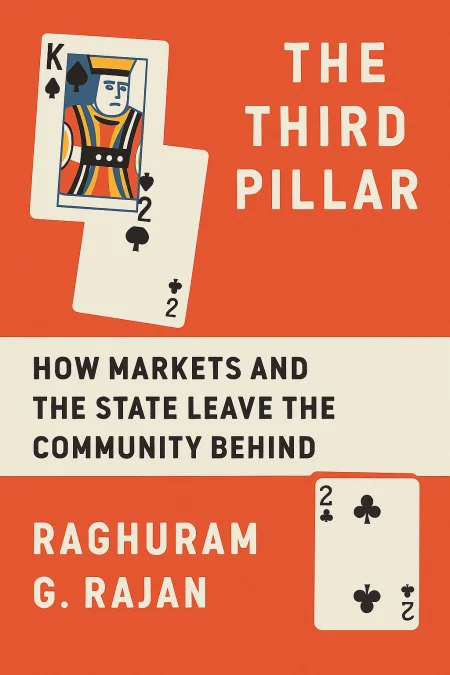
The Third Pillar
The Revival of Community in a Polarized World
Book Edition Details
Summary
In "The Third Pillar," Raghuram Rajan, a visionary economist with a storied career spanning from the IMF to India's central bank, crafts a powerful narrative on the global tug-of-war between state power, market forces, and the communities we call home. Rajan delves into the heart of our socio-economic landscape, exposing the hidden fault lines that have ignited the flames of modern populism. With a rich historical sweep, he reveals how technological upheavals have repeatedly dismantled the delicate balance between these pillars, often with tumultuous outcomes. Today, as economic and political might converge in urban centers, outlying communities crumble, threatening the very fabric of democracy. Rajan’s clarion call urges a reevaluation of how we empower grassroots movements to restore harmony and stability. His analysis is not only a profound exploration of the forces shaping our world but also a roadmap for reinvigorating the community pillar, offering hope in an era of uncertainty.
Introduction
Picture yourself standing in a bustling medieval marketplace where merchants haggle over prices while guild masters enforce quality standards and local magistrates settle disputes. This scene captures a fundamental truth about human civilization: our prosperity and freedom have always depended on the delicate balance between three essential pillars—markets that drive innovation and exchange, states that provide order and justice, and communities that foster belonging and mutual support. Throughout history, the relationship between these three forces has shaped the rise and fall of civilizations, the birth of democracies, and the prosperity of nations. When markets flourish without restraint, they create spectacular wealth but also devastating inequality. When states grow too powerful, they may provide stability but crush individual liberty. When communities become insular, they offer belonging but can exclude and oppress outsiders. The key to human flourishing lies not in choosing one pillar over others, but in maintaining their dynamic equilibrium. This historical journey will resonate with anyone seeking to understand why some societies thrive while others struggle, why democratic institutions sometimes falter, and how we might navigate the complex forces reshaping our world today. From the industrial revolutions that transformed entire societies to the technological disruptions challenging modern democracies, these timeless dynamics continue to shape our collective destiny and offer crucial insights for citizens, leaders, and anyone curious about the forces that drive historical change.
Medieval Foundations: From Feudal Community to Market State
The story begins in medieval Europe around the year 1000, where all three pillars of society existed within the archetypal feudal manor. Here, the lord governed his domain while settling disputes and dispensing justice. Markets operated within the manor's boundaries, with goods exchanged according to custom and feudal obligation. The community encompassed everyone from lord to peasant, bound together by mutual duties and shared survival in a world where cooperation meant the difference between prosperity and starvation. This seemingly stable world began to crack as new technologies emerged to shatter the closed system of the manor. The invention of gunpowder and siege cannons meant that small fortified communities could no longer defend themselves against centralized armies wielding superior firepower. Political entities consolidated rapidly—Europe went from over a thousand separate principalities in the fourteenth century to around twenty-five by 1900. The printing press spread ideas faster than ever before, while maritime innovations opened distant trade routes that connected local communities to global networks of commerce and exchange. Perhaps most dramatically, the Catholic Church's centuries-long battle against usury gradually gave way to acceptance of market transactions as trade expanded and monarchs needed funds for their larger armies. The moral prohibitions that had protected feudal communities from market forces weakened as scholars like John Calvin provided new theological justifications for profit-seeking, transforming what had once been considered avarice into a sign of divine favor and social virtue. The dissolution of English monasteries under Henry VIII exemplifies this transformation perfectly. Monastery lands, poorly managed and undefended, were seized and sold to the emerging gentry—practical men who applied commercial methods to agriculture. This created a new class of efficient landowners whose economic power would eventually constrain royal authority, laying crucial groundwork for constitutional government and truly competitive markets that would define the modern era.
Industrial Revolution: Democracy, Competition, and Social Balance
By the eighteenth century, the state had achieved a monopoly on violence within its borders, but a crucial question remained: how could it be strong enough to defend the realm yet limited enough to respect property rights? England's answer came through the Glorious Revolution of 1688, which established parliamentary supremacy over the monarchy. This constitutional settlement allowed the state to borrow more easily and build greater military capabilities, precisely because investors trusted that their property would be protected from arbitrary seizure. With the state constitutionally limited, the need for anti-competitive medieval structures like guilds disappeared entirely. Adam Smith could now advocate for free markets, confident that property rights were secure and competition would flourish. His "Wealth of Nations" argued that individual self-interest, channeled through competitive markets, would maximize national prosperity better than any government direction. The invisible hand of competition would ensure efficiency and innovation while the visible hand of constitutional government would maintain order and justice. Yet the Industrial Revolution's creative destruction left many behind as traditional ways of life crumbled. Handloom weavers clung to dying trades, agricultural workers were displaced by enclosures, and factory workers endured dangerous conditions in polluted industrial cities. The expansion of voting rights became a fight by communities for political voice to match their economic displacement. As suffrage broadened, democratically empowered communities used their new power to constrain markets through regulation and social legislation that protected workers and consumers. The Populist and Progressive movements in America exemplify this democratic rebalancing perfectly. Farmers crushed by railroad monopolies and deflation organized politically to demand antitrust laws and monetary reform. Middle-class Progressives, horrified by corporate concentration and corruption, pushed for professional regulation and competitive markets. These movements didn't destroy capitalism—they saved it from its own tendency toward monopolization, preserving the competition that made markets beneficial to society rather than destructive of it.
Post-War Expansion: State Promises and Economic Transformation
The Great Depression shattered faith in unfettered markets across the developed world as competition became a term of abuse and countries blamed market volatility for mass unemployment and social upheaval. The state expanded dramatically, taking over industries, regulating prices, and promising comprehensive social security to citizens traumatized by economic collapse. World War II further centralized economic control as governments organized entire economies for military production, demonstrating the state's capacity to mobilize resources on an unprecedented scale. The postwar miracle that followed seemed to vindicate state intervention completely. Western Europe experienced unprecedented growth rates—6 percent annually in Germany, over 5 percent in Italy—as Marshall Plan aid, technological catch-up, and consensus politics combined to create the "thirty glorious years" of prosperity. Governments made generous promises of pensions, healthcare, and full employment, confident that strong growth would continue indefinitely to fund these expanding commitments. Immigration supplemented aging workforces, while the expansion of civil rights reflected prosperous societies' growing confidence in their ability to solve social problems. This golden age rested on temporary foundations that would prove unsustainable. European countries were catching up to American productivity levels using technologies from the Second Industrial Revolution, but once this catch-up process ended in the early 1970s, growth slowed dramatically just as governments faced the bills for their expansive promises. The combination of stagnant growth and rising inflation—stagflation—revealed that Keynesian demand management couldn't solve supply-side problems created by reduced competition and overregulation of key industries. The response was a pendulum swing back toward markets as Ronald Reagan and Margaret Thatcher led a global movement to deregulate industries, privatize state enterprises, and reduce barriers to trade and capital flows. Continental Europe chose a different path, betting on deeper integration through the European Union and common currency to restore growth without confronting domestic constituencies. Both approaches would create new imbalances as the ICT revolution began reshaping the global economy in ways that would challenge all existing assumptions about work, community, and governance.
ICT Revolution: Technology, Inequality, and Community Breakdown
The Information and Communications Technology revolution has disrupted the balance between pillars more profoundly than any change since industrialization itself. Unlike previous technological revolutions that primarily automated physical labor, ICT has eliminated routine cognitive tasks while amplifying the returns to high-level skills and creativity. Bank tellers, travel agents, and factory supervisors have been replaced by software, while software engineers, financial analysts, and management consultants have seen their incomes soar to unprecedented levels. This technological change has been amplified by globalization, allowing production to move to the most efficient locations worldwide regardless of national boundaries or community ties. Manufacturing jobs migrated from American and European communities to Asia, while service jobs increasingly moved to wherever educated workers could be found. The result has been spectacular growth for some communities—typically large cities with major universities and technology companies—while others, particularly smaller manufacturing towns, have experienced devastating economic and social decline. The winners in this new economy have used their advantages to separate themselves geographically from the losers in ways that would have been unimaginable in earlier eras. Concerned about their children's education and future prospects, successful families have moved to communities with others like themselves, creating an unprecedented sorting of society by educational attainment and income. This residential segregation has turned the technology-induced meritocracy into an increasingly hereditary one, as children in wealthy communities receive far better preparation for the modern economy while others are left behind. Meanwhile, communities left behind have experienced not just economic decline but complete social breakdown. Family formation has collapsed, drug addiction has soared, and civic engagement has withered as traditional community institutions that once provided meaning and support—churches, unions, local businesses—have weakened or disappeared entirely. Into this vacuum have stepped populist movements promising to restore past greatness by rejecting the global economic system that created these disparities, setting the stage for the political upheavals that continue to reshape democratic societies worldwide.
Summary
The thousand-year journey from feudal manor to modern democracy reveals a recurring pattern that offers crucial insights for our current challenges: technological change repeatedly disrupts the balance between markets, state, and community, creating periods of crisis that demand social adaptation and institutional innovation. Each successful rebalancing has required not the dominance of any single pillar, but their mutual reinforcement in new configurations suited to changing circumstances. Competitive markets check state power while generating prosperity, constitutional states provide the framework for markets to function fairly, and engaged communities ensure that both markets and states serve human flourishing rather than narrow interests. Today's crisis stems from the weakening of community relative to markets and state, as globalized markets and centralized governments have grown in power and reach while local communities have lost the economic base, social cohesion, and political influence needed to balance them effectively. The result is a system that works well for mobile elites but fails ordinary people rooted in particular places, creating the conditions for populist backlash and democratic breakdown. History suggests that sustainable solutions must strengthen community capacity to shape both market outcomes and state policies rather than simply choosing between more markets or more government. The path forward requires what this historical analysis reveals as "inclusive localism"—devolving power and resources to communities while ensuring they remain open and dynamic rather than closed and stagnant. This means investing in local education and infrastructure, supporting community-based economic development, and creating political structures that give people genuine influence over the forces shaping their lives. Only by rebalancing the three pillars can democratic societies navigate the challenges of technological change while preserving the liberal values that have enabled human progress throughout this remarkable historical journey.
Related Books
Download PDF & EPUB
To save this Black List summary for later, download the free PDF and EPUB. You can print it out, or read offline at your convenience.
By Raghuram G. Rajan
