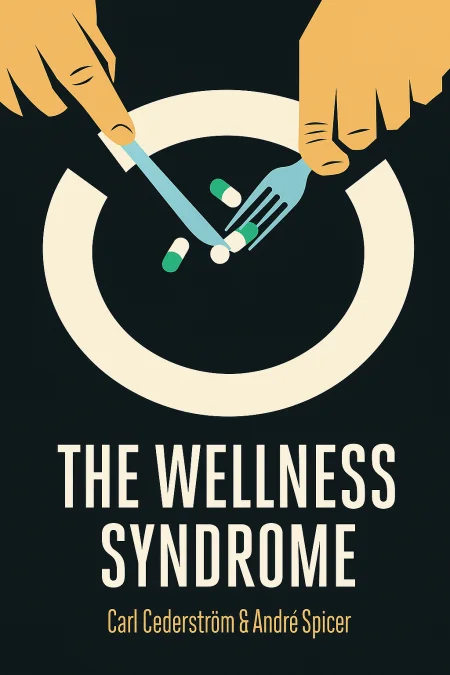
The Wellness Syndrome
Why healthy living isn't all it says it is
byCarl Cederström, André Spicer
Book Edition Details
Summary
A relentless drive to perfect our bodies and minds isn't just exhausting—it's backfiring. Carl Cederstrom and Andre Spicer's provocative exploration, *The Wellness Syndrome*, unravels the paradox where our pursuit of health turns into an oppressive force. Through witty observations and keen insights, this book exposes how today's obsession with self-improvement morphs into a societal pressure cooker. Meet the diet extremists, dawn-dancing corporate warriors, and those who track their every move—even bathroom breaks—all in a quest for a utopian wellness that ultimately isolates us. As personal transformation overtakes collective progress, this enlightening narrative challenges us to reconsider who truly benefits from our wellness woes. A must-read for anyone questioning the sanity of this relentless quest for self-optimization.
Introduction
Modern society has transformed wellness from a personal choice into a moral imperative, fundamentally reshaping how we understand individual responsibility and social control. This ideological transformation operates through what appears to be benevolent encouragement of healthy living, but beneath the surface lies a more troubling mechanism of subjugation. The wellness command functions as a form of biomorality, where physical and mental health become markers of moral worth, creating new categories of the virtuous and the deviant. The analysis reveals how this phenomenon extends far beyond simple health promotion, infiltrating workplaces, educational institutions, and intimate relationships. Through examining concrete examples from life coaching culture to corporate wellness programs, the investigation demonstrates how the pursuit of optimal health and happiness becomes a tool for disciplining subjects rather than liberating them. The methodology combines critical theory with empirical observation, drawing connections between seemingly disparate practices like mindfulness training, diet culture, and employment policies. The central paradox emerges clearly: the more individuals strive to optimize their wellness, the more anxious, guilty, and isolated they become. This contradiction exposes the underlying function of wellness ideology as a system of control rather than genuine care. Understanding this mechanism allows readers to recognize how contemporary power operates not through direct prohibition, but through the seemingly positive injunction to maximize one's potential and take responsibility for one's own flourishing.
The Rise of Wellness as Moral Imperative
Contemporary culture has witnessed the emergence of the "wo/man of now," a figure who embodies the convergence of personal optimization and market demands. This individual must simultaneously be authentic and flexible, creative and productive, healthy and available for constant consumption. The transformation from the rigid organizational workers of the Fordist era to these fluid, self-actualizing subjects represents more than mere economic change; it signals a fundamental shift in how power operates in advanced capitalist societies. The life coaching industry exemplifies this transformation, growing into a multi-billion dollar enterprise that promises to unlock human potential while systematically shifting responsibility onto individuals. Coaches encourage clients to view personal failures as internal obstacles rather than structural limitations, creating what amounts to a cruel optimization trap. The more individuals invest in self-improvement, the more they internalize blame for their circumstances, generating cycles of anxiety and self-recrimination. This dynamic reveals itself most clearly in practices like Google's "Search Inside Yourself" mindfulness program, where ancient contemplative traditions are repackaged as productivity enhancement tools. Such interventions promise to solve systemic workplace problems through individual psychological adjustment, effectively neutralizing potential collective resistance. The body becomes a "truth system," the ultimate authority for decision-making, while external social and political realities are dismissed as distractions from inner wisdom. The moral dimension becomes explicit when examining social attitudes toward smoking, where health concerns merge seamlessly with class-based disgust and moral judgment. Smokers are not merely seen as making poor health choices; they are viewed as morally deficient subjects who threaten the social fabric. This moralization of health extends across numerous behaviors, creating new categories of virtue and vice based on lifestyle choices rather than ethical principles or social solidarity.
Corporate Capitalism's Co-optation of Health and Happiness
The integration of wellness into workplace culture represents a sophisticated form of control that operates through apparent care for employee wellbeing. Investment bankers working 120-hour weeks learn to treat their bodies as obstacles to productivity, eventually developing techniques of self-monitoring and optimization that allow them to sustain inhuman work demands. This pattern extends across industries, where wellness programs serve not primarily to improve health, but to sculpt ideal workers who internalize corporate values and self-regulate their behavior. Corporate wellness initiatives reveal their true function through their emphasis on individual responsibility and behavioral modification. Programs like Scania's "24-hour employee" policy or the Chicago Teachers Union's mandatory biometric sharing demonstrate how wellness discourse provides cover for unprecedented surveillance and control of workers' private lives. The language of choice and empowerment masks what amounts to disciplinary intervention in the most intimate aspects of human existence, from sleep patterns to emotional states. The diet industry illustrates how market mechanisms capture and intensify moral anxieties about the body. Programs like Weight Watchers or the evangelical Daniel Plan combine surveillance techniques with moral frameworks that position food consumption as a reflection of spiritual and ethical worth. The inevitable cycle of failure and renewed effort generates sustained engagement with consumer products while reinforcing guilt and self-blame. This guilt becomes socially binding, creating communities of shared transgression that paradoxically strengthen attachment to the very norms being violated. The phenomenon of "fat acceptance" reveals the limits of resistance within wellness culture, as even movements opposing beauty standards tend to embrace other wellness values like positivity, productivity, and self-optimization. The figure of the "chav" or welfare queen serves as a convenient repository for middle-class anxieties about moral degradation, allowing wellness enthusiasts to maintain their sense of virtue through comparison with supposedly disgusting others. Celebrity chef interventions like Jamie Oliver's school dinner campaigns demonstrate how wellness ideology transforms complex social problems into simple matters of individual choice and lifestyle modification.
Political Consequences of Biomorality and Social Control
The political implications of wellness ideology extend far beyond individual psychology to reshape governance itself. David Cameron's happiness index exemplifies how governments deploy wellbeing discourse to legitimize austerity policies and withdraw public support. By measuring subjective satisfaction rather than material conditions, such initiatives suggest that structural problems can be solved through attitude adjustment rather than policy intervention. The timing of happiness surveys during periods of economic hardship is no coincidence; they serve to redirect attention from systemic failures to personal resilience. The transformation of unemployment into a performance of employability demonstrates how wellness ideology colonizes even the most vulnerable populations. Jobseekers are required to maintain positive attitudes, engage in elaborate self-presentation, and treat their search for work as a full-time occupation requiring constant self-improvement. The language of talent and potential masks the reality of systemic unemployment while placing the burden of economic insecurity squarely on individual shoulders. When people fail to find employment, they are encouraged to examine their own attitudes and behaviors rather than question economic structures. The quantified self movement represents the logical endpoint of wellness ideology, where life itself becomes a business requiring constant measurement and optimization. Self-tracking technologies promise enhanced performance and competitive advantage, but deliver instead a totalizing form of surveillance that extends corporate control into previously private domains. Participants willingly submit to monitoring that would have been considered dystopian if imposed externally, suggesting how effectively wellness discourse has naturalized self-disciplinary practices. The gamification of daily life reveals how control mechanisms have evolved beyond traditional disciplinary institutions. Apps that reward healthy behaviors or productive activities create seemingly voluntary systems of behavioral modification that rival B.F. Skinner's most ambitious experiments. The language of choice and empowerment disguises what amounts to systematic conditioning, while the focus on individual rewards obscures the social consequences of treating human relationships and activities as optimization problems.
Resistance Strategies and the Search for Authentic Liberation
Various forms of resistance to wellness ideology emerge from its own contradictions and failures. Illness and injury provide temporary refuge from optimization demands, creating spaces where individuals can experience relief from constant self-improvement pressures. The appeal of being incapacitated reveals the exhausting nature of contemporary demands for continuous self-monitoring and enhancement. Even celebrated figures like Karl Ove Knausgård discover unexpected pleasure in moments when external circumstances prevent them from meeting wellness expectations. The Fat Acceptance movement attempts to challenge beauty standards and health imperatives, but often finds itself reconstructing wellness values in new forms. Rather than fundamentally questioning the logic of optimization, fat acceptance advocates typically argue for inclusion within existing wellness frameworks, emphasizing their positivity, productivity, and social contribution. This pattern reveals the difficulty of escaping wellness ideology even when explicitly opposing its specific manifestations. More radical forms of resistance emerge in practices like HIV-positive "barebacking," where individuals explicitly reject health imperatives and safety protocols in favor of dangerous intimacy. Such practices directly challenge the fundamental assumptions of wellness culture by embracing mortality and risk rather than seeking to minimize or control them. While limited in scope and controversial in nature, these activities demonstrate possibilities for constructing alternative relationships to the body and to others that exist outside optimization frameworks. The analysis suggests that effective resistance requires abandoning the illusion of unlimited human potential and accepting the reality of impotence and limitation. True liberation may come not from better self-optimization strategies but from recognizing that human worth extends beyond health and happiness metrics. The pursuit of authentic experience necessarily involves pain, failure, and mortality - elements systematically excluded from wellness discourse yet essential for genuine human flourishing.
Summary
The wellness syndrome operates as a sophisticated mechanism of social control that transforms care into coercion through the seemingly benevolent demand for self-optimization. By making health and happiness into moral imperatives, contemporary society creates new forms of guilt, anxiety, and isolation while obscuring structural problems through the lens of individual responsibility. The analysis demonstrates how resistance must move beyond better wellness strategies toward a fundamental acceptance of human limitation and a recognition that authentic life experiences necessarily involve elements of pain, failure, and imperfection that wellness ideology systematically excludes. This perspective offers crucial insights for readers seeking to understand how contemporary power operates through positive injunctions rather than prohibitions, and how genuine liberation might require abandoning rather than perfecting the project of the optimized self.
Related Books
Download PDF & EPUB
To save this Black List summary for later, download the free PDF and EPUB. You can print it out, or read offline at your convenience.
By Carl Cederström
