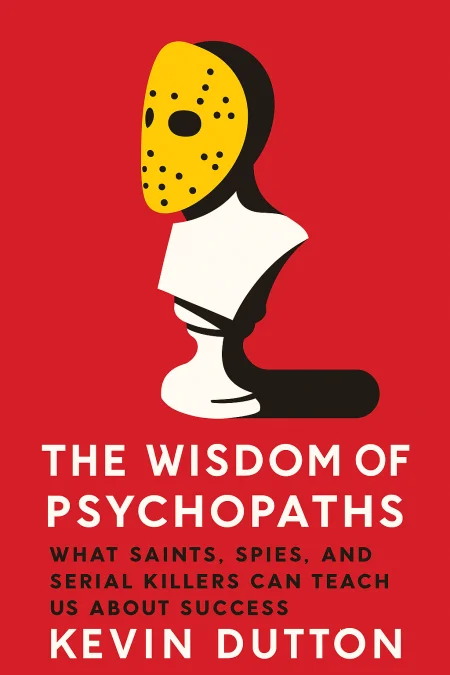
The Wisdom of Psychopaths
What Saints, Spies and Serial Killers Can Teach Us About Success
Book Edition Details
Summary
The line between brilliance and madness is thinner than we think. In "The Wisdom of Psychopaths," Kevin Dutton, a leading psychologist, dismantles our understanding of psychopathy by charting its spectrum and revealing surprising truths. Imagine a world where the same traits that define a killer also propel a CEO to success. Through groundbreaking neuroscience and daring encounters with both criminals and con artists, Dutton exposes how fearlessness, charm, and ruthless focus—often vilified—are virtues in disguise. As society's tilt towards these traits accelerates, Dutton provocatively suggests that our collective embrace of the psychopathic mindset might just be the key to thriving in today's relentless world.
Introduction
Picture this: You're sitting across from someone who has just calmly described committing horrific crimes, yet they possess an unsettling charm that makes you want to keep listening. This paradox lies at the heart of one of psychology's most fascinating mysteries. While society recoils from psychopaths, labeling them as monsters and predators, a growing body of research suggests something far more complex and, perhaps, more useful to understand. What if the very traits that make psychopaths dangerous in their extreme form could, when properly understood and selectively applied, actually enhance our daily lives? What if fearlessness, focus, charm, and mental toughness—hallmarks of the psychopathic personality—could serve as valuable tools in our personal and professional toolkit? This isn't about glamorizing destructive behavior, but rather about recognizing that certain psychological traits exist on a spectrum, and that understanding this spectrum might help us navigate life's challenges with greater resilience and effectiveness. Through encounters with both criminal psychopaths and highly successful individuals who share similar traits, we'll explore how the line between functional and dysfunctional behavior is often thinner than we imagine. The journey ahead reveals not just the dark corners of human nature, but also unexpected sources of strength, wisdom, and practical insight for anyone seeking to understand the complex landscape of human psychology.
Behind the Mask: Meeting the Real Psychopaths
In the sterile corridors of Broadmoor Hospital, one of Britain's most secure psychiatric facilities, a fascinating conversation unfolds. Danny, a patient diagnosed with psychopathy, pauses his video game to offer perspective on a seemingly mundane problem: how to remove an unwanted tenant from a property. Within minutes, he outlines a brilliant yet morally questionable solution involving fake health inspectors and fabricated asbestos readings. His plan is both creative and effective, delivered with the casual confidence of someone solving a crossword puzzle. What strikes most visitors to places like Broadmoor isn't the expected violence or chaos, but rather the unexpected ordinariness of many interactions. These individuals, despite their dark pasts, often display remarkable problem-solving abilities, unshakeable confidence, and an almost supernatural ability to remain calm under pressure. Jamie, another resident, demonstrates this when he matter-of-factly discusses fear: "If you don't have fear to start with, you don't need courage to overcome it, do you? Courage is just emotional blood doping." Larry, with his grandfatherly appearance and gentle demeanor, shares a childhood memory about watching his sister get knocked down by a wave at the beach. While she never returned to the water, he learned a different lesson: "You can either stay on the shore and not go in at all, or you can go out further so the waves lift you up and crash behind you." This metaphor captures something profound about the psychopathic mindset—a willingness to venture into dangerous territory rather than remain paralyzed by fear. These conversations reveal a troubling yet intriguing reality: the same traits that can lead to destructive behavior might also represent valuable psychological resources. The challenge lies not in acquiring these traits, but in learning how to harness them constructively while maintaining the moral compass that these individuals often lack.
The Psychopath's Toolkit: Seven Deadly Wins
Research has consistently shown that certain professions attract individuals with psychopathic traits at higher rates than the general population. CEOs, surgeons, lawyers, and even Special Forces soldiers often score higher on psychopathy scales than average citizens. This isn't coincidence—these roles require specific psychological strengths that psychopaths possess naturally. Consider Dr. Geraghty, a renowned neurosurgeon who describes his mindset during complex operations: "I have no compassion for those whom I operate on. That is a luxury I simply cannot afford. In the theater I am reborn as a cold, heartless machine, totally at one with scalpel, drill and saw. When you're cutting loose and cheating death high above the snowline of the brain, feelings aren't fit for purpose." Andy McNab, the former SAS soldier, demonstrates similar emotional regulation under extreme stress. During laboratory tests involving disturbing imagery designed to provoke anxiety, his physiological responses actually decreased as the intensity increased—a pattern typically seen only in individuals with significant psychopathic traits. His brain seemed to implement what researchers call "liquid nitrogen" thinking, shutting down emotional interference to maintain optimal performance. These examples illustrate what might be called the "Seven Deadly Wins"—core psychopathic traits that, when properly channeled, can enhance performance: ruthlessness in decision-making, charm in social situations, laser-like focus, mental toughness under pressure, fearlessness in the face of risk, mindfulness in staying present, and decisive action when others hesitate. The key insight isn't that we should become psychopaths, but rather that we might benefit from accessing these states temporarily when circumstances demand them. The difference between functional and dysfunctional psychopathy often comes down to context and control—knowing when to turn these traits on and, crucially, when to turn them off.
Making a Monster: The Neuroscience of Control
Modern neuroscience has revealed fascinating insights about the psychopathic brain that challenge our assumptions about both criminals and heroes. Using advanced brain imaging, researchers have discovered that psychopaths process emotions differently—not because they lack the neural hardware for empathy, but because they can switch it on and off at will, like a dimmer switch rather than a broken circuit. In a groundbreaking experiment, transcranial magnetic stimulation was used to temporarily simulate psychopathic brain states in normal volunteers. The results were remarkable: subjects who received the treatment showed dramatically improved performance on tasks requiring cool decision-making under pressure, reduced anxiety when faced with disturbing stimuli, and enhanced focus on immediate goals rather than distant worries. One volunteer described the experience: "It feels like having your conscience spiked with moral Rohypnol, your anxieties drowned with transcranial magnetic Jack Daniel's, but your whole way of being feels like it's been spring-cleaned with light." This artificial psychopath state lasted only about twenty minutes, but during that time, the subject demonstrated the kind of fearless, focused thinking that characterizes both dangerous criminals and extraordinary heroes. The implications are profound: the neural circuits that produce psychopathic traits aren't inherently evil—they're tools that can be used constructively or destructively depending on context and intention. Elite athletes, emergency responders, and military personnel often naturally access these states during peak performance moments. The question isn't whether these brain states are good or bad, but how we might learn to access them appropriately while maintaining our moral foundations. This research suggests that the line between saint and sinner, hero and villain, may be thinner and more permeable than we ever imagined.
Saints and Sinners: The Spectrum of Human Nature
Perhaps the most surprising discovery in psychopathy research is how closely certain psychopathic traits mirror those found in spiritual masters and moral exemplars. Tibetan Buddhist monks, renowned for their compassion and wisdom, share several key characteristics with psychopaths: exceptional emotional regulation, ability to remain present-focused, reduced anxiety and fear responses, and remarkable resilience in the face of adversity. Paul Ekman's research with Tibetan meditation masters revealed abilities that seem almost superhuman: monks who could suppress their startle response so completely that they showed no physiological reaction to gunshot-level sounds, and who demonstrated supernatural skill at reading micro-expressions and emotional states in others. These abilities mirror those found in high-functioning psychopaths, suggesting that the neural pathways for emotional mastery can be developed through either spiritual practice or natural neurological variation. The key difference lies not in the abilities themselves, but in how they're applied. While psychopaths might use their emotional insight to manipulate and exploit others, spiritual masters employ similar skills to offer compassion and wisdom. Both possess what might be called "emotional intelligence," but they direct it toward vastly different ends. This parallel extends to historical figures as well. Saint Paul, one of Christianity's most influential leaders, exhibited many traits we might recognize as psychopathic: fearlessness in the face of persecution, ruthless dedication to his mission, remarkable charisma and persuasive ability, and a willingness to endure extreme hardship without emotional distress. Yet his legacy is one of profound spiritual transformation rather than destruction. The spectrum of human nature reveals that our psychological traits are neutral tools—it's our choices about how to use them that determine whether we become saints or sinners, helpers or predators.
Summary
The journey through the landscape of psychopathy reveals a fundamental truth about human nature: we are all capable of both tremendous good and terrible evil, often using the same psychological tools. The traits we fear most in psychopaths—their fearlessness, focus, charm, and emotional detachment—are also the qualities we most admire in heroes, leaders, and spiritual masters. The difference lies not in the presence or absence of these traits, but in how they are channeled and controlled. Rather than viewing psychopathy as pure pathology, we might better understand it as an extreme position on the spectrum of human psychological variation. In their moderate forms, these traits can enhance our ability to make difficult decisions, maintain composure under pressure, and take necessary action when others are paralyzed by emotion or social convention. The key is learning to access these states consciously and temporarily, like putting on a psychological uniform for specific situations, then returning to our more empathetic, connected selves. This understanding offers hope for both personal development and societal progress. By recognizing that courage, resilience, and effective action often require temporary psychological distance from our fears and social pressures, we can develop greater emotional flexibility and practical wisdom. The goal isn't to become psychopaths, but to expand our psychological repertoire, accessing different modes of thinking and feeling as circumstances require while maintaining our moral compass and human connections.
Related Books
Download PDF & EPUB
To save this Black List summary for later, download the free PDF and EPUB. You can print it out, or read offline at your convenience.
By Kevin Dutton
