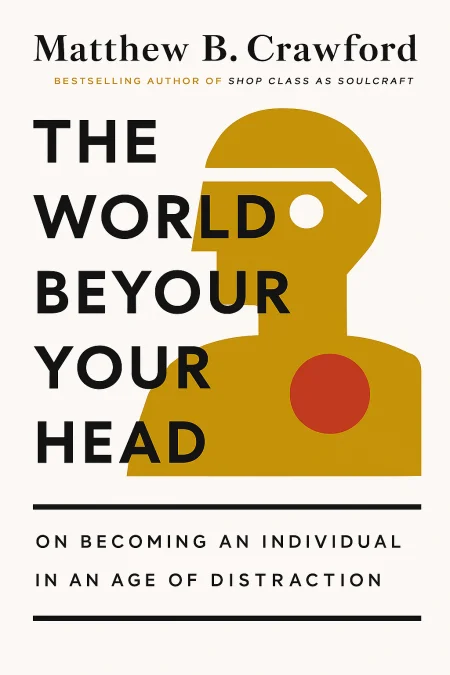
The World Beyond Your Head
On Becoming an Individual in an Age of Distraction
Book Edition Details
Summary
In a chaotic age where our minds are pulled in a thousand directions, Matthew B. Crawford presents a thought-provoking exploration of our fractured attention. "The World Beyond Your Head" delves into the unseen battle for our focus, illustrating how the art of attention is not just about resisting digital distractions but reclaiming our human essence from cultural assumptions. Crawford takes readers from the intense concentration of hockey players and short-order cooks to the contemplative world of organ builders, revealing the intricate dance between environment and self. This compelling narrative challenges us to rethink how we engage with the world, urging us to forge a deeper connection with our surroundings and ourselves. It's an essential read for anyone seeking clarity amid the noise, with profound implications for education, public spaces, and the essence of democracy itself.
Introduction
Contemporary society faces an unprecedented crisis of attention, where human consciousness has become a battleground for commercial interests seeking to capture and monetize our mental focus. This challenge extends far beyond mere distraction, revealing fundamental flaws in how Western culture understands individual autonomy, human agency, and the conditions necessary for genuine flourishing. The prevailing response—asserting our sovereign right to choose what deserves attention—proves inadequate because it rests on philosophical assumptions that misunderstand how minds actually develop and operate. The investigation that follows challenges the Enlightenment ideal of the autonomous individual who stands apart from external influences to make rational choices. Through careful analysis of phenomena ranging from machine gambling to traditional craftsmanship, a different picture emerges: genuine individuality arises not through isolation from external authority, but through skilled participation in practices that connect us to reality and to communities of shared understanding. This perspective draws on insights from cognitive science, phenomenology, and cultural criticism to demonstrate how our current predicament stems from deeper philosophical commitments about human nature and freedom. The analysis reveals that reclaiming attention requires more than individual willpower or technological solutions. It demands a fundamental reexamination of the cultural and institutional frameworks that shape human development, pointing toward forms of life that support rather than undermine our capacity for sustained engagement with the world beyond our immediate desires and manufactured experiences.
The Attention Economy: How Modern Culture Engineers Distraction
Modern society has systematically engineered environments where human attention serves as raw material for economic extraction. This transformation extends far beyond digital technology to encompass the design of public spaces, consumer products, and entertainment systems that reflect a coordinated effort to capture and direct mental focus toward commercial ends. The result represents more than simple distraction—it constitutes a fundamental reordering of the conditions under which human consciousness develops and operates. The phenomenon of machine gambling provides the clearest illustration of this dynamic. Slot machines employ sophisticated behavioral psychology to create experiences designed to produce addiction, using variable reward schedules and sensory manipulation to induce trance-like states that bypass conscious decision-making. Players report feeling merged with the machine, entering what designers call "the zone"—a condition of perfect responsiveness to engineered stimuli that eliminates the friction of reflective thought. This same logic extends throughout consumer culture, from hyperpalatable foods that override natural satiety signals to social media platforms that exploit fundamental human needs for social validation. The deeper problem lies in how these engineered experiences reshape our capacity for sustained attention itself. When our mental environment consists primarily of stimuli designed for immediate gratification, we lose the ability to engage with activities that require patience, effort, and gradual skill development. This erosion has profound implications for education, relationships, and our ability to find meaning in activities that connect us to reality rather than manufactured representations. The systematic nature of this transformation reveals that individual solutions prove insufficient. The crisis demands recognition that our shared cognitive environment—what might be called the "attentional commons"—has been colonized by interests that profit from fragmentation and distraction, making collective response necessary to preserve the conditions for genuine human development.
Beyond Enlightenment Individualism: The Embodied and Social Self
The standard response to attentional manipulation—asserting individual autonomy through conscious choice—fails because it rests on a fundamentally flawed understanding of how human minds actually work. The Enlightenment ideal of the rational individual who stands apart from external influences to make objective decisions ignores the embodied and social nature of human cognition. Our capacity to perceive, think, and act emerges through physical engagement with the world and interactions with other people, not through abstract reasoning in isolation. Cognitive science reveals that perception involves active exploration of our environment through movement and manipulation rather than passive reception of sensory data. A baseball outfielder catching a fly ball does not calculate trajectories but maintains constant optical angles by adjusting running speed and direction, demonstrating how skilled action involves direct coupling between perception and movement that bypasses explicit reasoning. Our cognitive capacities extend beyond the boundaries of our skulls to include the tools we use and environments we inhabit. This embodied understanding of mind has profound implications for how we conceptualize freedom and agency. Rather than achieving autonomy by abstracting ourselves from external influences, we develop genuine agency through skilled engagement with reality. The motorcycle rider who learns to feel the road through tire contact patches, or the craftsperson who judges material quality through touch, exemplifies intelligence that emerges through practice and attention to the world as it actually is. The situated self that emerges from this perspective is not diminished by dependence on external supports but enriched by them. Our individuality develops through particular histories of encounters with people, places, and practices that shape our capacities and sensibilities. This suggests that protecting human agency requires not just defending our right to choose but cultivating conditions that support the development of skill, judgment, and meaningful engagement with reality beyond manufactured experiences.
Authority and Tradition as Foundations for Genuine Independence
Genuine individuality paradoxically requires submission to forms of authority that exist outside the self. This becomes evident when examining how expertise develops in any domain, from scientific research to traditional craftsmanship. Learning requires accepting guidance from teachers who embody knowledge that cannot be fully articulated in explicit rules. Students must trust masters' judgment before understanding the reasons behind it, gradually developing capacity for independent judgment through prolonged practice within established forms. Traditional pipe organ makers exemplify this process through continuous dialogue with centuries of accumulated knowledge about acoustics, materials, and construction techniques. Rather than constraining creativity, engagement with tradition provides the foundation for genuine innovation. They improve upon historical designs precisely because they understand the problems predecessors were solving and the principles underlying their solutions. This pattern appears throughout domains of human excellence, where creative freedom emerges through disciplined engagement with inherited practices rather than rejection of external authority. The contemporary suspicion of tradition reflects misunderstanding of how learning actually occurs. The Enlightenment ideal of thinking for oneself, while valuable as a corrective to dogmatism, becomes destructive when preventing recognition of legitimate forms of authority. Communities of practice provide social contexts within which individuals can develop capacities necessary for genuine independence of judgment, offering earned freedom that comes from mastery rather than the hollow autonomy of consumer choice. Jazz musicians develop improvisational abilities by mastering standard forms and learning to play within established harmonic structures. Scientists make discoveries by apprenticing themselves to research traditions that embody tacit knowledge about productive ways of investigating natural phenomena. In each case, submission to tradition enables rather than constrains individual expression, revealing how genuine authority serves human development rather than merely asserting power over others.
Skilled Practice and Joint Attention as Pathways to Reality
The path toward reclaiming attention requires recognizing that human flourishing depends on forms of engagement that connect us to reality rather than manufactured representations. Skilled practices provide models for this kind of engagement because they involve direct encounter with the constraints and possibilities of the material world. The short-order cook coordinating multiple tasks in a busy kitchen, or the glassblower responding to changing properties of molten glass, develops forms of intelligence that cannot be reduced to abstract rules or digital simulations. These activities exemplify what might be called an "erotics of attention"—engagement driven by genuine interest in the object of attention rather than external rewards or punishments. The craftsperson who takes pleasure in well-seasoned wood or the musician who delights in perfectly tuned instrument resonance experiences satisfaction that emerges from the activity itself rather than from social recognition or monetary compensation. This intrinsic motivation provides sustainable foundation for sustained attention that manufactured experiences cannot replicate. Joint attention—the capacity to share focus on common objects of concern—provides another foundation for reclaiming reality. When people work together on meaningful projects, whether building organs or preparing meals, they develop forms of mutual understanding that transcend abstract categories of democratic equality. They recognize each other as individuals with particular excellences rather than as representatives of generic categories, providing more solid foundation for community than artificial equality that treats all preferences as equally valid. The goal is not retreating from modernity but recovering aspects of human experience that technological society tends to obscure. This requires creating spaces—both physical and cultural—that support sustained attention, skill development, and meaningful encounter with reality. Such spaces would serve as refuges from manufactured experiences dominating contemporary life, providing opportunities for growth that can only occur through patient engagement with the world beyond our immediate desires and digital mediation.
Summary
The crisis of attention in contemporary culture reveals deeper problems with how we understand human agency and individual development, stemming from philosophical assumptions that misunderstand the embodied and social nature of human flourishing. Rather than achieving freedom through autonomous choice, genuine independence emerges through skilled engagement with reality and meaningful participation in communities of practice that embody legitimate forms of authority and tradition. The solution to systematic attentional manipulation requires not stronger assertion of individual rights but cultivation of conditions that support human development—spaces for sustained practice, communities that preserve genuine knowledge, and opportunities for patient attention that connects us to reality rather than manufactured representations. This perspective offers hope for reclaiming forms of human excellence that technological society tends to undermine, pointing toward cultural and institutional reforms that could restore the conditions necessary for genuine agency while avoiding both nostalgic retreat from modernity and uncritical embrace of technological innovation that treats human consciousness as raw material for economic extraction.
Related Books
Download PDF & EPUB
To save this Black List summary for later, download the free PDF and EPUB. You can print it out, or read offline at your convenience.
By Matthew B. Crawford
