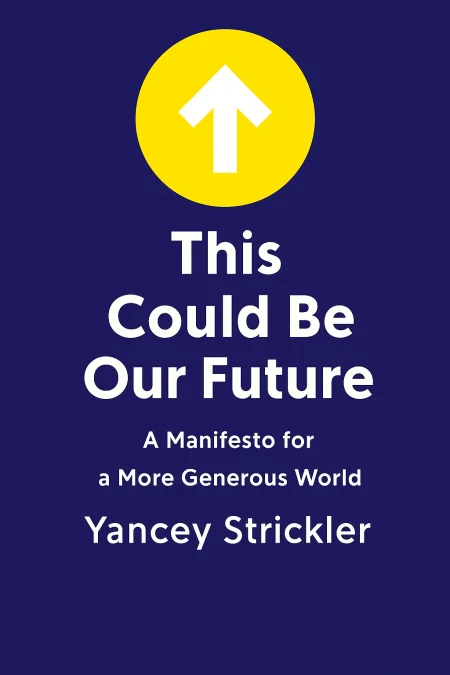
This Could Be Our Future
A Manifesto for a More Generous World
Book Edition Details
Summary
What if the compass guiding our world is fundamentally flawed? Yancey Strickler, cofounder of Kickstarter, provocatively challenges the entrenched belief that life’s ultimate goal is wealth accumulation. In "This Could Be Our Future," Strickler dismantles the idea that our world is a battleground of isolated individuals, each striving for personal gain at the expense of others. This gripping manifesto invites readers to envision a society where value extends beyond the dollar sign, encompassing community, purpose, and sustainability. As financial maximization leads us toward environmental ruin and deepening inequality, Strickler offers a bold blueprint for transformation. His message is one of hope and practicality: by redefining value, we can transition from scarcity to abundance, crafting a future that is generous and just. This is a call to action, an invitation to redefine what truly makes life worth living.
Introduction
Modern society operates under a fundamental assumption that financial maximization represents the pinnacle of rational decision-making. This assumption has become so deeply embedded in our economic, political, and social systems that we rarely question its validity or consider alternatives. Yet this singular focus on monetary returns may be constraining human potential and limiting our ability to create truly sustainable and meaningful progress. The dominant paradigm treats financial growth as the ultimate measure of success, relegating other forms of value—community, purpose, environmental stewardship, and human flourishing—to secondary considerations at best. This analysis challenges the supremacy of financial maximization by examining its historical origins, tracing its expansion beyond appropriate domains, and proposing a more nuanced understanding of rational value creation. Rather than dismissing the importance of financial considerations entirely, the argument advocates for recognizing multiple forms of value that deserve consideration in decision-making processes. Through philosophical examination, historical case studies, and contemporary examples, we can see how expanding our definition of rational self-interest beyond immediate financial gain opens pathways to more sustainable and fulfilling approaches to individual and collective decision-making.
The Rise and Dominance of Financial Maximization
Financial maximization as the defining principle of rational behavior emerged relatively recently in human history, despite feeling inevitable today. The transformation began in earnest during the Cold War era, when game theorists at institutions like the RAND Corporation developed mathematical models for strategic decision-making under conditions of uncertainty and conflict. These models, originally designed for nuclear warfare scenarios, introduced concepts of rational behavior that prioritized individual gain over collective outcomes. The theoretical foundation crystallized in 1970 when economist Milton Friedman published his influential essay arguing that the social responsibility of business was singular: to increase profits. This marked a decisive shift from earlier business philosophies that balanced multiple stakeholders and community obligations. Friedman's perspective gained traction during economic downturns of the 1970s, as organizations sought clear, measurable objectives that promised growth and competitiveness in uncertain times. What began as economic theory evolved into a comprehensive worldview that penetrated far beyond business circles. Educational institutions, healthcare systems, and government agencies increasingly adopted metrics and practices derived from financial maximization principles. The emergence of what could be termed the "Maximizing Class"—consultants, analysts, and executives trained to optimize financial returns—institutionalized these approaches across diverse sectors of society. The psychological appeal of financial maximization lies partly in its apparent simplicity and measurability. Unlike abstract values such as community well-being or environmental health, monetary outcomes can be quantified, compared, and optimized using sophisticated analytical tools. This clarity provided organizations and individuals with seemingly objective criteria for evaluating choices, reducing complex decisions to calculations of cost and benefit measured in financial terms.
Hidden Defaults and the Narrowing of Rational Choice
The dominance of financial maximization operates largely through hidden defaults—unseen influences that guide behavior without explicit awareness. These defaults function like the architectural choices that shape traffic patterns, making certain decisions feel natural while others appear irrational or impractical. The no-left-turn rule in retail planning exemplifies how environmental design channels behavior toward predetermined outcomes, much as economic frameworks channel decision-making toward financial optimization. Game theory experiments reveal how contextual framing shapes rational behavior in profound ways. When identical scenarios are presented as "Wall Street Games" versus "Community Games," participants make significantly different choices, with the naming convention alone influencing cooperation versus competition rates. This demonstrates that rationality itself depends heavily on the frameworks and assumptions we accept as given, rather than representing objective truth about optimal behavior. The hidden default of financial maximization manifests in multiple domains simultaneously. Healthcare systems prioritize procedures that generate revenue over preventive care that maintains health. Educational institutions emphasize metrics that attract funding rather than measures of genuine learning or human development. Political systems reward fundraising capacity over policy expertise or public service commitment. These patterns emerge not from conscious conspiracy but from the systematic application of financial optimization logic across diverse institutional contexts. The narrowing effect becomes self-reinforcing as institutions adopt compatible metrics and reward structures. Organizations that resist financial maximization face competitive disadvantages in markets, funding competitions, and talent acquisition. This creates evolutionary pressure toward convergence on financial optimization, even among entities whose stated missions emphasize other values entirely. The result is a gradually constricting range of acceptable rational behavior, with alternatives increasingly viewed as naive, impractical, or unsustainable.
Bentoism: Expanding Self-Interest Beyond Immediate Financial Gain
The alternative framework termed Bentoism expands the concept of rational self-interest across both temporal and social dimensions. Rather than focusing solely on immediate personal financial benefit, this approach recognizes four interconnected perspectives that comprise a more complete picture of rational value creation: present self needs, future self values, present community relationships, and future community welfare. This expanded model challenges the assumption that immediate individual financial gain represents the pinnacle of rationality. By incorporating future consequences and community impacts into decision-making frameworks, Bentoism reveals how apparently irrational choices—such as Patagonia sharing proprietary technology with competitors or Adele implementing anti-scalping measures for concert tickets—actually serve broader definitions of self-interest that include reputation, legacy, and community relationship maintenance. The philosophical foundation draws from both classical economic theory and contemporary behavioral research. Abraham Maslow's hierarchy of needs suggests that financial security, while essential, represents only one level of human motivation, with higher-order needs including belonging, esteem, and self-actualization. Daniel Pink's research on motivation demonstrates that autonomy, mastery, and purpose often drive performance more effectively than financial incentives alone, particularly for complex cognitive tasks. Practical applications of expanded value recognition already exist across multiple sectors. The Financial Independence Retire Early movement prioritizes long-term financial freedom over short-term consumption. Public benefit corporations legally commit to balancing profit with social impact. Professional sports teams discovered that three-point shots, despite lower individual success rates, produce superior overall performance through strategic value optimization rather than immediate gratification.
Toward a Values Maximizing Society: Implementation and Future Prospects
The transition toward values-based decision-making requires systematic development of measurement tools, institutional frameworks, and cultural practices that support multiple forms of value creation. Historical precedent exists for such transformations, as evidenced by the adoption of exercise culture, environmental consciousness, and public health measures—each requiring approximately thirty years to shift from fringe practice to mainstream acceptance. Personal implementation begins with explicit identification of individual values and priorities through structured self-reflection processes. Organizational transformation requires legal and governance structures that protect mission-driven decision-making from short-term financial pressures, similar to public benefit corporation frameworks that embed social and environmental commitments into corporate governance. Community and political changes demand metrics and policies that recognize non-financial forms of value creation and wealth building. The emergence of a "Values Maximizing Class" mirrors the historical development of financial expertise, requiring specialized knowledge and tools for optimizing complex value equations. This includes developing measurement systems for community health, environmental sustainability, educational effectiveness, and other outcomes that resist simple quantification but demonstrate substantial impact on human flourishing and social stability. Technological advancement provides unprecedented opportunities for tracking and optimizing multiple value streams simultaneously. Algorithms originally designed for advertising optimization could be reprogrammed to maximize fairness in resource distribution. Data analysis techniques developed for financial markets could be applied to community development, environmental restoration, and educational effectiveness. The infrastructure for sophisticated optimization already exists; the question becomes which values we choose to optimize for.
Summary
The fundamental argument presented challenges the assumption that financial maximization represents the highest form of rational decision-making, revealing instead how this narrow focus constrains human potential and creates systematic blindness to other forms of value creation. Through historical analysis, philosophical examination, and contemporary examples, the case emerges that expanding our understanding of rational self-interest beyond immediate financial benefit opens pathways to more sustainable, fulfilling, and ultimately more successful approaches to individual and collective challenges. The transition requires conscious choice to recognize and optimize for multiple forms of value simultaneously, supported by appropriate measurement tools, institutional frameworks, and cultural practices that honor the full spectrum of human flourishing rather than reducing complex decisions to financial calculations alone.
Related Books
Download PDF & EPUB
To save this Black List summary for later, download the free PDF and EPUB. You can print it out, or read offline at your convenience.
By Yancey Strickler
